Texas TEKS 5.6
TEKS Knowledge Statement (Expectation Cluster)
Matter and energy. The student knows that matter has measurable physical properties that determine how matter is identified, classified, changed, and used. The student is expected to: compare and contrast matter based on measurable, testable, or observable physical properties, including mass, magnetism, relative density (sinking and floating using water as a reference point), physical state (solid, liquid, gas), volume, solubility in water, and the ability to conduct or insulate thermal energy and electric energy; demonstrate and explain that some mixtures maintain physical properties of their substances such as iron filings and sand or sand and water; compare the properties of substances before and after they are combined into a solution and demonstrate that matter is conserved in solutions; and illustrate how matter is made up of particles that are too small to be seen such as air in a balloon.
Texas Essential Knowledge and Skills for Science
Cluster contents
Student Expectations in This Statement
5.6 is a TEKS knowledge and skills statement. These are the student expectations under it.
- 5.6.A
compare and contrast matter based on measurable, testable, or observable physical properties, including mass, magnetism, relative density (sinking and floating ...
- 5.6.B
demonstrate and explain that some mixtures maintain physical properties of their substances such as iron filings and sand or sand and water
- 5.6.C
compare the properties of substances before and after they are combined into a solution and demonstrate that matter is conserved in solutions
- 5.6.D
illustrate how matter is made up of particles that are too small to be seen such as air in a balloon.
Teacher's field guide
What This Cluster Means
What Students Need to Do
- Students compare and classify materials using measured or observed properties, including mass, state, volume, magnetism, density, solubility, and conductivity. They explain what happens in mixtures and solutions, track total mass, and use particle models to represent matter they cannot see.
What Mastery Looks Like
- Given unfamiliar samples, students choose suitable tests and use results to identify or sort each sample. They distinguish mixtures from solutions, show that total mass remains constant, and draw accurate particle models for solids, liquids, and gases.
Common Misconceptions
- Students may assume all metals are magnetic, heavy objects always sink, or clear liquids are water. They may think dissolved material disappears or that mixing substances changes total mass. They may also draw gas as empty space instead of widely spaced particles.
How to Assess It
- Give a four-part exit ticket: choose tests for steel, wax, and sugar; explain how to separate iron and sand; find the mass of 20 grams of water mixed with 5 grams of salt; draw air particles inside a balloon.
Lesson moves
Ways to Teach It
Pairs test foil, wood, plastic, and steel for mass, magnetism, floating, solubility, and electrical conductivity, then sort them by evidence.
Ask students to write: Why can you separate iron filings from sand, but not dissolved salt from water with a magnet?
Play Property Detective: students draw material cards and give measurable clues until teammates identify the material and name a confirming test.
Compare a metal spoon, wooden handle, and foam cup, then explain why each material is chosen for cooking or keeping drinks cold.
Free download
Printable 5.6 Worksheet
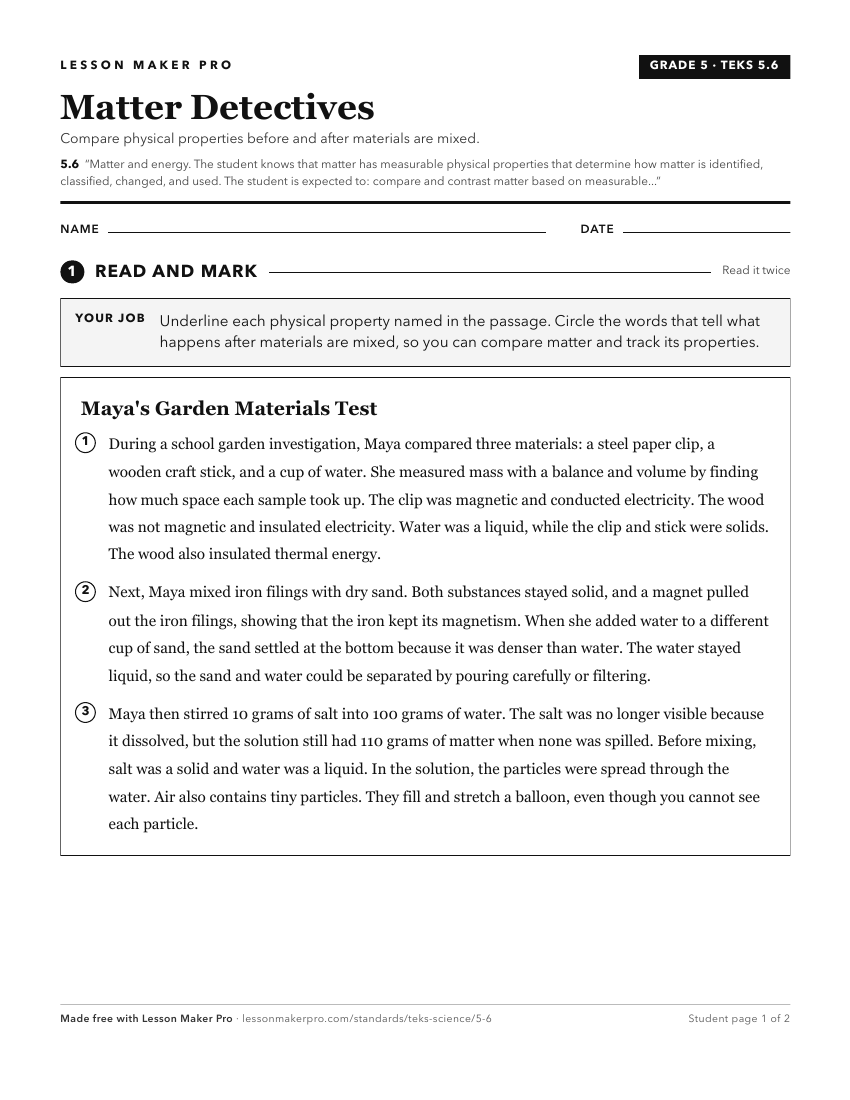
A ready-to-print activity worksheet aligned to 5.6, with an answer key for the teacher on its own page. No account needed.
PDF, US Letter, prints cleanly in black and white.
Download the worksheetKeep exploring
Related Standards
- 3.6
The 3rd Grade version of this standard.
- 4.6
The 4th Grade version of this standard.
- 2.6
Matter and its properties. The student knows that matter has physical properties that determine how it is described, classified, and used. The student is expect...
- 6.6
Matter and energy. The student knows that matter is made of atoms, can be classified according to its properties, and can undergo changes. The student is expect...
Turn this cluster into a lesson
Grade, subject, topic, and the complete cluster are prefilled. Create one free, no account needed.
Also for this cluster:Make a WorksheetMake a QuizMake a Sub Lesson