Texas TEKS 3.6
TEKS Knowledge Statement (Expectation Cluster)
Matter and energy. The student knows that matter has measurable physical properties that determine how matter is identified, classified, changed, and used. The student is expected to: measure, test, and record physical properties of matter, including temperature, mass, magnetism, and the ability to sink or float in water; describe and classify samples of matter as solids, liquids, and gases and demonstrate that solids have a definite shape and that liquids and gases take the shape of their container; predict, observe, and record changes in the state of matter caused by heating or cooling in a variety of substances such as ice becoming liquid water, condensation forming on the outside of a glass, or liquid water being heated to the point of becoming water vapor (gas); and demonstrate that materials can be combined based on their physical properties to create or modify objects such as building a tower or adding clay to sand to make a stronger brick and justify the selection of materials based on their physical properties.
Texas Essential Knowledge and Skills for Science
Cluster contents
Student Expectations in This Statement
3.6 is a TEKS knowledge and skills statement. These are the student expectations under it.
- 3.6.A
measure, test, and record physical properties of matter, including temperature, mass, magnetism, and the ability to sink or float in water
- 3.6.B
describe and classify samples of matter as solids, liquids, and gases and demonstrate that solids have a definite shape and that liquids and gases take the shap...
- 3.6.C
predict, observe, and record changes in the state of matter caused by heating or cooling in a variety of substances such as ice becoming liquid water, condensat...
- 3.6.D
demonstrate that materials can be combined based on their physical properties to create or modify objects such as building a tower or adding clay to sand to mak...
Teacher's field guide
What This Cluster Means
What Students Need to Do
- Students measure and record temperature, mass, magnetism, and whether objects sink or float. They classify solids, liquids, and gases, then observe changes caused by heating and cooling. They also choose and combine materials for a purpose, using physical properties to explain each choice.
What Mastery Looks Like
- Students collect accurate measurements, organize results in a table, and classify matter using evidence. They predict state changes, compare predictions with observations, and explain why specific materials work well in a designed object.
Common Misconceptions
- Students may think heavy objects always sink, all metals are magnetic, or gases have no matter. They may also confuse melting with dissolving or believe condensation leaks through a container.
How to Assess It
- Give students an ice cube, a paper clip, and a plastic cap. Ask them to record each object's state, mass, magnetism, and sink or float prediction, then explain what heating changes.
Lesson moves
Ways to Teach It
Set up stations where students measure mass and temperature, test magnetism, and place small objects in water to check sinking or floating.
Ask students to explain why condensation appears outside a cold cup and support their answer with an observation.
Play a sorting relay using picture cards for solids, liquids, gases, heating changes, cooling changes, magnetic objects, and buoyant objects.
Have teams choose foil, cardboard, clay, or craft sticks to build a waterproof boat, then justify each material choice.
Free download
Printable 3.6 Worksheet
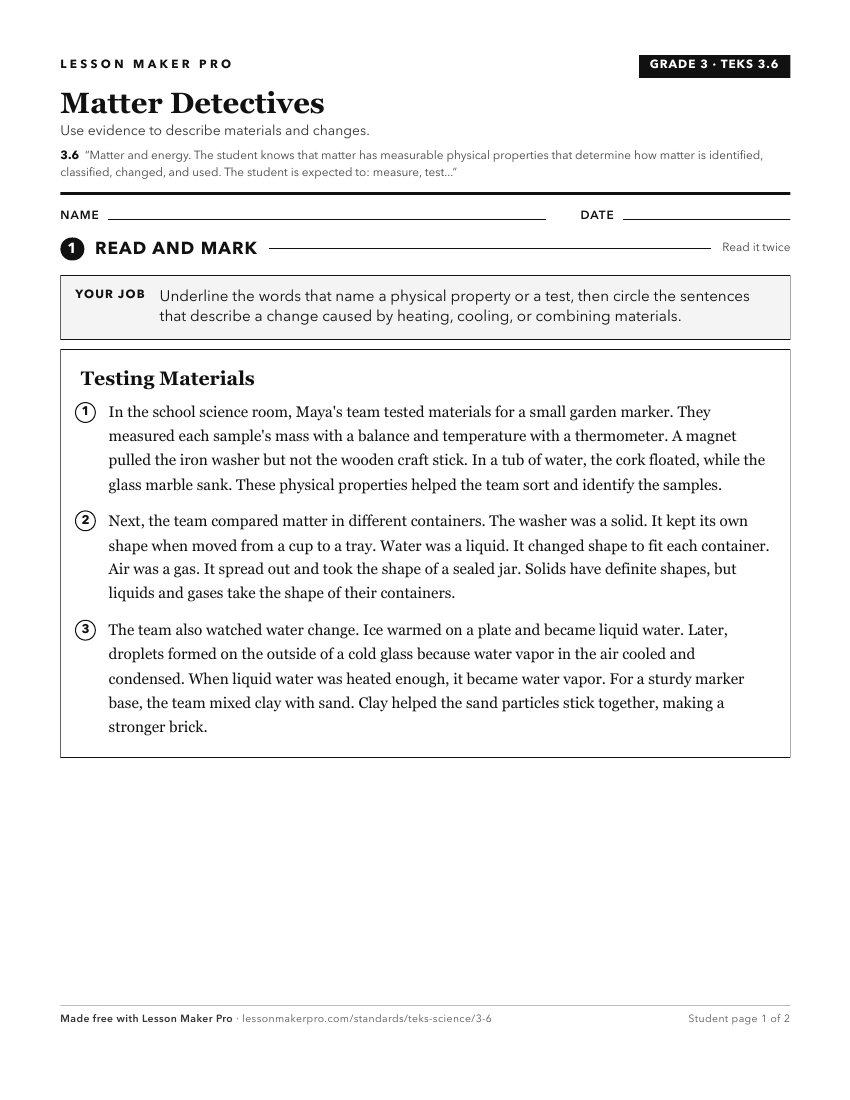
A ready-to-print activity worksheet aligned to 3.6, with an answer key for the teacher on its own page. No account needed.
PDF, US Letter, prints cleanly in black and white.
Download the worksheetKeep exploring
Related Standards
- 5.6
The 5th Grade version of this standard.
- 4.6
The 4th Grade version of this standard.
- 2.6
Matter and its properties. The student knows that matter has physical properties that determine how it is described, classified, and used. The student is expect...
- 6.6
Matter and energy. The student knows that matter is made of atoms, can be classified according to its properties, and can undergo changes. The student is expect...
Turn this cluster into a lesson
Grade, subject, topic, and the complete cluster are prefilled. Create one free, no account needed.
Also for this cluster:Make a WorksheetMake a QuizMake a Sub Lesson