Texas TEKS 6.6
TEKS Knowledge Statement (Expectation Cluster)
Matter and energy. The student knows that matter is made of atoms, can be classified according to its properties, and can undergo changes. The student is expected to: compare solids, liquids, and gases in terms of their structure, shape, volume, and kinetic energy of atoms and molecules; investigate the physical properties of matter to distinguish between pure substances, homogeneous mixtures (solutions), and heterogeneous mixtures; identify elements on the periodic table as metals, nonmetals, metalloids, and rare Earth elements based on their physical properties and importance to modern life; compare the density of substances relative to various fluids; and identify the formation of a new substance by using the evidence of a possible chemical change, including production of a gas, change in thermal energy, production of a precipitate, and color change.
Texas Essential Knowledge and Skills for Science
Cluster contents
Student Expectations in This Statement
6.6 is a TEKS knowledge and skills statement. These are the student expectations under it.
- 6.6.A
compare solids, liquids, and gases in terms of their structure, shape, volume, and kinetic energy of atoms and molecules
- 6.6.B
investigate the physical properties of matter to distinguish between pure substances, homogeneous mixtures (solutions), and heterogeneous mixtures
- 6.6.C
identify elements on the periodic table as metals, nonmetals, metalloids, and rare Earth elements based on their physical properties and importance to modern li...
- 6.6.D
compare the density of substances relative to various fluids
- 6.6.E
identify the formation of a new substance by using the evidence of a possible chemical change, including production of a gas, change in thermal energy, producti...
Teacher's field guide
What This Cluster Means
What Students Need to Do
- Students use particle models to compare spacing, motion, shape, volume, and kinetic energy in solids, liquids, and gases. They test properties to classify samples, compare density in different fluids, and group elements by physical traits. They also use observable evidence to decide whether a new substance may have formed.
What Mastery Looks Like
- A student can explain particle diagrams and correctly classify samples and elements using evidence. They can predict whether a substance will sink or float in a named fluid and support a possible chemical change with two observations.
Common Misconceptions
- Students may think particles grow when matter is heated, or that gases have no mass. They often call any uniform sample a pure substance and think density changes with sample size. They may treat every bubble, color shift, or temperature change as proof of a reaction, and confuse metalloids with rare Earth elements.
How to Assess It
- Give a four-box exit ticket with a particle diagram, sample property data, an element clue, and a density comparison. Ask students to classify each and explain one possible chemical change.
Lesson moves
Ways to Teach It
At four stations, students model particles with beads, classify saltwater and soil, test objects in water and oil, and mix baking soda with vinegar.
Ask students to write: Which observations prove the sample is a solution, and which only suggest a chemical change?
Play a periodic-table sort: teams place element cards under metal, nonmetal, metalloid, or rare Earth, then defend each choice with property clues.
Have students inspect a phone parts diagram and match silicon, copper, lithium, and rare Earth elements to properties that make each useful.
Free download
Printable 6.6 Worksheet
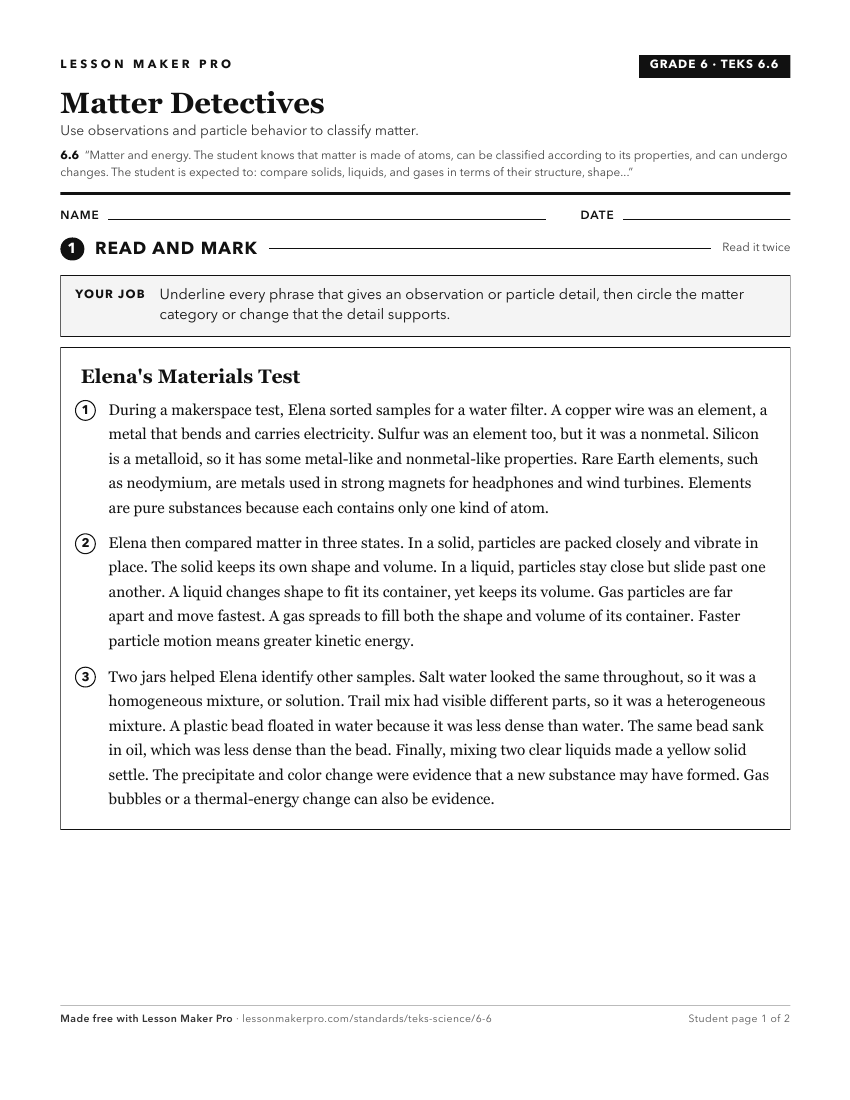
A ready-to-print activity worksheet aligned to 6.6, with an answer key for the teacher on its own page. No account needed.
PDF, US Letter, prints cleanly in black and white.
Download the worksheetKeep exploring
Related Standards
- 5.6
Matter and energy. The student knows that matter has measurable physical properties that determine how matter is identified, classified, changed, and used. The ...
- 7.6
Matter and energy. The student distinguishes between elements and compounds, classifies changes in matter, and understands the properties of solutions. The stud...
- 3.6
Matter and energy. The student knows that matter has measurable physical properties that determine how matter is identified, classified, changed, and used. The ...
- 4.6
Matter and energy. The student knows that matter has measurable physical properties that determine how matter is identified, classified, changed, and used. The ...
Turn this cluster into a lesson
Grade, subject, topic, and the complete cluster are prefilled. Create one free, no account needed.
Also for this cluster:Make a WorksheetMake a QuizMake a Sub Lesson