Texas TEKS 6.6.C
The Standard
- 6.6
- Matter and energy. The student knows that matter is made of atoms, can be classified according to its properties, and can undergo changes. The student is expected to:
identify elements on the periodic table as metals, nonmetals, metalloids, and rare Earth elements based on their physical properties and importance to modern life
Texas Essential Knowledge and Skills for Science
Teacher's field guide
What This Standard Means
What Students Need to Do
- Students use physical properties and periodic table location to sort elements as metals, nonmetals, metalloids, or rare earth elements. They connect conductivity, luster, malleability, brittleness, and magnetism to common uses. They explain why copper, silicon, and neodymium are used in modern products.
What Mastery Looks Like
- Given an element tile, a property clue, and a periodic table, a student assigns the best category and cites evidence. The student can explain why copper is used in wires, silicon in chips, and neodymium in strong magnets. The student also recognizes that rare earth elements are metals.
Common Misconceptions
- Students may call every shiny solid a metal or assume every nonmetal is a gas. They may describe a metalloid as a mixture of a metal and a nonmetal. They often think rare earth elements are extremely scarce or are not metals.
How to Assess It
- Exit ticket: Classify copper, oxygen, silicon, and neodymium, then give one physical property and one modern use for each. For neodymium, also state whether it is a metal.
Lesson moves
Ways to Teach It
Build a floor periodic table from element tiles, then place category labels and property cards in the correct regions.
Discuss why copper, silicon, and neodymium are chosen for wires, chips, and speakers, requiring one supporting property for each choice.
Play four corners: call an element and a property clue, then have students choose a category corner and defend their choice.
Use a smartphone parts diagram to match copper, silicon, and neodymium with wiring, chips, and speakers, then explain each match.
Free download
Printable 6.6.C Worksheet
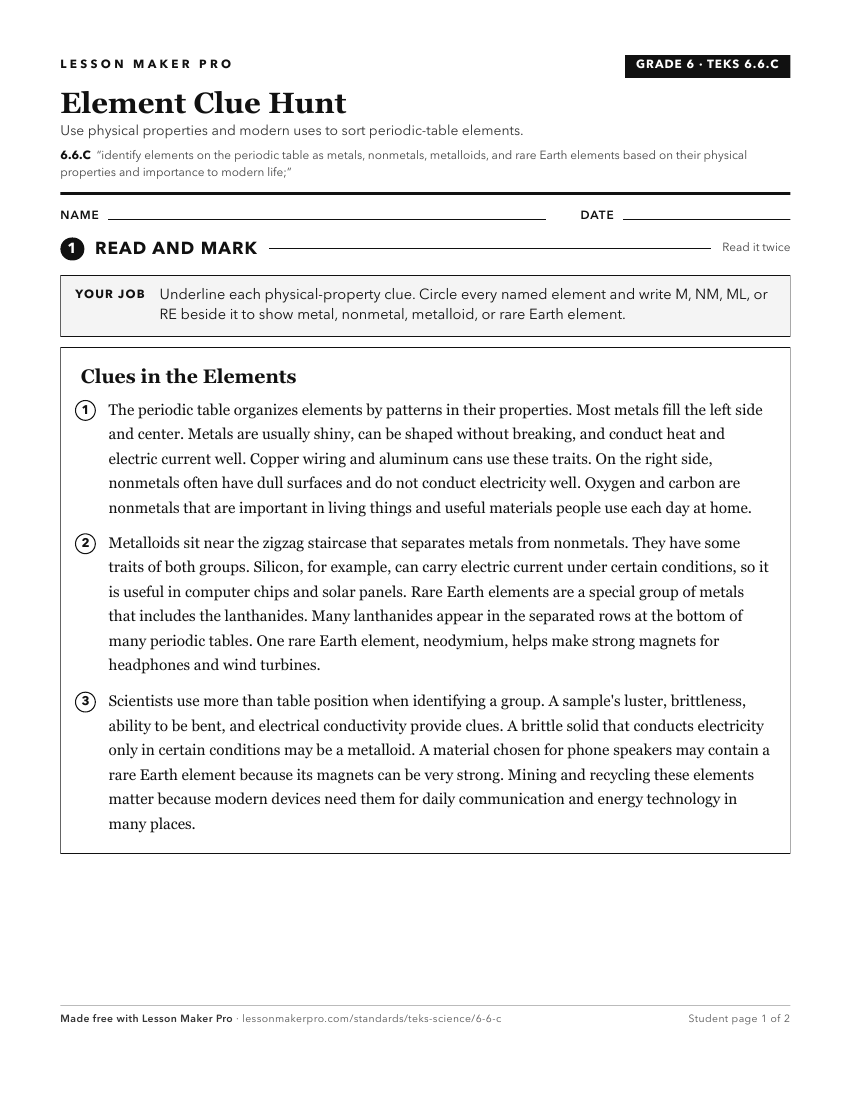
A ready-to-print activity worksheet aligned to 6.6.C, with an answer key for the teacher on its own page. No account needed.
PDF, US Letter, prints cleanly in black and white.
Download the worksheetKeep exploring
Related Standards
- 8.6.B
use the periodic table to identify the atoms involved in chemical reactions
- 7.6.B
use the periodic table to identify the atoms and the number of each kind within a chemical formula
- 4.6.A
classify and describe matter using observable physical properties, including temperature, mass, magnetism, relative density (the ability to sink or float in wat...
- 7.6.A
compare and contrast elements and compounds in terms of atoms and molecules, chemical symbols, and chemical formulas
Turn this exact standard into a lesson
Grade, subject, topic, and the complete standard are prefilled. Create one free, no account needed.
Also for this standard:Make a WorksheetMake a QuizMake a Sub Lesson