Texas TEKS 5.6.D
The Standard
- 5.6
- Matter and energy. The student knows that matter has measurable physical properties that determine how matter is identified, classified, changed, and used. The student is expected to:
illustrate how matter is made up of particles that are too small to be seen such as air in a balloon.
Texas Essential Knowledge and Skills for Science
Teacher's field guide
What This Standard Means
What Students Need to Do
- Students use dots or circles to model the tiny particles that make up air. They explain why air can fill or change a balloon even though its particles cannot be seen.
What Mastery Looks Like
- Given an inflated balloon or sealed syringe, a student draws particles spread throughout the available space and labels the drawing as a model. The student explains that air occupies space even though its particles are too small to see.
Common Misconceptions
- Students may think an uninflated balloon is empty or that air is not matter because it is invisible. They may draw air as one large blob or show particles growing when the balloon expands.
How to Assess It
- Exit ticket: Draw what is inside a tied, inflated balloon using a particle model. Add one observation that shows air occupies space.
Lesson moves
Ways to Teach It
Trap air in a needleless syringe, press the plunger, then draw before and after particle models showing the air in less space.
Write a response to: How can invisible air change a balloon's size? Use a particle drawing and one observation as evidence.
Play Particle Match by pairing balloon, tire, syringe, and upside-down cup cards with particle diagrams, then explain each match.
Compare a soft basketball with an inflated one, then explain the change using particles entering the ball.
Free download
Printable 5.6.D Worksheet
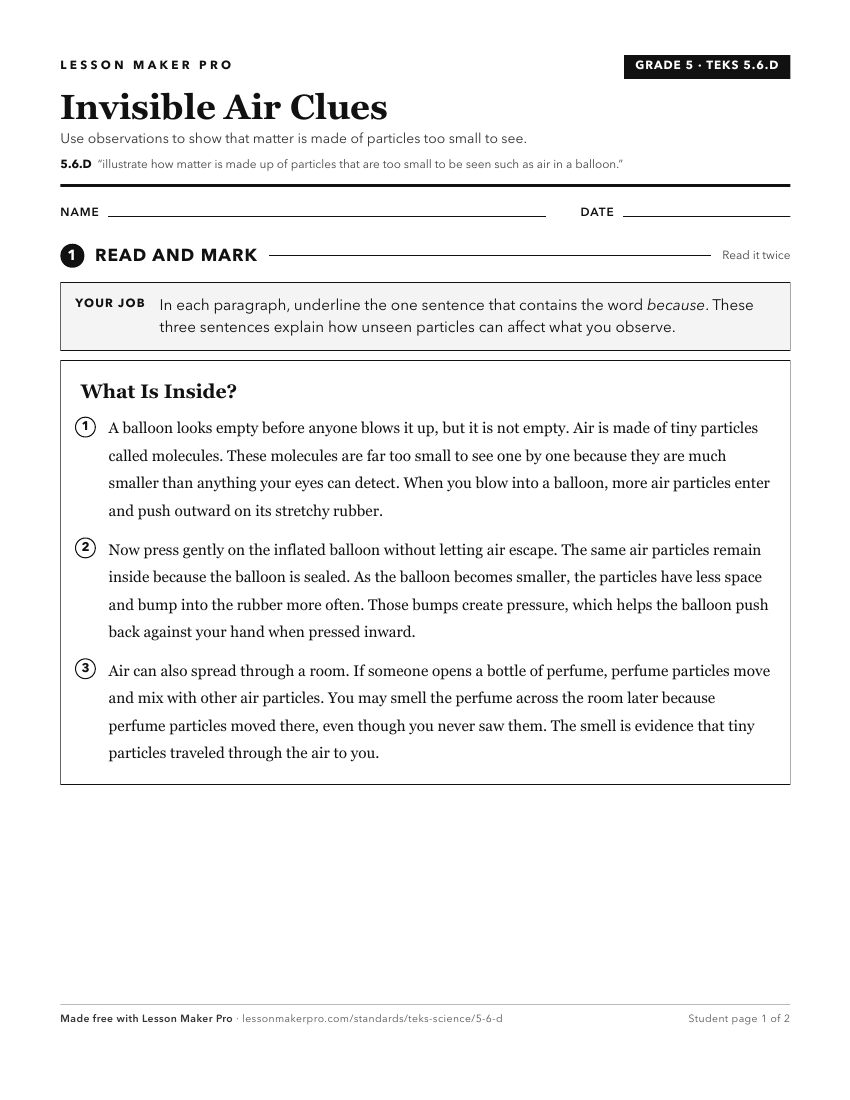
A ready-to-print activity worksheet aligned to 5.6.D, with an answer key for the teacher on its own page. No account needed.
PDF, US Letter, prints cleanly in black and white.
Download the worksheetKeep exploring
Related Standards
- K.10.C
identify evidence that supports the idea that air is all around us and demonstrate that wind is moving air using items such as a windsock, pinwheel, or ribbon.
- 3.6.B
describe and classify samples of matter as solids, liquids, and gases and demonstrate that solids have a definite shape and that liquids and gases take the shap...
- 2.8.A
demonstrate and explain that sound is made by vibrating matter and that vibrations can be caused by a variety of means, including sound
- 2.6.C
demonstrate that small units such as building blocks can be combined or reassembled to form new objects for different purposes and explain the materials chosen ...
Turn this exact standard into a lesson
Grade, subject, topic, and the complete standard are prefilled. Create one free, no account needed.
Also for this standard:Make a WorksheetMake a QuizMake a Sub Lesson