Texas TEKS K.10.C
The Standard
- K.10
- Earth and space. The student knows that the natural world includes earth materials and systems that can be observed. The student is expected to:
identify evidence that supports the idea that air is all around us and demonstrate that wind is moving air using items such as a windsock, pinwheel, or ribbon.
Texas Essential Knowledge and Skills for Science
Teacher's field guide
What This Standard Means
What Students Need to Do
- Students notice clues that invisible air fills the classroom and outdoor spaces. They use a fan, breath, or outdoor breeze to move an object and explain what made it move.
What Mastery Looks Like
- A student can point to an inflated bag, moving ribbon, or turning pinwheel and name air as the cause. The student can make air move and predict what a lightweight object will do.
Common Misconceptions
- Students may think air exists only outdoors or only when they feel a breeze. They may say a pinwheel makes wind, rather than recognizing that passing air turns it.
How to Assess It
- Hand each student a ribbon and ask, “Show evidence that air is here, then explain what makes the ribbon move.” Listen for a clear link between moving air and the ribbon’s motion.
Lesson moves
Ways to Teach It
Hold ribbons near a still fan, turn the fan on, and have students describe what changed and what caused the movement.
Use the prompt, “What evidence shows that air is in our classroom even though we cannot see it?”
Play Evidence Sort: students sort picture cards into Clear Evidence and Not Clear Evidence, then explain each choice.
Take students outside to watch a flag or tree leaves, then use their movement to describe the day’s wind.
Free download
Printable K.10.C Worksheet
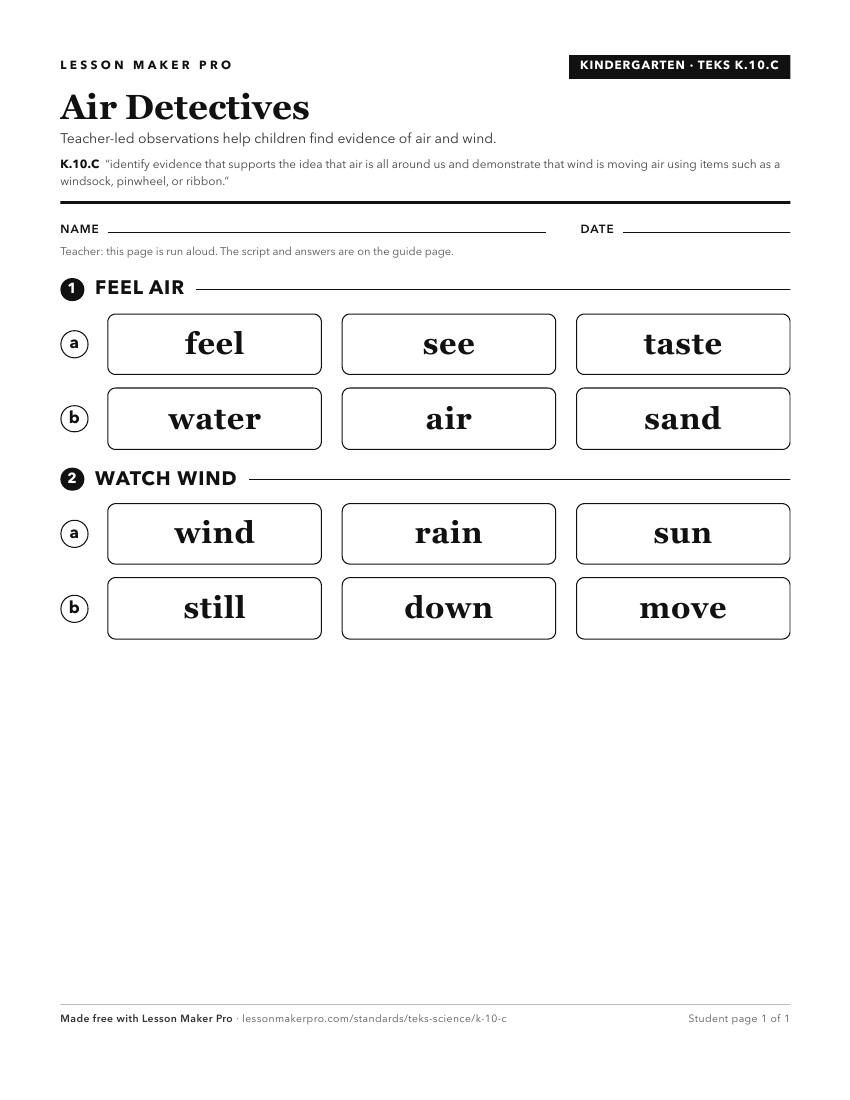
A ready-to-print activity worksheet aligned to K.10.C, with an answer key for the teacher on its own page. No account needed.
PDF, US Letter, prints cleanly in black and white.
Download the worksheetKeep exploring
Related Standards
- 8.10.B
identify global patterns of atmospheric movement and how they influence local weather
- 5.6.D
illustrate how matter is made up of particles that are too small to be seen such as air in a balloon.
- 3.1.E
collect observations and measurements as evidence
- 4.1.E
collect observations and measurements as evidence
Turn this exact standard into a lesson
Grade, subject, topic, and the complete standard are prefilled. Create one free, no account needed.
Also for this standard:Make a WorksheetMake a QuizMake a Sub Lesson