Texas TEKS 8.10.B
The Standard
- 8.10
- The student knows that interactions between Earth, ocean, and weather systems impact climate.
identify global patterns of atmospheric movement and how they influence local weather
Texas Essential Knowledge and Skills for Science
Teacher's field guide
What This Standard Means
What Students Need to Do
- Students locate prevailing winds, jet streams, and large circulation patterns on maps. They connect the movement of air masses to local wind, temperature, clouds, and precipitation.
What Mastery Looks Like
- Students can read a global wind map and predict how moving air may affect weather at a location. They support the prediction with wind direction, air source, and moisture or temperature.
Common Misconceptions
- Students may think winds move straight from the equator to the poles or that Earth’s rotation creates wind instead of deflecting it. They may also name winds by where they go rather than where they originate.
How to Assess It
- Give students a map showing a moist air mass moving toward Texas from the Gulf. Ask them to predict two local weather changes and explain each prediction.
Lesson moves
Ways to Teach It
Place warm and cold water at opposite ends of a clear pan, add food coloring, and observe the convection pattern.
Ask students to write why storms across Texas often move from west to east, using prevailing winds in their explanation.
Give teams location, wind, and air-mass cards, then award points for matching each location with a reasonable weather forecast.
Compare a national weather map with your local forecast, then trace where the air affecting your area came from.
Free download
Printable 8.10.B Worksheet
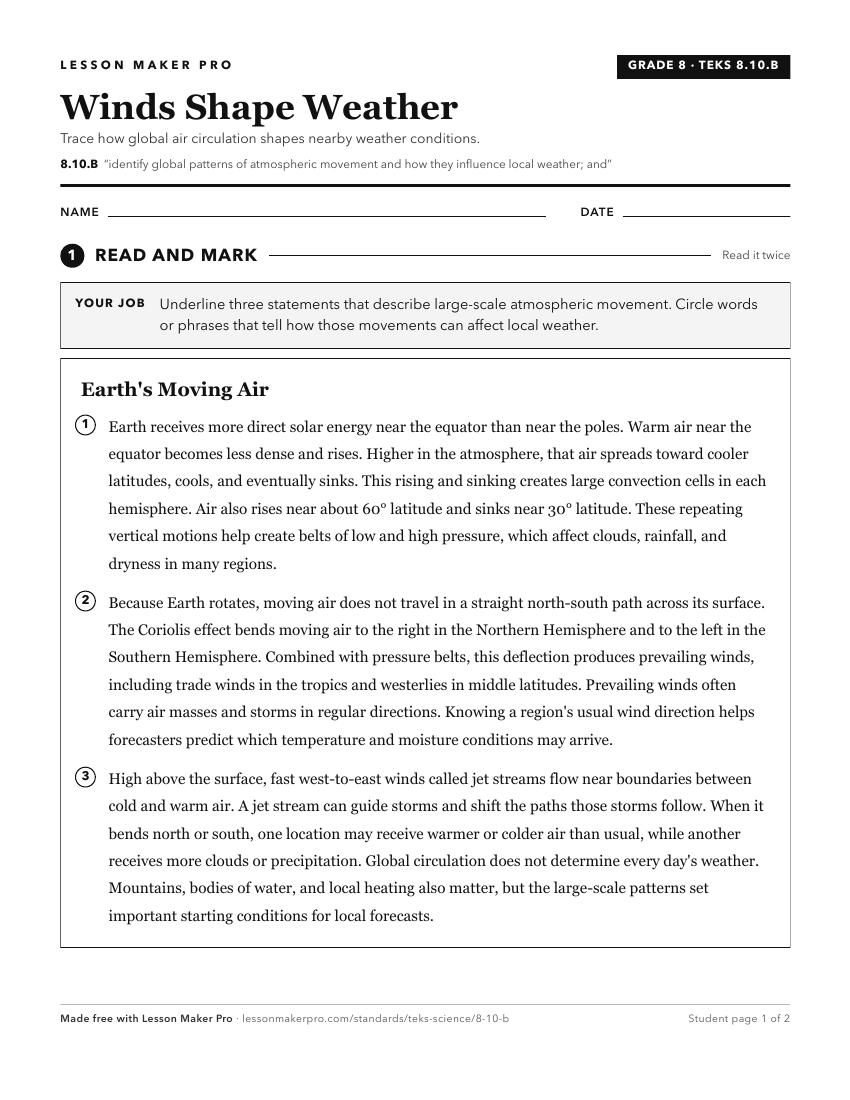
A ready-to-print activity worksheet aligned to 8.10.B, with an answer key for the teacher on its own page. No account needed.
PDF, US Letter, prints cleanly in black and white.
Download the worksheetKeep exploring
Related Standards
- 1.10.D
describe and record observable characteristics of weather, including hot or cold, clear or cloudy, calm or windy, and rainy or icy, and explain the impact of we...
- K.10.B
observe and describe weather changes from day to day and over seasons
- 3.10.A
compare and describe day-to-day weather in different locations at the same time, including air temperature, wind direction, and precipitation
- 8.10.A
describe how energy from the Sun, hydrosphere, and atmosphere interact and influence weather and climate
Turn this exact standard into a lesson
Grade, subject, topic, and the complete standard are prefilled. Create one free, no account needed.
Also for this standard:Make a WorksheetMake a QuizMake a Sub Lesson