Texas TEKS 2.8.A
The Standard
- 2.8
- Force, motion, and energy. The student knows that energy is everywhere and can be observed in everyday life. The student is expected to:
demonstrate and explain that sound is made by vibrating matter and that vibrations can be caused by a variety of means, including sound
Texas Essential Knowledge and Skills for Science
Teacher's field guide
What This Standard Means
What Students Need to Do
- Students make objects vibrate by plucking, striking, rubbing, blowing, or playing a nearby sound. They identify the vibrating object as the source of the sound they hear.
What Mastery Looks Like
- A student can produce a sound, point to the part that vibrates, and describe how the vibration started. They can also show that sound from a speaker makes nearby matter vibrate.
Common Misconceptions
- Students may think an object is not vibrating when its movement is too small or fast to see. They may confuse the action that starts a vibration with the vibration itself. Some think sound cannot make another object vibrate.
How to Assess It
- Exit ticket: Draw and label an object making sound, then explain what vibrates and how a nearby sound could make another object vibrate.
Lesson moves
Ways to Teach It
Set up stations where students pluck rubber bands, strike a ruler, tap a drum, and observe rice moving near a speaker.
Ask students to explain why a ruler hanging over a desk edge makes sound after being plucked.
Play vibration charades where students match action cards, such as pluck or strike, to objects that can make sound.
Examine a speaker, doorbell, or musical instrument and identify the vibrating part that produces its sound.
Free download
Printable 2.8.A Worksheet
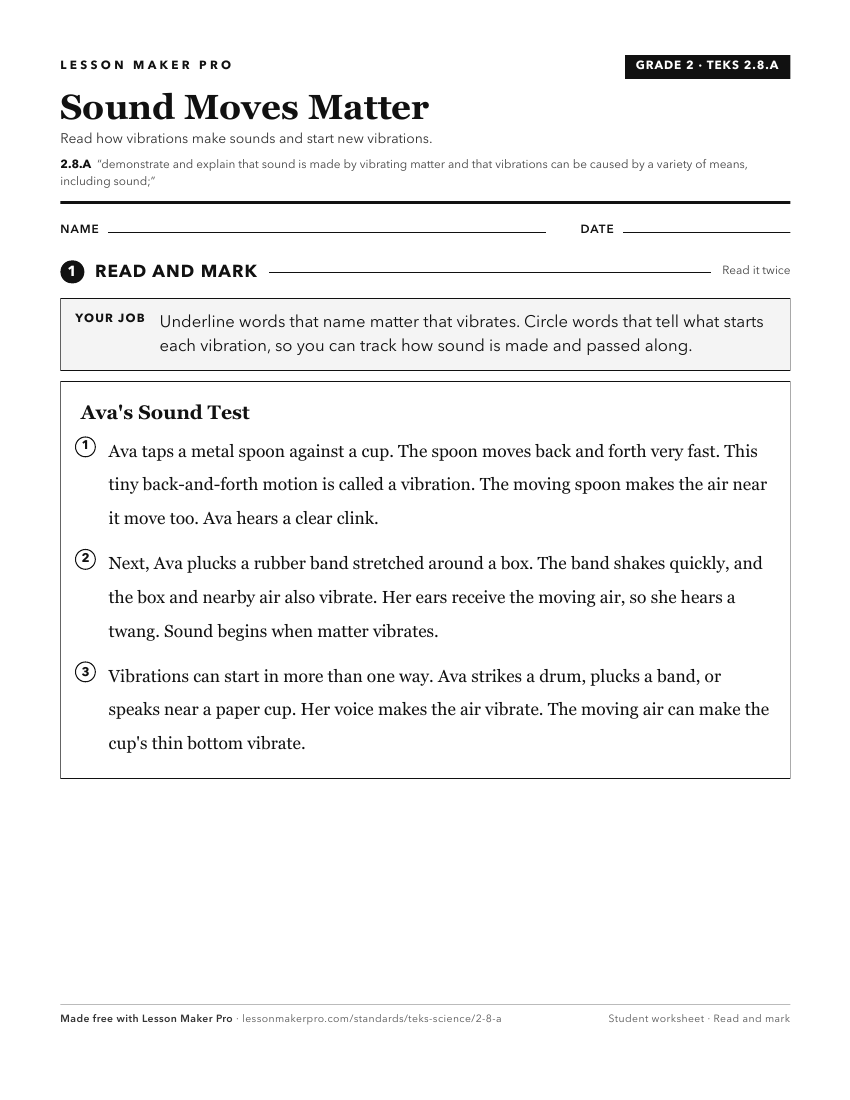
A ready-to-print activity worksheet aligned to 2.8.A, with an answer key for the teacher on its own page. No account needed.
PDF, US Letter, prints cleanly in black and white.
Download the worksheetKeep exploring
Related Standards
- 2.8.B
explain how different levels of sound are used in everyday life such as a whisper in a classroom or a fire alarm
- 5.8.B
demonstrate that electrical energy in complete circuits can be transformed into motion, light, sound, or thermal energy and identify the requirements for a func...
- 4.8.A
investigate and identify the transfer of energy by objects in motion, waves in water, and sound
- 3.8.A
identify everyday examples of energy, including light, sound, thermal, and mechanical
Turn this exact standard into a lesson
Grade, subject, topic, and the complete standard are prefilled. Create one free, no account needed.
Also for this standard:Make a WorksheetMake a QuizMake a Sub Lesson