Texas TEKS 3.8.A
The Standard
- 3.8
- Force, motion, and energy. The student knows that energy is everywhere and can be observed in cycles, patterns, and systems. The student is expected to:
identify everyday examples of energy, including light, sound, thermal, and mechanical
Texas Essential Knowledge and Skills for Science
Teacher's field guide
What This Standard Means
What Students Need to Do
- Students observe familiar objects and events, then name the energy they can detect. They use clues such as movement, warmth, visible light, or vibrations that produce sound.
What Mastery Looks Like
- Students correctly classify examples such as a lamp, ringing phone, warm pan, and rolling ball. They can explain each choice using an observable clue.
Common Misconceptions
- Students may think energy means only electricity or movement. They may label the object instead of the energy observed. They may also miss that one event can show more than one form of energy.
How to Assess It
- Exit ticket: “A hair dryer is running. Name two forms of energy you observe and give one clue for each.”
Lesson moves
Ways to Teach It
Set up stations with a flashlight, bell, sealed cup of warm water, and wind-up toy, then have students label the energy observed.
Have students write which energy forms they notice when popcorn pops and cite one observation for each choice.
Play a card sort using pictures of lamps, drums, ovens, bicycles, televisions, and rubbing hands, then compare answers with a partner.
Take an energy walk around the school and record examples from lights, speakers, sunny windows, fans, and moving doors.
Free download
Printable 3.8.A Worksheet
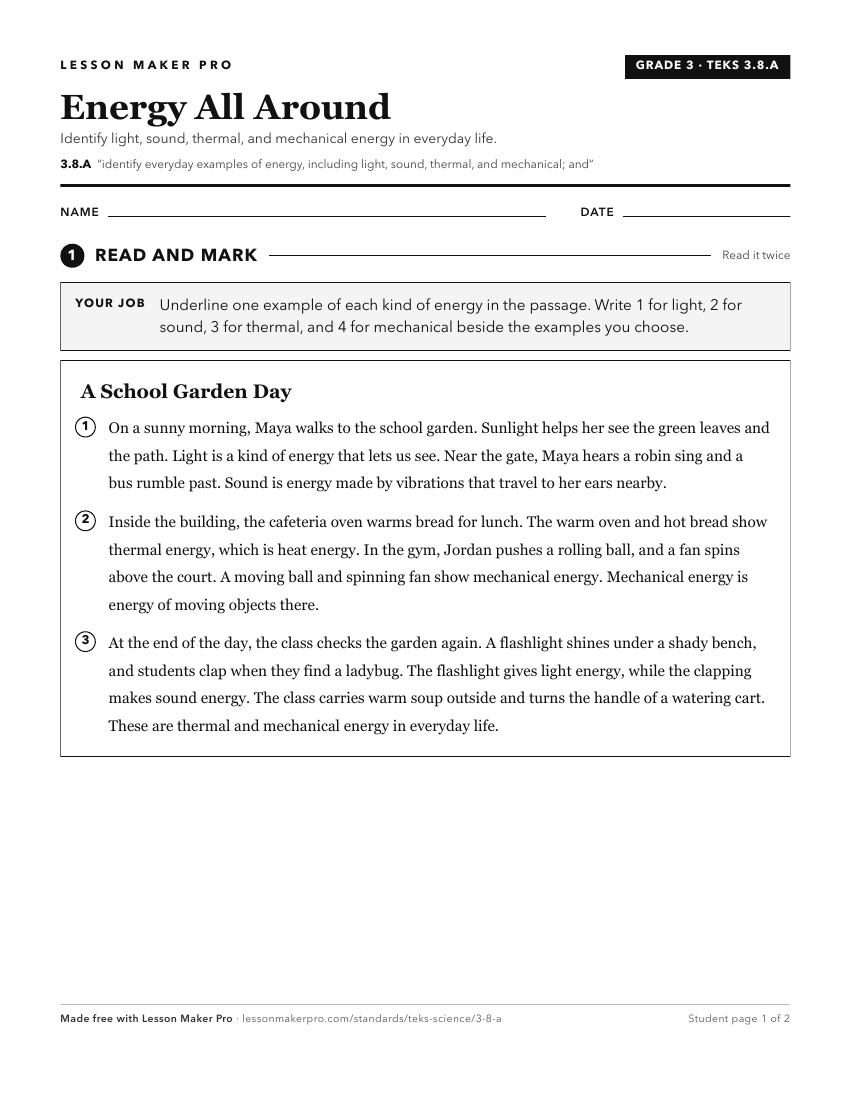
A ready-to-print activity worksheet aligned to 3.8.A, with an answer key for the teacher on its own page. No account needed.
PDF, US Letter, prints cleanly in black and white.
Download the worksheetKeep exploring
Related Standards
- K.5.E
identify forms of energy and properties of matter
- 1.5.E
identify forms of energy and properties of matter
- 5.8.B
demonstrate that electrical energy in complete circuits can be transformed into motion, light, sound, or thermal energy and identify the requirements for a func...
- 2.5.E
identify forms of energy and properties of matter
Turn this exact standard into a lesson
Grade, subject, topic, and the complete standard are prefilled. Create one free, no account needed.
Also for this standard:Make a WorksheetMake a QuizMake a Sub Lesson