Texas TEKS 2.8.B
The Standard
- 2.8
- Force, motion, and energy. The student knows that energy is everywhere and can be observed in everyday life. The student is expected to:
explain how different levels of sound are used in everyday life such as a whisper in a classroom or a fire alarm
Texas Essential Knowledge and Skills for Science
Teacher's field guide
What This Standard Means
What Students Need to Do
- Students identify sounds as quiet, medium, or loud and explain why each level fits a situation. They connect volume to a purpose, such as avoiding disruption or warning people.
What Mastery Looks Like
- A student can compare two sounds by volume and choose an appropriate level for a given setting. The student supports the choice with a clear reason.
Common Misconceptions
- Students may confuse volume with pitch, calling a high note loud. They may choose the loudest sound for every important message without considering the location or listener.
How to Assess It
- Give students three picture cards: a library, a playground game, and a smoke alarm. Ask them to label each expected volume and explain one choice.
Lesson moves
Ways to Teach It
Let pairs use shakers at quiet, medium, and loud levels, then match each level to classroom, celebration, and warning cards.
Ask, “Why should a fire alarm be louder than a partner voice?” Students answer with one reason and one safety detail.
Play Volume Match: students draw a situation card, choose quiet, medium, or loud, and earn a point for a sound reason.
Take a school sound walk, record five sounds on a chart, and explain how each volume helps people work, communicate, or stay safe.
Free download
Printable 2.8.B Worksheet
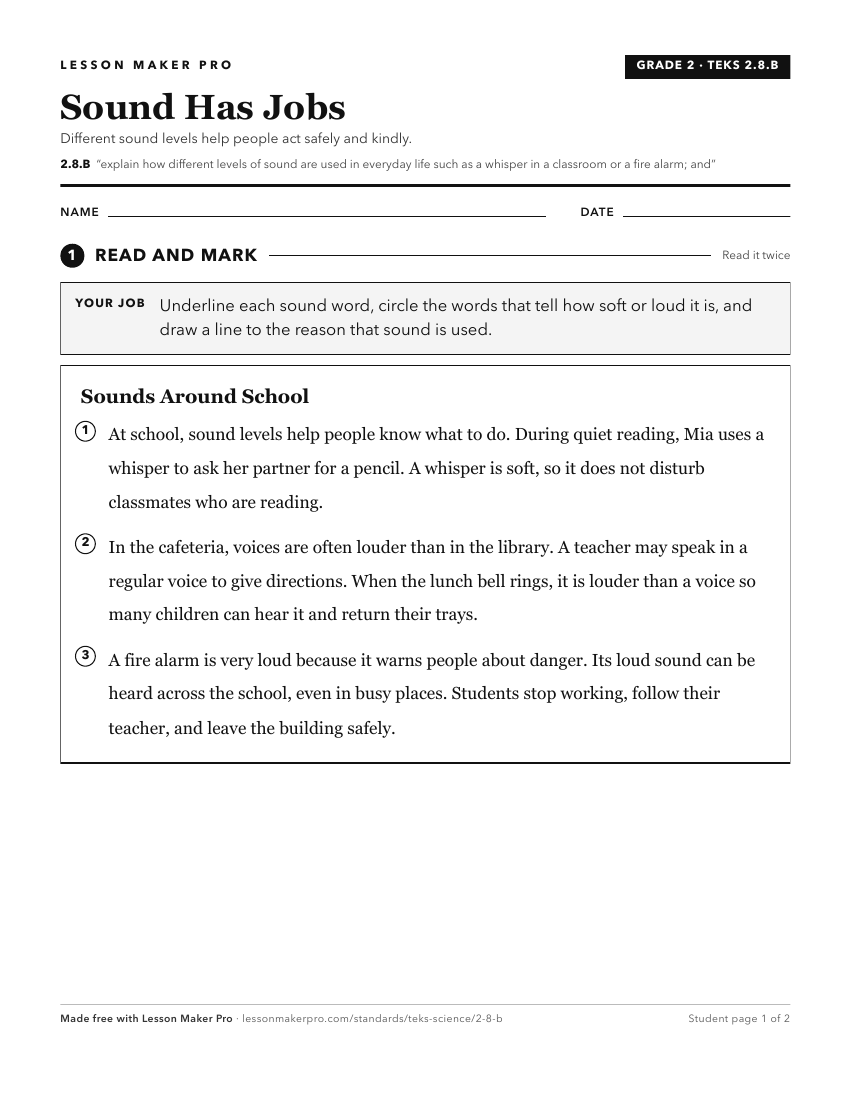
A ready-to-print activity worksheet aligned to 2.8.B, with an answer key for the teacher on its own page. No account needed.
PDF, US Letter, prints cleanly in black and white.
Download the worksheetKeep exploring
Related Standards
- 2.8.C
design and build a device using tools and materials that uses sound to solve the problem of communicating over a distance.
- 3.8.A
identify everyday examples of energy, including light, sound, thermal, and mechanical
- 2.8.A
demonstrate and explain that sound is made by vibrating matter and that vibrations can be caused by a variety of means, including sound
- 1.8.A
investigate and describe applications of heat in everyday life such as cooking food or using a clothes dryer
Turn this exact standard into a lesson
Grade, subject, topic, and the complete standard are prefilled. Create one free, no account needed.
Also for this standard:Make a WorksheetMake a QuizMake a Sub Lesson