Texas TEKS 7.6.E
The Standard
- 7.6
- Matter and energy. The student distinguishes between elements and compounds, classifies changes in matter, and understands the properties of solutions. The student is expected to:
investigate and model how temperature, surface area, and agitation affect the rate of dissolution of solid solutes in aqueous solutions.
Texas Essential Knowledge and Skills for Science
Teacher's field guide
What This Standard Means
What Students Need to Do
- Students compare how water temperature, solute particle size, and stirring change how quickly a solid dissolves. They change one variable at a time, record dissolution time, and draw particle models to explain the results.
What Mastery Looks Like
- Students can plan a fair test with equal amounts of water and solute. They can predict that warmer water, smaller particles, and stirring usually increase dissolution rate, then support the prediction with data and a particle model.
Common Misconceptions
- Students often confuse dissolving faster with dissolving a greater total amount. They may think stirring creates more solute, or that crushing changes the solute rather than exposing more surface area.
How to Assess It
- Give students four cups: a control, warmer water, crushed solute, and stirred water. Ask them to compare each cup with the control and explain each prediction.
Lesson moves
Ways to Teach It
Time equal masses of sugar dissolving in warm or cool water, crushed or cubed form, and stirred or unstirred cups.
Write a claim explaining why crushed sugar dissolves faster than a sugar cube in the same amount of water.
Sort scenario cards into faster, slower, or unchanged dissolution rate, then defend each placement with one sentence.
Test whether drink-mix directions about water temperature and stirring actually produce a faster result than ignoring the directions.
Free download
Printable 7.6.E Worksheet
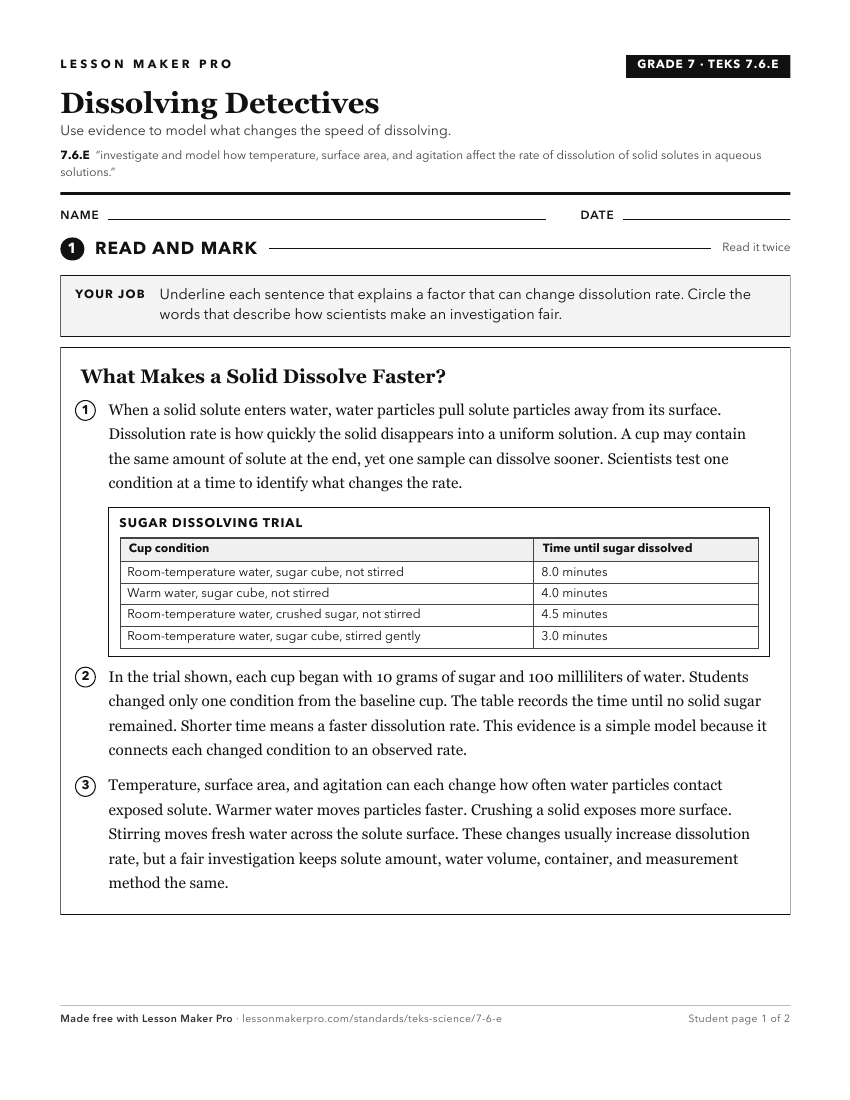
A ready-to-print activity worksheet aligned to 7.6.E, with an answer key for the teacher on its own page. No account needed.
PDF, US Letter, prints cleanly in black and white.
Download the worksheetKeep exploring
Related Standards
- 7.6.D
describe aqueous solutions in terms of solute and solvent, concentration, and dilution
- 4.6.B
investigate and compare a variety of mixtures, including solutions that are composed of liquids in liquids and solids in liquids
- 7.8.B
investigate how thermal energy moves in a predictable pattern from warmer to cooler until all substances within the system reach thermal equilibrium
- 6.6.B
investigate the physical properties of matter to distinguish between pure substances, homogeneous mixtures (solutions), and heterogeneous mixtures
Turn this exact standard into a lesson
Grade, subject, topic, and the complete standard are prefilled. Create one free, no account needed.
Also for this standard:Make a WorksheetMake a QuizMake a Sub Lesson