Texas TEKS 7.6.D
The Standard
- 7.6
- Matter and energy. The student distinguishes between elements and compounds, classifies changes in matter, and understands the properties of solutions. The student is expected to:
describe aqueous solutions in terms of solute and solvent, concentration, and dilution
Texas Essential Knowledge and Skills for Science
Teacher's field guide
What This Standard Means
What Students Need to Do
- Students identify water as the solvent and the dissolved substance as the solute in an aqueous solution. They compare concentration and explain that adding water dilutes a solution.
What Mastery Looks Like
- Students correctly label the solute and solvent in examples such as salt water or powdered drink mix. They explain that dilution lowers concentration without removing solute.
Common Misconceptions
- Students may call the substance present in the largest amount the solute, or think any liquid must be the solvent. They may think dilution removes solute rather than spreading it through more water.
How to Assess It
- Show two cups containing equal amounts of drink mix but different amounts of water. Ask students to identify the more concentrated cup and explain why.
Lesson moves
Ways to Teach It
Mix measured amounts of powdered drink mix and water, then add water to one sample and compare color intensity after dilution.
Ask students to explain what happens to solute amount and concentration when water is added to salt water.
Give teams solute, solvent, concentrated, and dilute cards to match with solution diagrams, then check matches against an answer key.
Have students read frozen juice concentrate directions and explain how adding different amounts of water changes the final drink.
Free download
Printable 7.6.D Worksheet
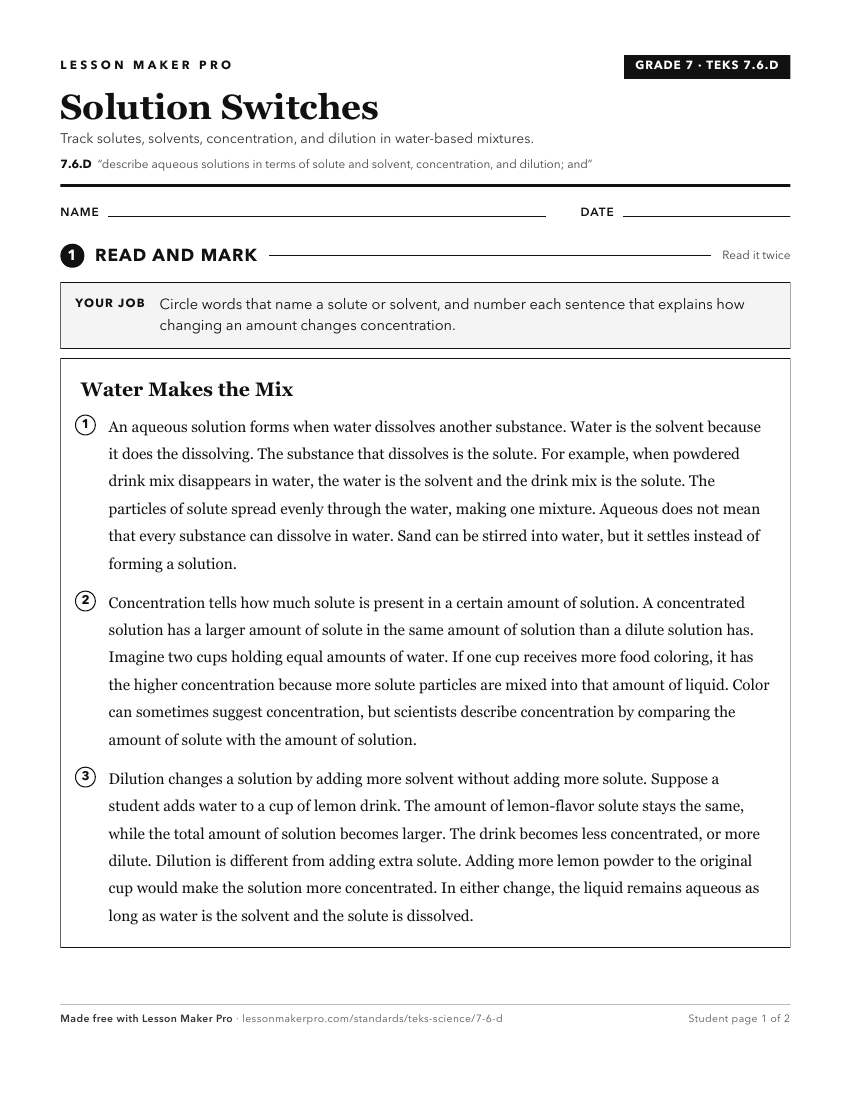
A ready-to-print activity worksheet aligned to 7.6.D, with an answer key for the teacher on its own page. No account needed.
PDF, US Letter, prints cleanly in black and white.
Download the worksheetKeep exploring
Related Standards
- 7.6.E
investigate and model how temperature, surface area, and agitation affect the rate of dissolution of solid solutes in aqueous solutions.
- 5.6.C
compare the properties of substances before and after they are combined into a solution and demonstrate that matter is conserved in solutions
- 4.6.B
investigate and compare a variety of mixtures, including solutions that are composed of liquids in liquids and solids in liquids
- 6.6.D
compare the density of substances relative to various fluids
Turn this exact standard into a lesson
Grade, subject, topic, and the complete standard are prefilled. Create one free, no account needed.
Also for this standard:Make a WorksheetMake a QuizMake a Sub Lesson