Texas TEKS 8.6.C
The Standard
- 8.6
- The student understands that matter can be classified according to its properties and matter is conserved in chemical changes that occur within closed systems
describe the properties of cohesion, adhesion, and surface tension in water and relate to observable phenomena such as the formation of droplets, transport in plants, and insects walking on water
Texas Essential Knowledge and Skills for Science
Teacher's field guide
What This Standard Means
What Students Need to Do
- Students explain how water molecules attract one another and other materials. They connect these attractions to water behavior they can see, including beading, capillary movement, and supported insects.
What Mastery Looks Like
- Students distinguish cohesion from adhesion. They explain that cohesion causes surface tension, while cohesion and adhesion both help water climb a plant stem. They point to water beading on a leaf and rising in a stem as evidence.
Common Misconceptions
- Students often treat cohesion, adhesion, and surface tension as the same property. They may think insects float because they are weightless or that plants actively pull each water molecule upward.
How to Assess It
- Show a photo of water beading on a leaf and water rising in a plant stem. Ask students to identify and explain the water property involved in each.
Lesson moves
Ways to Teach It
Place drops on wax paper, glass, and a coin, then compare shape, spread, and the number of drops each surface holds.
Write a claim explaining how cohesion and adhesion work together to move water through a plant stem.
Sort phenomenon cards into cohesion, adhesion, surface tension, or multiple properties, then defend each choice to a partner.
Test paper towel brands by measuring how far colored water climbs in five minutes, then connect the results to plant water transport.
Free download
Printable 8.6.C Worksheet
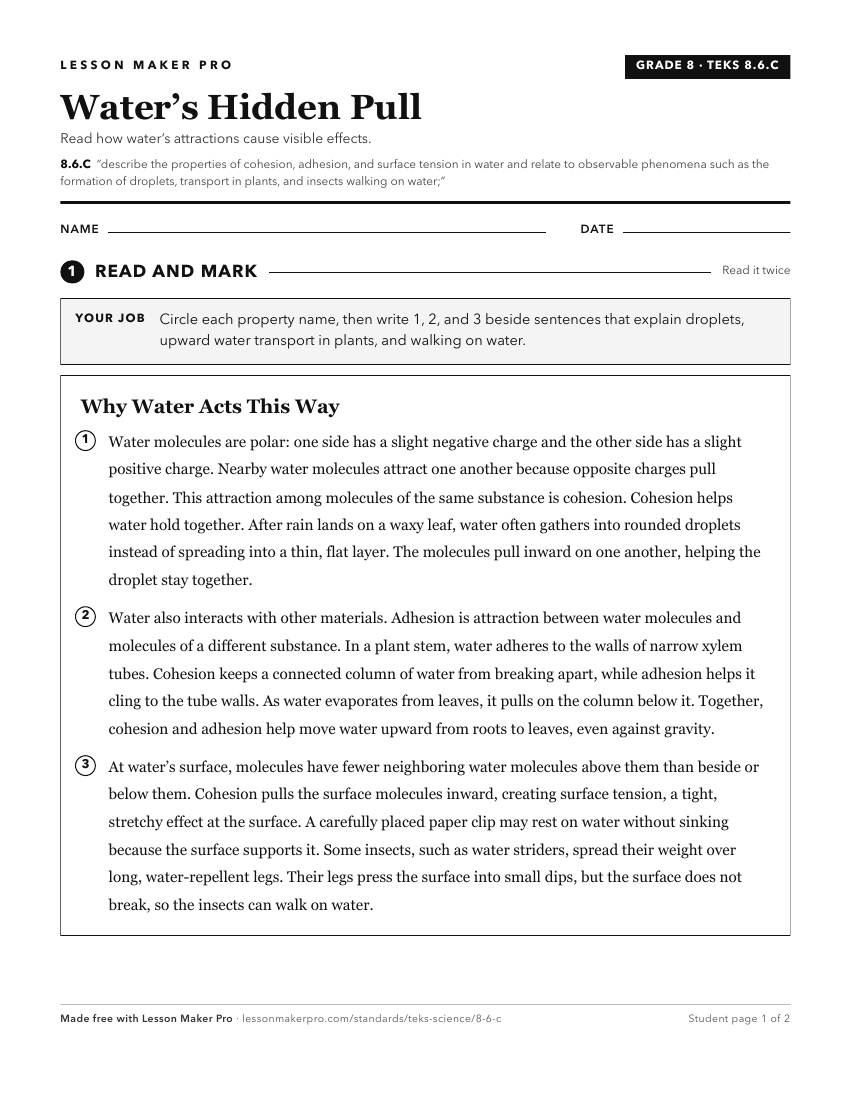
A ready-to-print activity worksheet aligned to 8.6.C, with an answer key for the teacher on its own page. No account needed.
PDF, US Letter, prints cleanly in black and white.
Download the worksheetKeep exploring
Related Standards
- 1.10.C
compare the properties of puddles, ponds, streams, rivers, lakes, and oceans, including color, clarity, size, shape, and whether it is freshwater or saltwater
- 5.6.B
demonstrate and explain that some mixtures maintain physical properties of their substances such as iron filings and sand or sand and water
- 4.6.A
classify and describe matter using observable physical properties, including temperature, mass, magnetism, relative density (the ability to sink or float in wat...
- 5.6.A
compare and contrast matter based on measurable, testable, or observable physical properties, including mass, magnetism, relative density (sinking and floating ...
Turn this exact standard into a lesson
Grade, subject, topic, and the complete standard are prefilled. Create one free, no account needed.
Also for this standard:Make a WorksheetMake a QuizMake a Sub Lesson