Texas TEKS 1.10.C
The Standard
- 1.10
- Earth and space. The student knows that the natural world includes earth materials that can be observed in systems and processes. The student is expected to:
compare the properties of puddles, ponds, streams, rivers, lakes, and oceans, including color, clarity, size, shape, and whether it is freshwater or saltwater
Texas Essential Knowledge and Skills for Science
Teacher's field guide
What This Standard Means
What Students Need to Do
- Students use evidence from photos, maps, and models to tell different bodies of water apart. They explain which features help with identification and classify each as fresh water or salt water.
What Mastery Looks Like
- A student can compare two water bodies using several accurate observations. The student knows oceans contain salt water and avoids deciding water type from appearance alone.
Common Misconceptions
- Students may think all blue or clear water is fresh water, or that every large body of water is an ocean. They may also confuse ponds with lakes and streams with rivers because their sizes can overlap.
How to Assess It
- Show a photo of a pond and an ocean. Ask, “Name two differences, then tell which has salt water and explain how you know.”
Lesson moves
Ways to Teach It
Shape clay in trays to make a puddle, pond, and stream, then add water and compare how each model looks.
Show two water body photos and ask students to write one similarity, one difference, and which clue best identifies each.
Play Water Body Match by pairing photo cards with name, water type, and feature cards.
Find a nearby pond, stream, river, or lake on a map, then compare it with an ocean photo.
Free download
Printable 1.10.C Worksheet
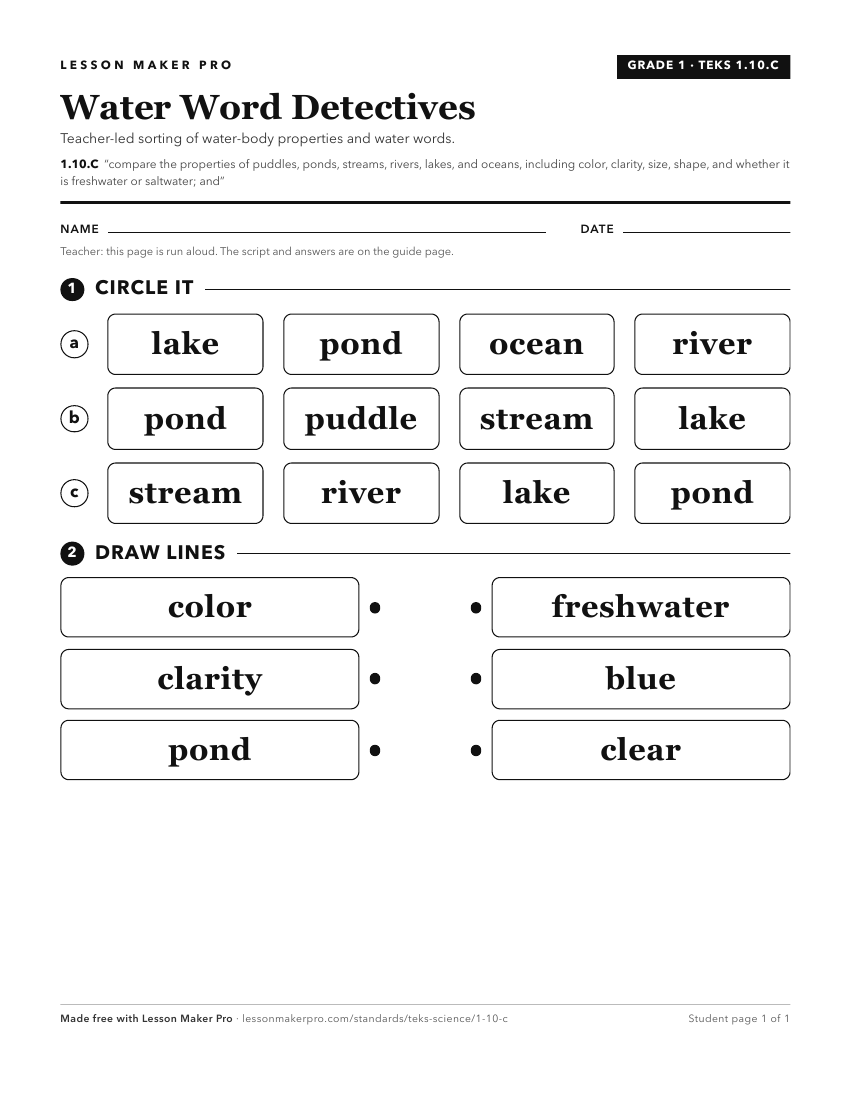
A ready-to-print activity worksheet aligned to 1.10.C, with an answer key for the teacher on its own page. No account needed.
PDF, US Letter, prints cleanly in black and white.
Download the worksheetKeep exploring
Related Standards
- 6.6.D
compare the density of substances relative to various fluids
- 8.6.D
compare and contrast the properties of acids and bases, including pH relative to water
- 3.6.A
measure, test, and record physical properties of matter, including temperature, mass, magnetism, and the ability to sink or float in water
- 5.6.A
compare and contrast matter based on measurable, testable, or observable physical properties, including mass, magnetism, relative density (sinking and floating ...
Turn this exact standard into a lesson
Grade, subject, topic, and the complete standard are prefilled. Create one free, no account needed.
Also for this standard:Make a WorksheetMake a QuizMake a Sub Lesson