Texas TEKS 8.6.D
The Standard
- 8.6
- The student understands that matter can be classified according to its properties and matter is conserved in chemical changes that occur within closed systems
compare and contrast the properties of acids and bases, including pH relative to water
Texas Essential Knowledge and Skills for Science
Teacher's field guide
What This Standard Means
What Students Need to Do
- Students identify acids, bases, and neutral substances from their properties and pH values. They compare each substance’s pH with water, which is about pH 7.
What Mastery Looks Like
- Students correctly classify a substance with pH below 7 as acidic and above 7 as basic. They use indicator results and observable properties to explain their classifications.
Common Misconceptions
- Students often reverse the pH scale and think higher numbers mean more acidic. They may also think neutral means harmless, or that every acid is dangerous while every base is safe.
How to Assess It
- Give students three samples with pH values of 3, 7, and 11. Ask them to classify each and compare it with water.
Lesson moves
Ways to Teach It
Test vinegar, water, and baking soda solution with pH paper, then sort the samples as acidic, neutral, or basic.
Write a claim explaining how pH and indicator color can distinguish an acid from a base.
Play a card sort matching household substances, pH values, indicator colors, and acid or base labels.
Compare labels for an antacid and stomach acid, then explain why their acid and base properties matter.
Free download
Printable 8.6.D Worksheet
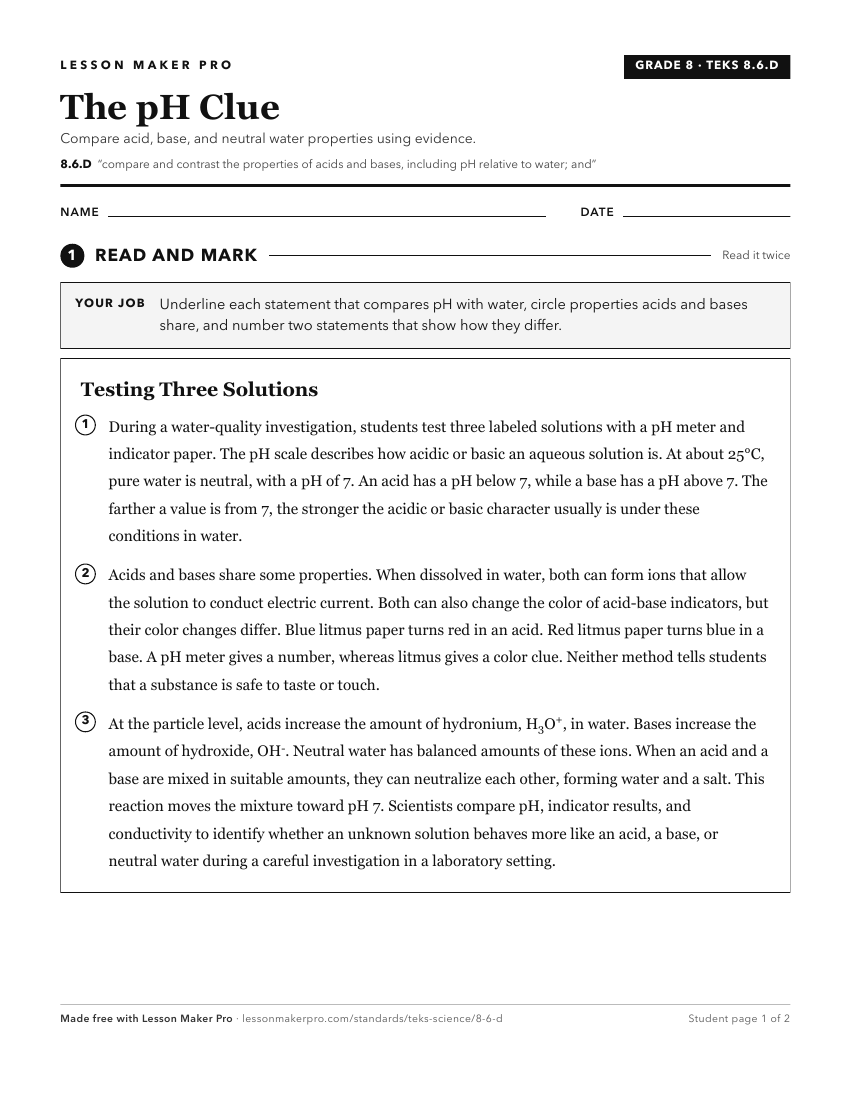
A ready-to-print activity worksheet aligned to 8.6.D, with an answer key for the teacher on its own page. No account needed.
PDF, US Letter, prints cleanly in black and white.
Download the worksheetKeep exploring
Related Standards
- 1.10.C
compare the properties of puddles, ponds, streams, rivers, lakes, and oceans, including color, clarity, size, shape, and whether it is freshwater or saltwater
- 6.6.D
compare the density of substances relative to various fluids
- 7.6.A
compare and contrast elements and compounds in terms of atoms and molecules, chemical symbols, and chemical formulas
- 5.6.A
compare and contrast matter based on measurable, testable, or observable physical properties, including mass, magnetism, relative density (sinking and floating ...
Turn this exact standard into a lesson
Grade, subject, topic, and the complete standard are prefilled. Create one free, no account needed.
Also for this standard:Make a WorksheetMake a QuizMake a Sub Lesson