Texas TEKS 8.6.E
The Standard
- 8.6
- The student understands that matter can be classified according to its properties and matter is conserved in chemical changes that occur within closed systems
investigate how mass is conserved in chemical reactions and relate conservation of mass to the rearrangement of atoms using chemical equations, including photosynthesis.
Texas Essential Knowledge and Skills for Science
Teacher's field guide
What This Standard Means
What Students Need to Do
- Students measure the total mass of a closed reaction before and after substances react. They use atom counts and chemical equations to show that atoms rearrange but are not created or destroyed, including during photosynthesis.
What Mastery Looks Like
- A student can balance a chemical equation with coefficients without changing chemical formulas. They can use mass data and atom counts to explain why reactant and product masses match in a closed system. They can trace carbon, hydrogen, and oxygen through the photosynthesis equation.
Common Misconceptions
- Students may think matter disappears when a gas leaves an open container or that gases have no mass. They may change subscripts instead of adding coefficients when balancing equations. They may also think plants get most of their mass from soil rather than carbon dioxide and water.
How to Assess It
- Exit ticket: Balance CO2 + H2O → C6H12O6 + O2, list each atom count on both sides, and explain why total mass stays constant.
Lesson moves
Ways to Teach It
Seal vinegar and baking soda in a zip bag, weigh it before and after mixing, then compare the measurements.
Write a claim explaining why an open flask may lose measured mass during a reaction even though atoms are not destroyed.
Play equation relay: teams add coefficient cards to equations, then verify equal atom counts on both sides.
Use the photosynthesis equation to trace carbon from classroom carbon dioxide into glucose made by a plant.
Free download
Printable 8.6.E Worksheet
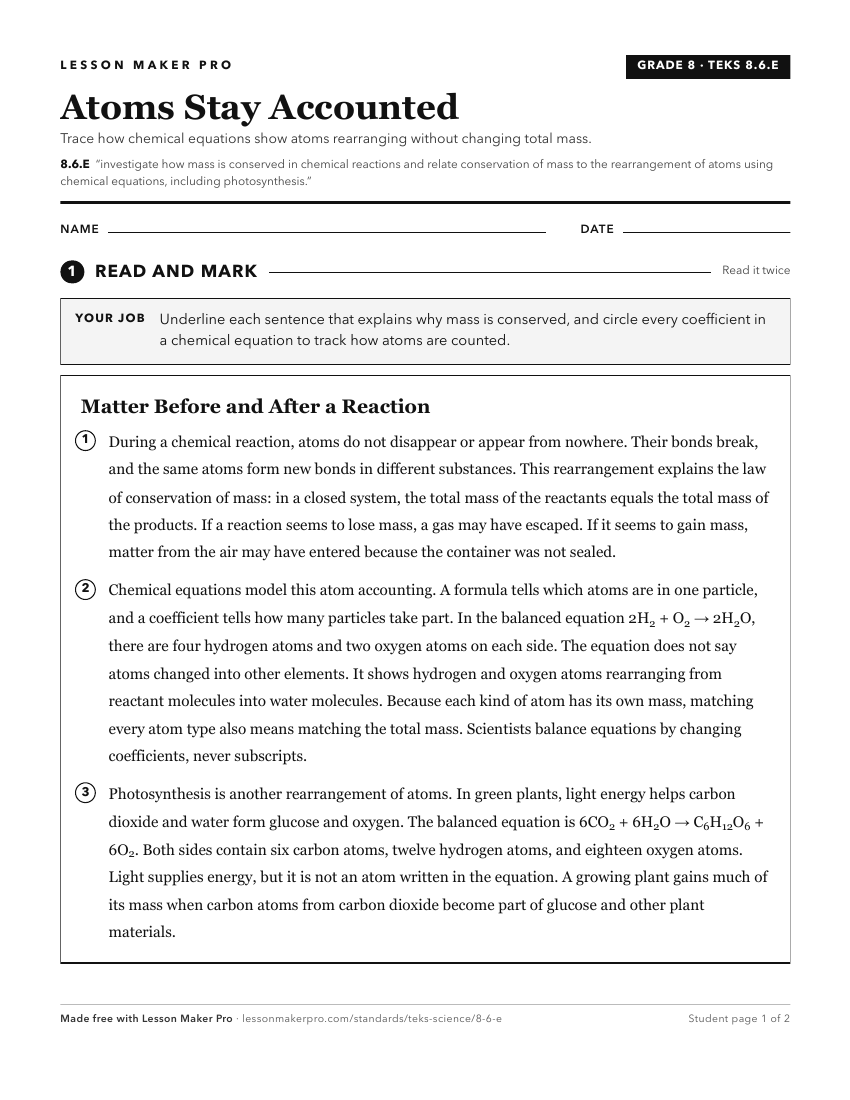
A ready-to-print activity worksheet aligned to 8.6.E, with an answer key for the teacher on its own page. No account needed.
PDF, US Letter, prints cleanly in black and white.
Download the worksheetKeep exploring
Related Standards
- 6.5.E
analyze and explain how energy flows and matter cycles through systems and how energy and matter are conserved through a variety of systems
- 5.5.E
investigate how energy flows and matter cycles through systems and how matter is conserved
- 5.6.C
compare the properties of substances before and after they are combined into a solution and demonstrate that matter is conserved in solutions
- 4.5.E
investigate how energy flows and matter cycles through systems and how matter is conserved
Turn this exact standard into a lesson
Grade, subject, topic, and the complete standard are prefilled. Create one free, no account needed.
Also for this standard:Make a WorksheetMake a QuizMake a Sub Lesson