TEKS Math K.6
Knowledge and Skills Statement (Standard Cluster)
The student applies mathematical process standards to analyze attributes of two-dimensional shapes and three-dimensional solids to develop generalizations about their properties
Texas Essential Knowledge and Skills for Mathematics
Cluster contents
Student Expectations in This Statement
K.6 is a knowledge and skills statement. These are the student expectations under it.
- K.6.A
identify two-dimensional shapes, including circles, triangles, rectangles, and squares as special rectangles
- K.6.B
identify three-dimensional solids, including cylinders, cones, spheres, and cubes, in the real world
- K.6.C
identify two-dimensional components of three-dimensional objects
- K.6.D
identify attributes of two-dimensional shapes using informal and formal geometric language interchangeably
- K.6.E
classify and sort a variety of regular and irregular two- and three-dimensional figures regardless of orientation or size
- K.6.F
create two-dimensional shapes using a variety of materials and drawings
Teacher's field guide
What This Cluster Means
What Students Need to Do
- Students identify, describe, sort, and build flat shapes and solid figures. They use sides, corners, faces, and curved surfaces to explain their choices and find flat shapes on solid objects.
What Mastery Looks Like
- Students correctly name and sort shapes and solids even when their size, color, or position changes. They describe sides, corners, flat faces, and curved surfaces, and they explain that a square belongs in the rectangle group.
Common Misconceptions
- Students may think a rotated square is a diamond or that a large triangle is a different shape from a small one. They may not recognize that a square is also a rectangle, or they may confuse flat faces with the whole solid.
How to Assess It
- Show a rotated square, an irregular triangle, a cylinder, and a cube. Ask students to name each figure, tell one attribute, and point to a flat shape on one solid.
Lesson moves
Ways to Teach It
Give students craft sticks, yarn, and clay, then ask them to build a circle, triangle, rectangle, and square.
Show a square and a rectangle, then ask, “How are these alike, and how are they different?”
Play a mystery shape game using clues such as, “I have three sides,” or, “I roll and have two flat faces.”
Take a classroom shape hunt, recording objects shaped like cylinders, cones, spheres, cubes, circles, triangles, rectangles, and squares.
Free download
Printable K.6 Worksheet
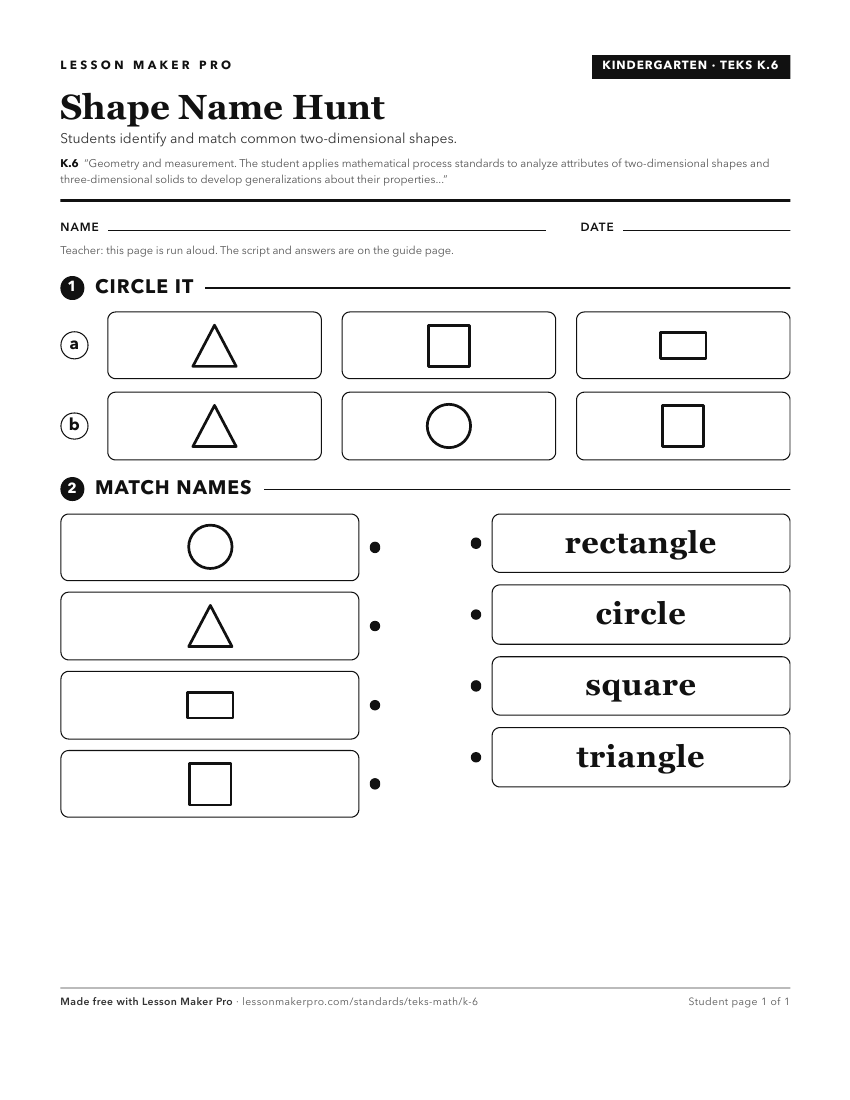
A ready-to-print activity worksheet aligned to K.6, with an answer key for the teacher on its own page. No account needed.
PDF, US Letter, prints cleanly in black and white.
Download the worksheetKeep exploring
Related Standards
- 5.5
The student applies mathematical process standards to classify two-dimensional figures by attributes and properties. The student is expected to classify two-dim...
- 3.6
The student applies mathematical process standards to analyze attributes of two-dimensional geometric figures to develop generalizations about their properties
- 1.6
The 1st Grade version of this standard.
- 4.6
The student applies mathematical process standards to analyze geometric attributes in order to develop generalizations about their properties
Turn this cluster into a lesson
Grade, subject, topic, and the complete cluster are prefilled. Create one free, no account needed.
Also for this cluster:Make a WorksheetMake a QuizMake a Sub Lesson