TEKS Math 1.6
Knowledge and Skills Statement (Standard Cluster)
The student applies mathematical process standards to analyze attributes of two-dimensional shapes and three-dimensional solids to develop generalizations about their properties
Texas Essential Knowledge and Skills for Mathematics
Cluster contents
Student Expectations in This Statement
1.6 is a knowledge and skills statement. These are the student expectations under it.
- 1.6.A
classify and sort regular and irregular two-dimensional shapes based on attributes using informal geometric language
- 1.6.B
distinguish between attributes that define a two-dimensional or three-dimensional figure and attributes that do not define the shape
- 1.6.C
create two-dimensional figures, including circles, triangles, rectangles, and squares, as special rectangles, rhombuses, and hexagons
- 1.6.D
identify two-dimensional shapes, including circles, triangles, rectangles, and squares, as special rectangles, rhombuses, and hexagons and describe their attrib...
- 1.6.E
identify three-dimensional solids, including spheres, cones, cylinders, rectangular prisms (including cubes), and triangular prisms, and describe their attribut...
- 1.6.F
compose two-dimensional shapes by joining two, three, or four figures to produce a target shape in more than one way if possible
- 1.6.G
partition two-dimensional figures into two and four fair shares or equal parts and describe the parts using words
- 1.6.H
identify examples and non-examples of halves and fourths
Teacher's field guide
What This Cluster Means
What Students Need to Do
- Students sort and name familiar and unusual shapes by defining attributes such as sides, vertices, faces, and curved or flat surfaces. They explain that color, size, pattern, and orientation do not determine a shape’s name. They build larger shapes from smaller ones and divide figures into two or four equal shares.
What Mastery Looks Like
- A student correctly names and describes circles, triangles, rectangles, squares, rhombuses, hexagons, spheres, cones, cylinders, and prisms, even when examples look unusual. The student explains that every square is a rectangle and uses attributes to reject non-examples. The student composes target shapes and marks halves or fourths that are equal in size.
Common Misconceptions
- Students often name shapes by appearance, so a tilted square becomes a diamond and a long rectangle is not seen as a rectangle. They may use color or size as defining attributes, or call a solid by the name of one flat face. They may count two or four pieces as fair shares without checking that the pieces are equal in size.
How to Assess It
- Exit ticket: show a tilted square, a non-square rectangle, a cylinder, and a circle. Ask students to name each, give one defining attribute, and divide a rectangle into four equal shares.
Lesson moves
Ways to Teach It
Give pairs pattern blocks and solid models to sort, then require each pair to explain one defining attribute for every group.
Show a tilted square and ask students to explain whether it is still a square and also a rectangle, using its attributes.
Play Shape Detective: one student draws a card and gives attribute clues while classmates identify the shape without seeing it.
Walk around the classroom to find a cylinder, rectangular prism, sphere, and cone, then sketch each object and label its solid.
Free download
Printable 1.6 Worksheet
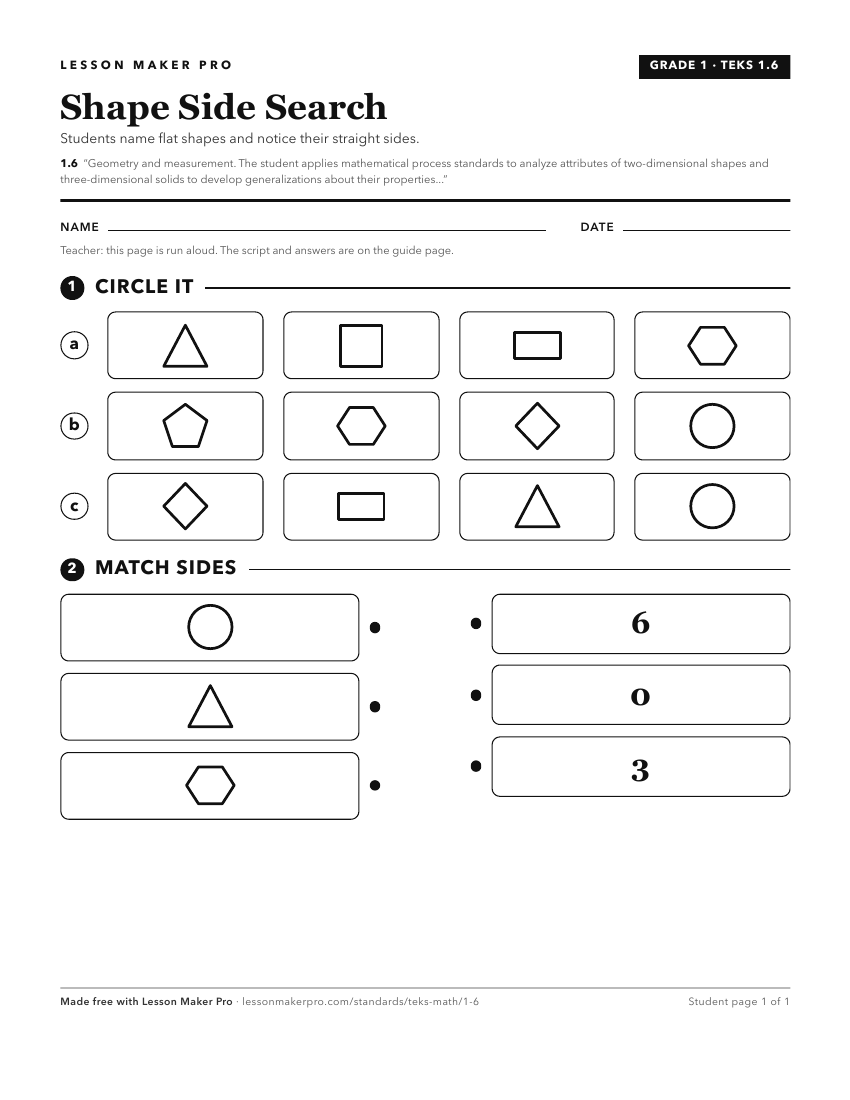
A ready-to-print activity worksheet aligned to 1.6, with an answer key for the teacher on its own page. No account needed.
PDF, US Letter, prints cleanly in black and white.
Download the worksheetKeep exploring
Related Standards
- K.6
The Kindergarten version of this standard.
- 5.5
The student applies mathematical process standards to classify two-dimensional figures by attributes and properties. The student is expected to classify two-dim...
- 3.6
The student applies mathematical process standards to analyze attributes of two-dimensional geometric figures to develop generalizations about their properties
- 4.6
The student applies mathematical process standards to analyze geometric attributes in order to develop generalizations about their properties
Turn this cluster into a lesson
Grade, subject, topic, and the complete cluster are prefilled. Create one free, no account needed.
Also for this cluster:Make a WorksheetMake a QuizMake a Sub Lesson