TEKS Math 1.6.B
The Standard
distinguish between attributes that define a two-dimensional or three-dimensional figure and attributes that do not define the shape
Texas Essential Knowledge and Skills for Mathematics
Teacher's field guide
What This Standard Means
What Students Need to Do
- Students decide which features determine a shape’s name and which features can change. They use sides, corners, faces, and surfaces instead of color, size, or position.
What Mastery Looks Like
- Students correctly name shapes that are rotated, resized, or shown in different colors. They explain their choices using sides, corners, faces, and surfaces rather than color, size, or position.
Common Misconceptions
- Students may think color, size, position, or material changes a shape’s name. They may also focus on one feature, such as pointed corners, while ignoring sides, faces, or surfaces.
How to Assess It
- Show a small red cube and a large blue cube. Ask, “Which features make both objects cubes, and which features do not matter?”
Lesson moves
Ways to Teach It
Use paper shapes and solid blocks; students sort attribute cards into “names the shape” and “can change” groups.
Ask, “Can a large red triangle turned sideways still be a triangle? Explain using sides and corners.”
Play Attribute Detective: describe a hidden shape by sides, corners, faces, or surfaces while classmates guess and reject color or size clues.
Hunt for classroom examples, then compare a small box and large box to explain why both can be rectangular prisms.
Free download
Printable 1.6.B Worksheet
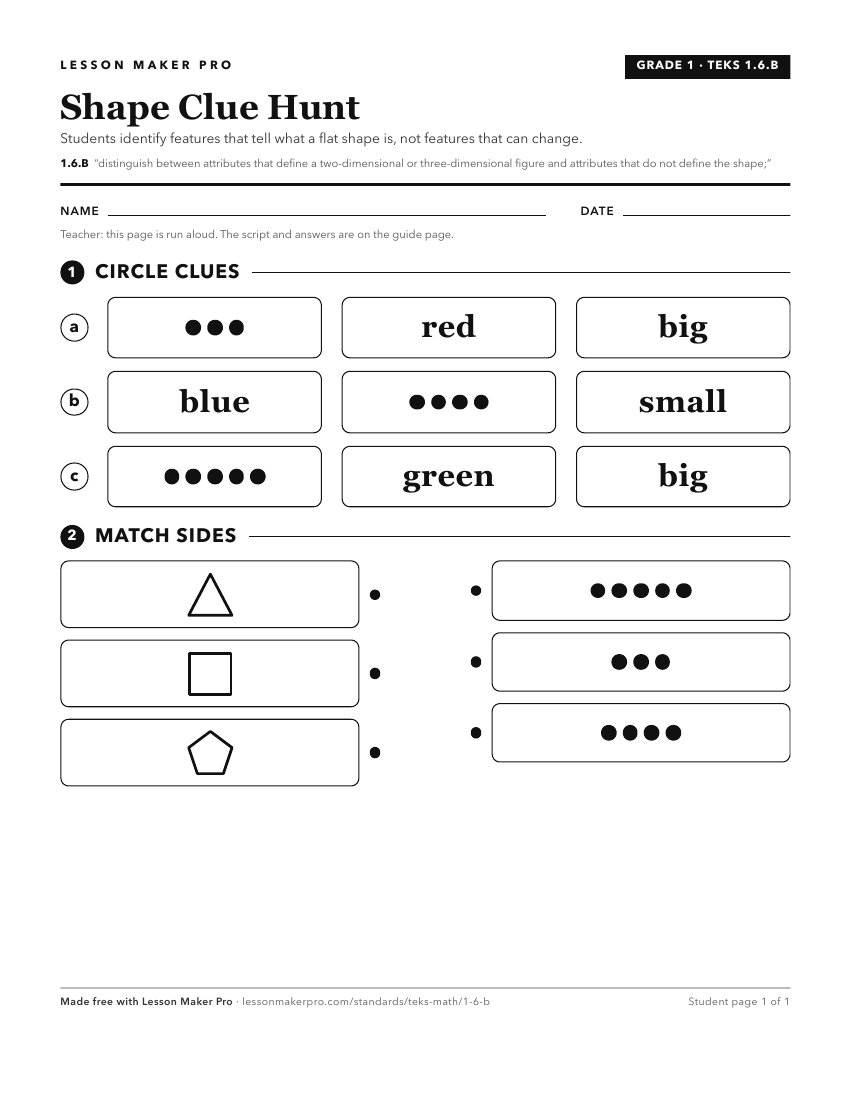
A ready-to-print activity worksheet aligned to 1.6.B, with an answer key for the teacher on its own page. No account needed.
PDF, US Letter, prints cleanly in black and white.
Download the worksheetKeep exploring
Related Standards
- K.6.C
identify two-dimensional components of three-dimensional objects
- 2.8.D
compose two-dimensional shapes and three-dimensional solids with given properties or attributes
- K.6.D
identify attributes of two-dimensional shapes using informal and formal geometric language interchangeably
- 1.6.A
classify and sort regular and irregular two-dimensional shapes based on attributes using informal geometric language
Turn this exact standard into a lesson
Grade, subject, topic, and the complete standard are prefilled. Create one free, no account needed.
Also for this standard:Make a WorksheetMake a QuizMake a Sub Lesson