TEKS Math K.6.C
The Standard
identify two-dimensional components of three-dimensional objects
Texas Essential Knowledge and Skills for Mathematics
Teacher's field guide
What This Standard Means
What Students Need to Do
- Students inspect a solid object and name the flat shape found on each face. They match faces to circles, squares, rectangles, or triangles.
What Mastery Looks Like
- A student can say that a cube has square faces, a cylinder has circular faces, and a cone has one circular face. The student also knows a sphere has no flat face.
Common Misconceptions
- Students may name the whole solid instead of the shape on a face. They may call every box face a square, even when it is a rectangle. They may treat a curved surface as a circle.
How to Assess It
- Show a cube, cylinder, cone, and sphere. Ask, "Point to one flat face, name its shape, then tell which object has no flat face."
Lesson moves
Ways to Teach It
Give pairs solid blocks, paper, and crayons. Students trace each flat face, then sort the tracings by shape.
Display a cereal box and ask, "Which flat shapes can you find, and how do you know?"
Play Face Match. Students draw a solid object card and cover the matching flat shape pictures on a bingo board.
Have students inspect cans, boxes, and party hats, then attach sticky notes naming the flat shapes they find.
Free download
Printable K.6.C Worksheet
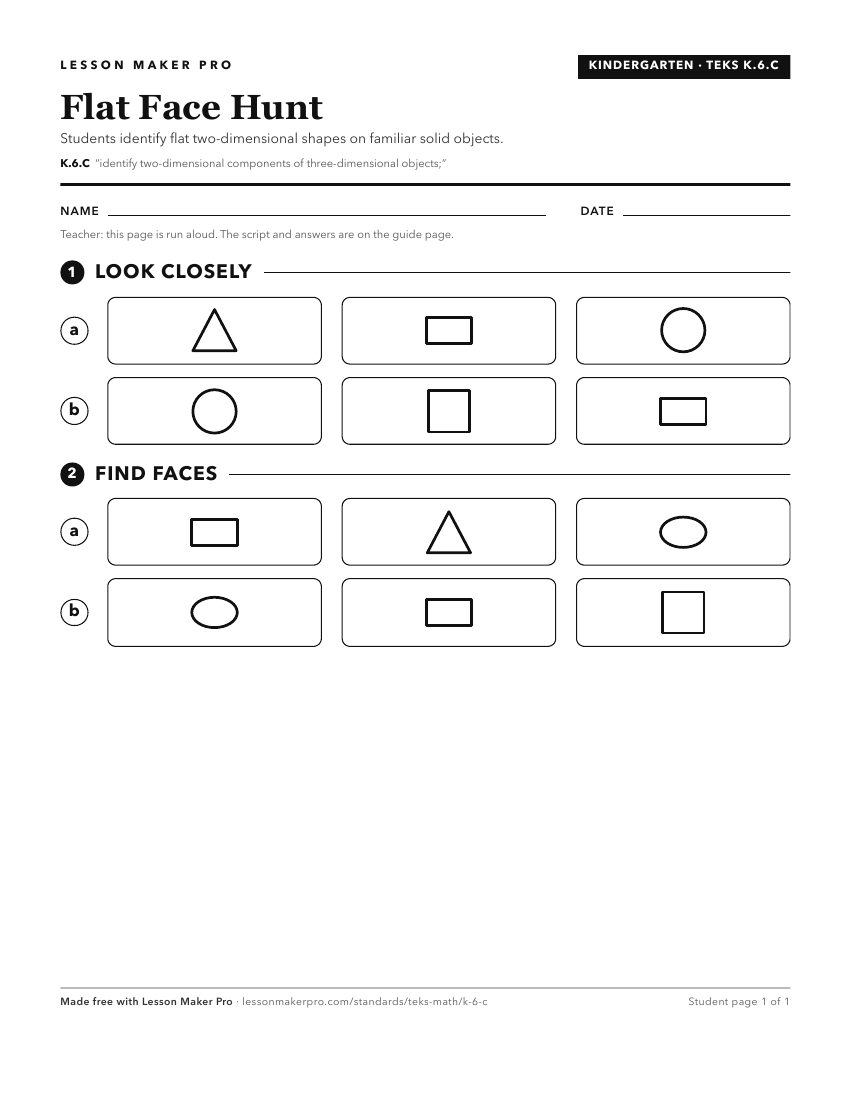
A ready-to-print activity worksheet aligned to K.6.C, with an answer key for the teacher on its own page. No account needed.
PDF, US Letter, prints cleanly in black and white.
Download the worksheetKeep exploring
Related Standards
- 1.6.B
distinguish between attributes that define a two-dimensional or three-dimensional figure and attributes that do not define the shape
- 1.6.E
identify three-dimensional solids, including spheres, cones, cylinders, rectangular prisms (including cubes), and triangular prisms, and describe their attribut...
- 2.8.D
compose two-dimensional shapes and three-dimensional solids with given properties or attributes
- K.6.B
identify three-dimensional solids, including cylinders, cones, spheres, and cubes, in the real world
Turn this exact standard into a lesson
Grade, subject, topic, and the complete standard are prefilled. Create one free, no account needed.
Also for this standard:Make a WorksheetMake a QuizMake a Sub Lesson