TEKS Math K.6.B
The Standard
identify three-dimensional solids, including cylinders, cones, spheres, and cubes, in the real world
Texas Essential Knowledge and Skills for Mathematics
Teacher's field guide
What This Standard Means
What Students Need to Do
- Students recognize and name cubes, spheres, cylinders, and cones when they see objects around them. They match everyday items to the solid they resemble.
What Mastery Looks Like
- A student correctly matches common objects to cubes, spheres, cylinders, and cones. The student uses the solid names rather than flat shape names.
Common Misconceptions
- Students may call a sphere a circle or a cube a square because they focus on one flat face. They may confuse cones and cylinders or think object size changes the solid’s name.
How to Assess It
- Show a ball, soup can, party hat, and number cube. Ask students to name the solid each object resembles.
Lesson moves
Ways to Teach It
Set out a ball, soup can, party hat, and number cube, then have students sort and label them with solid-name cards.
Ask, “How is a soup can like a cylinder, and how is it different from a sphere?” Record students’ observations.
Play Mystery Bag: students feel one hidden solid, name it, then pull it out to check.
Take a classroom solid hunt and photograph one object resembling each solid for a class chart.
Free download
Printable K.6.B Worksheet
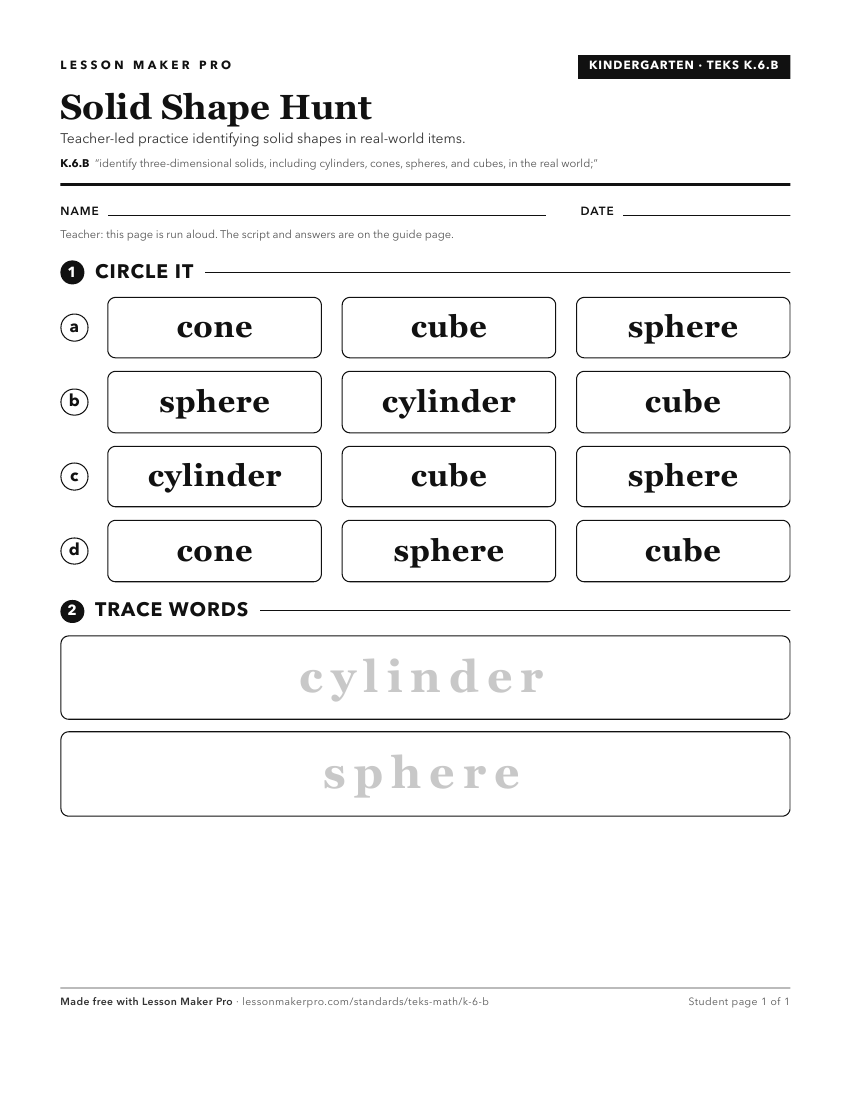
A ready-to-print activity worksheet aligned to K.6.B, with an answer key for the teacher on its own page. No account needed.
PDF, US Letter, prints cleanly in black and white.
Download the worksheetKeep exploring
Related Standards
- K.6.C
identify two-dimensional components of three-dimensional objects
- 1.6.E
identify three-dimensional solids, including spheres, cones, cylinders, rectangular prisms (including cubes), and triangular prisms, and describe their attribut...
- 8.7.A
solve problems involving the volume of cylinders, cones, and spheres
- 2.8.B
classify and sort three-dimensional solids, including spheres, cones, cylinders, rectangular prisms (including cubes as special rectangular prisms), and triangu...
Turn this exact standard into a lesson
Grade, subject, topic, and the complete standard are prefilled. Create one free, no account needed.
Also for this standard:Make a WorksheetMake a QuizMake a Sub Lesson