TEKS Math 2.8.B
The Standard
classify and sort three-dimensional solids, including spheres, cones, cylinders, rectangular prisms (including cubes as special rectangular prisms), and triangular prisms, based on attributes using formal geometric language
Texas Essential Knowledge and Skills for Mathematics
Teacher's field guide
What This Standard Means
What Students Need to Do
- Students identify common three-dimensional solids and group them by visible attributes. They use terms such as face, curved surface, edge, and vertex to explain each grouping.
What Mastery Looks Like
- Students correctly name each solid and describe its flat faces, curved surfaces, edges, and vertices. They can sort the same set in different ways and explain why a cube belongs with rectangular prisms.
Common Misconceptions
- Students may treat a cube as separate from rectangular prisms instead of as a special kind. They may confuse faces, edges, and vertices or call a cylinder a circle.
How to Assess It
- Show a cube, cylinder, and triangular prism. Ask students to name each solid, sort them by one attribute, and explain the rule using face, edge, vertex, or curved surface.
Lesson moves
Ways to Teach It
Give pairs solid models to sort on labeled mats for flat faces, curved surfaces, edges, and vertices, then compare their groupings.
Ask, “Why is every cube a rectangular prism, but not every rectangular prism a cube?” Students discuss, then write one explanation.
Play Solid Riddle Bingo by reading attribute clues while students cover the matching sphere, cone, cylinder, or prism on their cards.
Have students find classroom objects shaped like each solid, sketch them, and label one geometric attribute that matches the model.
Free download
Printable 2.8.B Worksheet
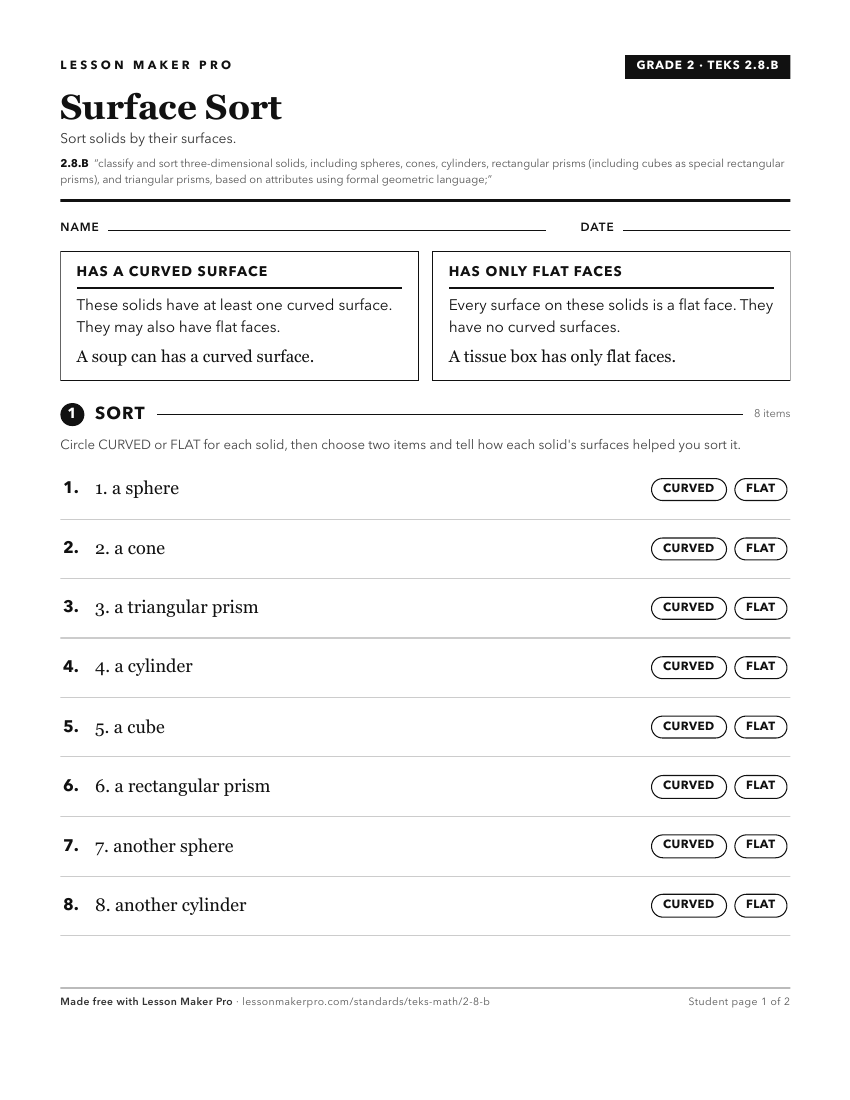
A ready-to-print activity worksheet aligned to 2.8.B, with an answer key for the teacher on its own page. No account needed.
PDF, US Letter, prints cleanly in black and white.
Download the worksheetKeep exploring
Related Standards
- 1.6.E
identify three-dimensional solids, including spheres, cones, cylinders, rectangular prisms (including cubes), and triangular prisms, and describe their attribut...
- K.6.B
identify three-dimensional solids, including cylinders, cones, spheres, and cubes, in the real world
- K.6.E
classify and sort a variety of regular and irregular two- and three-dimensional figures regardless of orientation or size
- 1.6.A
classify and sort regular and irregular two-dimensional shapes based on attributes using informal geometric language
Turn this exact standard into a lesson
Grade, subject, topic, and the complete standard are prefilled. Create one free, no account needed.
Also for this standard:Make a WorksheetMake a QuizMake a Sub Lesson