TEKS Math K.6.E
The Standard
classify and sort a variety of regular and irregular two- and three-dimensional figures regardless of orientation or size
Texas Essential Knowledge and Skills for Mathematics
Teacher's field guide
What This Standard Means
What Students Need to Do
- Students group flat shapes and solid figures by features such as sides, corners, faces, and curved surfaces. They recognize that turning or resizing a figure does not change its group.
What Mastery Looks Like
- Students sort flat shapes and solid figures using visible features. They keep the same figure in its group when it is turned, moved, or shown in another size.
Common Misconceptions
- Students may think a turned square is a different shape or that all triangles must point upward. They may sort by color or size instead of sides, corners, faces, or curved surfaces.
How to Assess It
- Give each student six mixed shape cards and solid objects. Say, "Sort these into two groups, then tell me your rule and where a turned shape belongs."
Lesson moves
Ways to Teach It
Give pairs paper shapes and solid blocks to sort twice, first by flat or solid, then by sides, corners, faces, or curves.
Show a large tilted triangle and a small upright triangle, then ask, "Do they belong together? What features prove your answer?"
Play Shape Sort Relay: students draw a figure card, name one feature, and place it in the matching labeled hoop.
Take a classroom shape hunt, then sort found objects or object photos by flat surfaces, curved surfaces, corners, or overall shape.
Free download
Printable K.6.E Worksheet
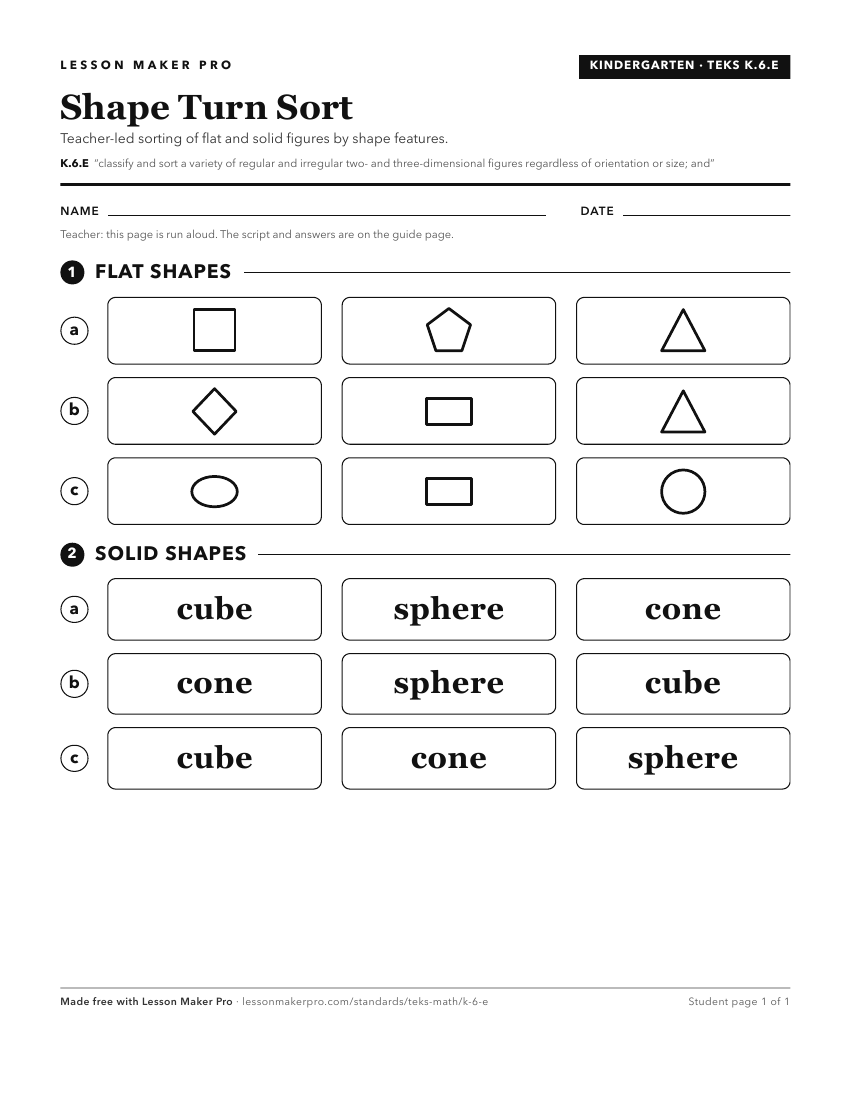
A ready-to-print activity worksheet aligned to K.6.E, with an answer key for the teacher on its own page. No account needed.
PDF, US Letter, prints cleanly in black and white.
Download the worksheetKeep exploring
Related Standards
- 2.8.C
classify and sort polygons with 12 or fewer sides according to attributes, including identifying the number of sides and number of vertices
- 4.6.D
classify two-dimensional figures based on the presence or absence of parallel or perpendicular lines or the presence or absence of angles of a specified size
- 1.6.A
classify and sort regular and irregular two-dimensional shapes based on attributes using informal geometric language
- 2.8.B
classify and sort three-dimensional solids, including spheres, cones, cylinders, rectangular prisms (including cubes as special rectangular prisms), and triangu...
Turn this exact standard into a lesson
Grade, subject, topic, and the complete standard are prefilled. Create one free, no account needed.
Also for this standard:Make a WorksheetMake a QuizMake a Sub Lesson