TEKS Math 4.6.D
The Standard
classify two-dimensional figures based on the presence or absence of parallel or perpendicular lines or the presence or absence of angles of a specified size
Texas Essential Knowledge and Skills for Mathematics
Teacher's field guide
What This Standard Means
What Students Need to Do
- Students inspect sides and angles, then sort two-dimensional shapes using a given rule. They explain each choice with evidence from the shape’s lines or angles.
What Mastery Looks Like
- Students sort the same set of shapes correctly using different stated rules. They identify relevant sides and angles, then use those features to explain why each shape belongs.
Common Misconceptions
- Students may think parallel lines must be horizontal or vertical. They may also confuse perpendicular lines with any intersecting lines or classify a shape by its appearance alone.
How to Assess It
- Give students six labeled shapes and ask: “Circle every shape with perpendicular sides, then underline every shape with a 90° angle. Explain one choice.”
Lesson moves
Ways to Teach It
Give pairs shape cutouts, rulers, and square corners, then have them sort the shapes on labeled attribute mats.
Ask students to explain in writing how one shape can fit two groups, such as having parallel sides and 90° angles.
Play Attribute Mystery by revealing one clue at a time while students remove shape cards that do not match.
Photograph road signs, windows, and floor tiles, then label examples with parallel sides, perpendicular sides, or specified angle measures.
Free download
Printable 4.6.D Worksheet
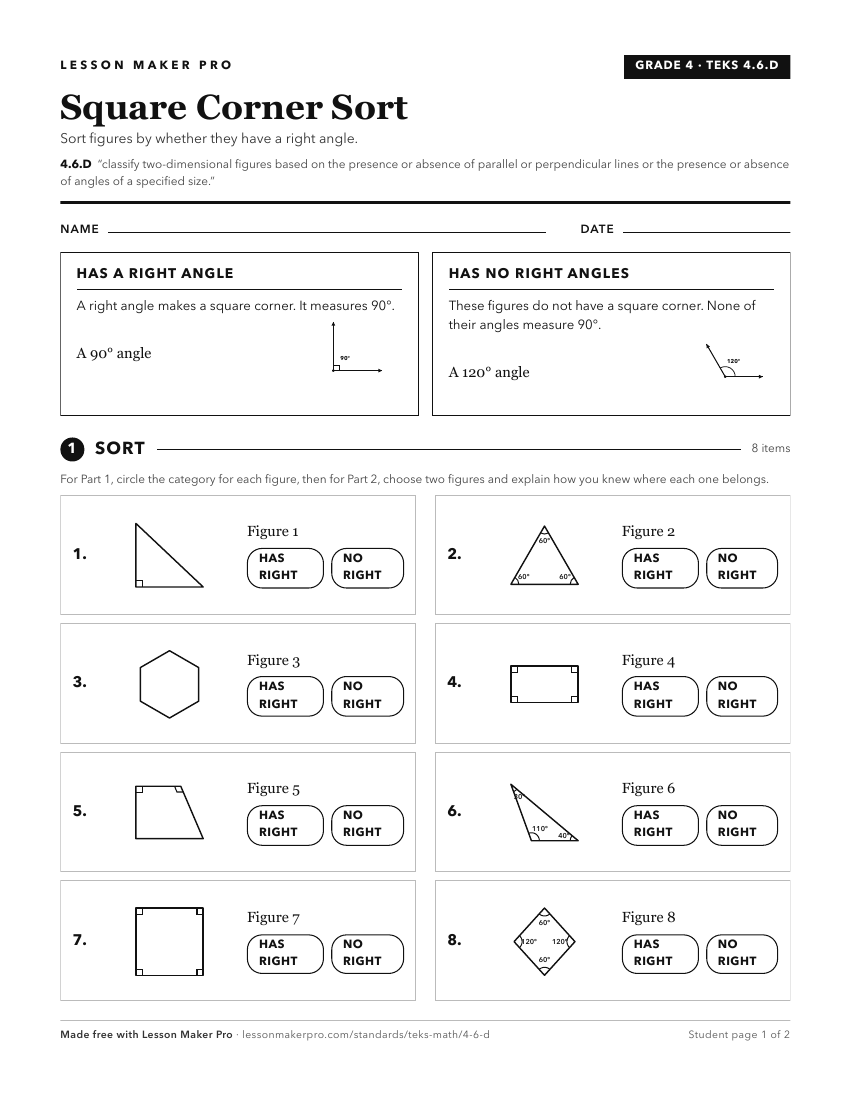
A ready-to-print activity worksheet aligned to 4.6.D, with an answer key for the teacher on its own page. No account needed.
PDF, US Letter, prints cleanly in black and white.
Download the worksheetKeep exploring
Related Standards
- 5.5
The student applies mathematical process standards to classify two-dimensional figures by attributes and properties. The student is expected to classify two-dim...
- 4.6.B
identify and draw one or more lines of symmetry, if they exist, for a two-dimensional figure
- K.6.E
classify and sort a variety of regular and irregular two- and three-dimensional figures regardless of orientation or size
- 1.6.A
classify and sort regular and irregular two-dimensional shapes based on attributes using informal geometric language
Turn this exact standard into a lesson
Grade, subject, topic, and the complete standard are prefilled. Create one free, no account needed.
Also for this standard:Make a WorksheetMake a QuizMake a Sub Lesson