TEKS Math K.6.D
The Standard
identify attributes of two-dimensional shapes using informal and formal geometric language interchangeably
Texas Essential Knowledge and Skills for Mathematics
Teacher's field guide
What This Standard Means
What Students Need to Do
- Students describe flat shapes by noticing sides, vertices, straight edges, curved edges, and other visible features. They use everyday words and geometry words for the same attribute.
What Mastery Looks Like
- Students describe shapes by their sides, vertices, curves, and other visible features. They can pair words such as pointy and vertex, or round and curved.
Common Misconceptions
- Students may name a shape instead of describing its attributes. They may count a curved edge as a straight side or think a rotated shape has changed.
How to Assess It
- Show a triangle and a circle. Ask each student to describe one attribute of each shape using an everyday word and a geometry word.
Lesson moves
Ways to Teach It
Give students foam shapes to trace, then have them mark vertices with counters and trace straight or curved edges with yarn.
Ask, “How are a rectangle and circle alike and different?” Record both everyday words and geometry words from student responses.
Play Mystery Shape by giving attribute clues, such as “I have three straight sides and three vertices,” while students hold up matching cards.
Photograph classroom objects, outline their flat faces, and label attributes using words such as straight, curved, side, and vertex.
Free download
Printable K.6.D Worksheet
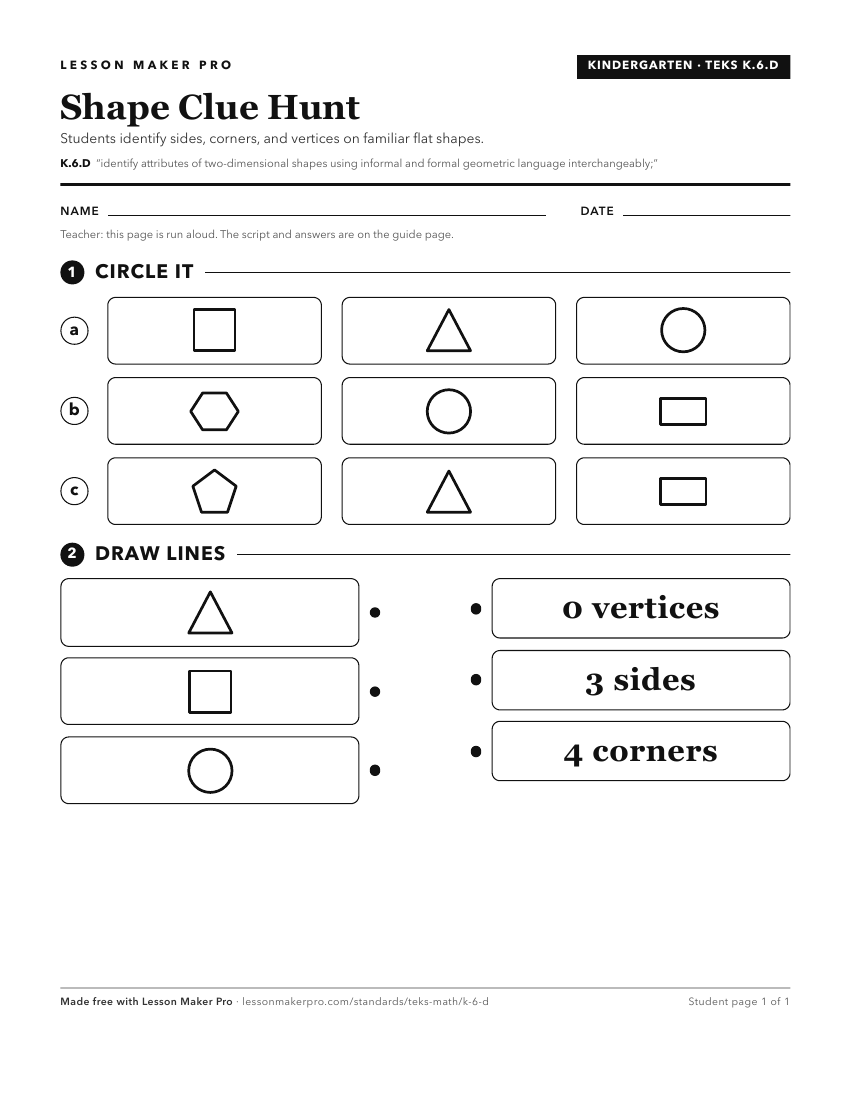
A ready-to-print activity worksheet aligned to K.6.D, with an answer key for the teacher on its own page. No account needed.
PDF, US Letter, prints cleanly in black and white.
Download the worksheetKeep exploring
Related Standards
- 1.6.B
distinguish between attributes that define a two-dimensional or three-dimensional figure and attributes that do not define the shape
- 2.8.D
compose two-dimensional shapes and three-dimensional solids with given properties or attributes
- 1.6.D
identify two-dimensional shapes, including circles, triangles, rectangles, and squares, as special rectangles, rhombuses, and hexagons and describe their attrib...
- 1.6.A
classify and sort regular and irregular two-dimensional shapes based on attributes using informal geometric language
Turn this exact standard into a lesson
Grade, subject, topic, and the complete standard are prefilled. Create one free, no account needed.
Also for this standard:Make a WorksheetMake a QuizMake a Sub Lesson