TEKS Math 4.6
Knowledge and Skills Statement (Standard Cluster)
The student applies mathematical process standards to analyze geometric attributes in order to develop generalizations about their properties
Texas Essential Knowledge and Skills for Mathematics
Cluster contents
Student Expectations in This Statement
4.6 is a knowledge and skills statement. These are the student expectations under it.
- 4.6.A
identify points, lines, line segments, rays, angles, and perpendicular and parallel lines
- 4.6.B
identify and draw one or more lines of symmetry, if they exist, for a two-dimensional figure
- 4.6.C
apply knowledge of right angles to identify acute, right, and obtuse triangles
- 4.6.D
classify two-dimensional figures based on the presence or absence of parallel or perpendicular lines or the presence or absence of angles of a specified size
Teacher's field guide
What This Cluster Means
What Students Need to Do
- Students identify and draw basic geometric parts, including points, lines, rays, segments, angles, and parallel or perpendicular lines. They find and draw lines of symmetry in flat shapes. They classify triangles by angle type and sort other figures by their angles and line relationships.
What Mastery Looks Like
- Given a diagram, students correctly name points, lines, segments, rays, angles, and parallel or perpendicular line pairs. They draw all lines of symmetry and classify triangles as acute, right, or obtuse. They classify other figures using angle sizes and line relationships, and explain each choice with a visible property.
Common Misconceptions
- Students often confuse lines, rays, and line segments, especially when arrowheads are missing or overlooked. They may call any intersecting lines perpendicular or think parallel lines must be horizontal. They may classify a square only as a square, miss diagonal symmetry lines, or classify triangles by appearance instead of angle size.
How to Assess It
- Give an exit ticket with a labeled geometry diagram and three shapes. Ask students to name one point, segment, ray, parallel pair, and perpendicular pair, draw symmetry lines, then classify each shape with one property as evidence.
Lesson moves
Ways to Teach It
Give pairs straws, string, and dot stickers to build and label points, rays, segments, parallel lines, perpendicular lines, and angles.
Show a rotated square and ask, "What names fit this shape, and which visible properties prove each name?"
Run a property sort with shape cards labeled by clues such as one right angle, parallel sides, or no symmetry.
Have students photograph classroom objects, then mark parallel lines, perpendicular lines, angle types, and symmetry on printed copies.
Free download
Printable 4.6 Worksheet
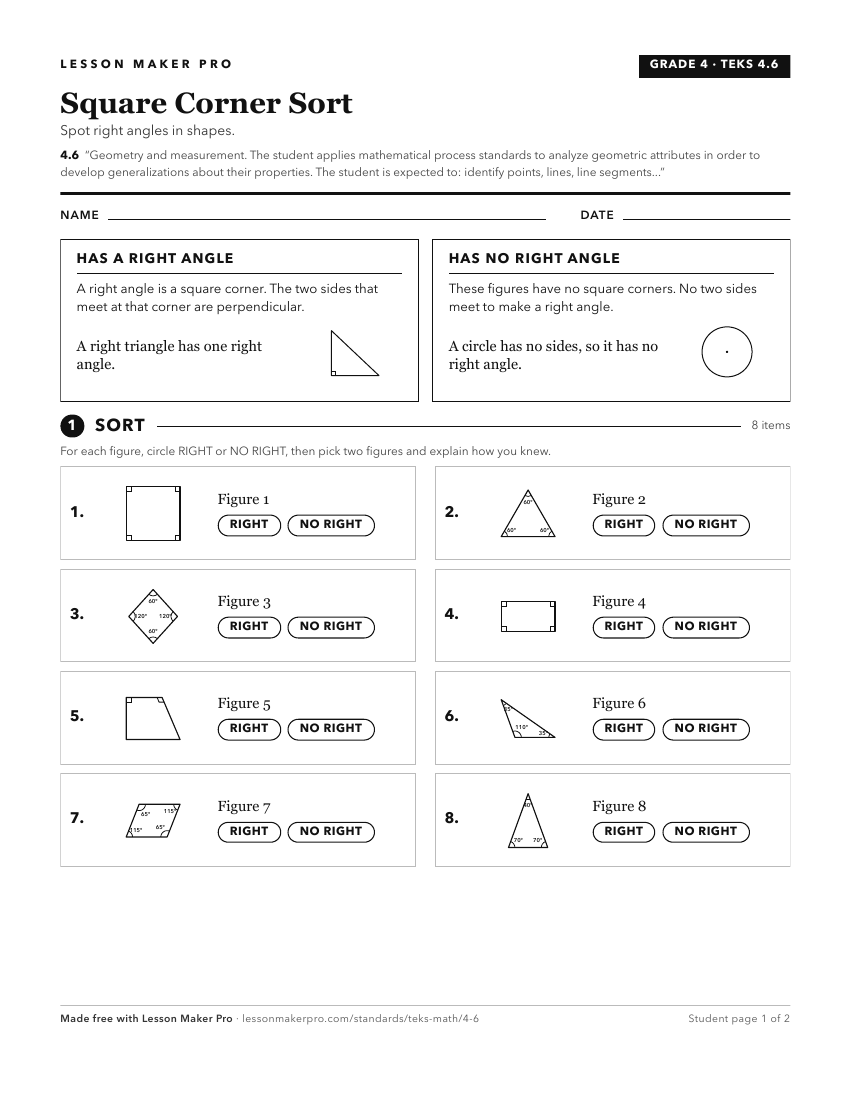
A ready-to-print activity worksheet aligned to 4.6, with an answer key for the teacher on its own page. No account needed.
PDF, US Letter, prints cleanly in black and white.
Download the worksheetKeep exploring
Related Standards
- K.6
The student applies mathematical process standards to analyze attributes of two-dimensional shapes and three-dimensional solids to develop generalizations about...
- 3.6
The student applies mathematical process standards to analyze attributes of two-dimensional geometric figures to develop generalizations about their properties
- 1.6
The student applies mathematical process standards to analyze attributes of two-dimensional shapes and three-dimensional solids to develop generalizations about...
- 7.9
The student applies mathematical process standards to solve geometric problems
Turn this cluster into a lesson
Grade, subject, topic, and the complete cluster are prefilled. Create one free, no account needed.
Also for this cluster:Make a WorksheetMake a QuizMake a Sub Lesson