TEKS Math 4.6.A
The Standard
identify points, lines, line segments, rays, angles, and perpendicular and parallel lines
Texas Essential Knowledge and Skills for Mathematics
Teacher's field guide
What This Standard Means
What Students Need to Do
- Students sort and name geometric figures by looking at endpoints, arrows, vertices, and intersections. They distinguish lines that never meet from lines that meet at right angles.
What Mastery Looks Like
- Students correctly label each figure in a mixed diagram. They use endpoints, arrows, shared vertices, right-angle marks, and line direction to explain their choices.
Common Misconceptions
- Students often confuse lines, segments, and rays because they overlook arrows and endpoints. They may call any intersecting lines perpendicular. They may think parallel lines must be horizontal or vertical.
How to Assess It
- Give students one diagram containing eight labeled figures. Ask them to name each figure and justify two answers using endpoints, arrows, or right-angle marks.
Lesson moves
Ways to Teach It
Give pairs of students string, craft sticks, and dot stickers to build and label each type of geometric figure.
Show two intersecting lines and ask, "What evidence proves whether these lines are perpendicular?"
Play a matching game with cards showing figures, names, and defining clues such as two endpoints or never intersect.
Take a classroom photo walk to find examples such as parallel floor tiles, perpendicular door frames, and angles on furniture.
Free download
Printable 4.6.A Worksheet
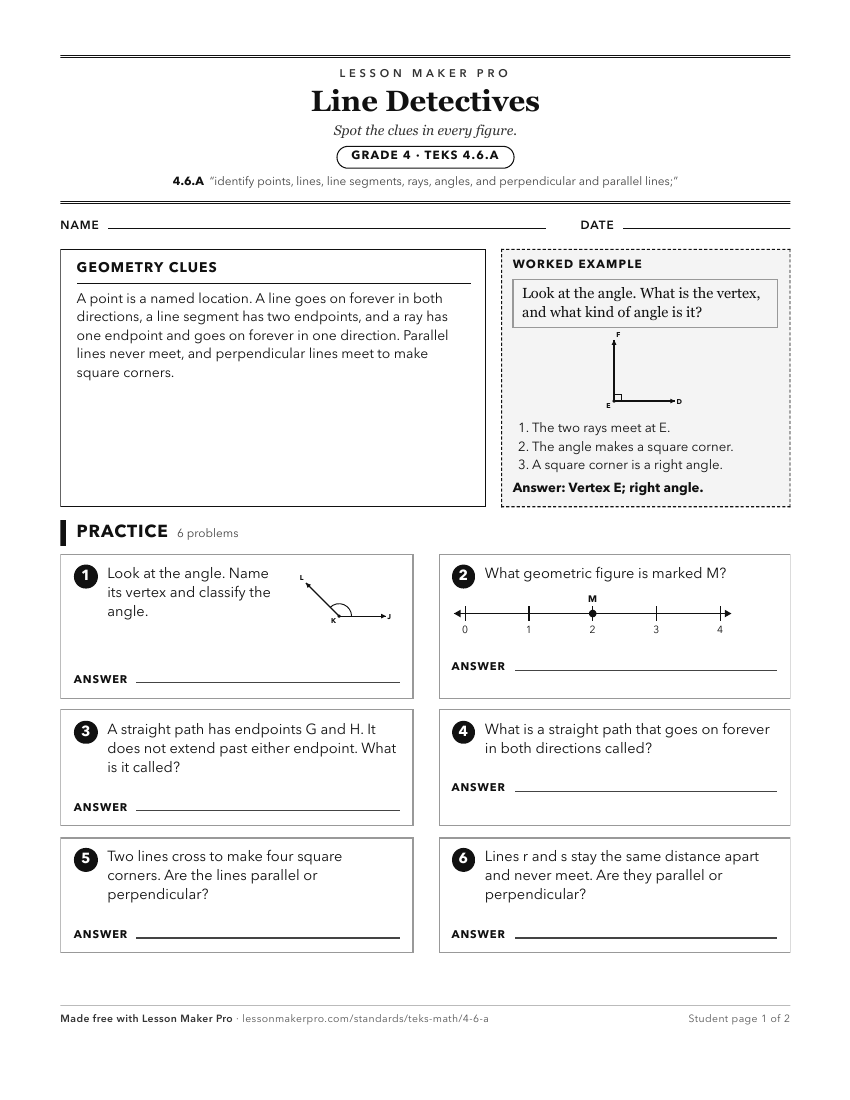
A ready-to-print activity worksheet aligned to 4.6.A, with an answer key for the teacher on its own page. No account needed.
PDF, US Letter, prints cleanly in black and white.
Download the worksheetKeep exploring
Related Standards
- 3.6.B
use attributes to recognize rhombuses, parallelograms, trapezoids, rectangles, and squares as examples of quadrilaterals and draw examples of quadrilaterals tha...
- 8.8.D
use informal arguments to establish facts about the angle sum and exterior angle of triangles, the angles created when parallel lines are cut by a transversal, ...
- 1.6.D
identify two-dimensional shapes, including circles, triangles, rectangles, and squares, as special rectangles, rhombuses, and hexagons and describe their attrib...
- 4.6.D
classify two-dimensional figures based on the presence or absence of parallel or perpendicular lines or the presence or absence of angles of a specified size
Turn this exact standard into a lesson
Grade, subject, topic, and the complete standard are prefilled. Create one free, no account needed.
Also for this standard:Make a WorksheetMake a QuizMake a Sub Lesson