TEKS Math 8.8.D
The Standard
use informal arguments to establish facts about the angle sum and exterior angle of triangles, the angles created when parallel lines are cut by a transversal, and the angle-angle criterion for similarity of triangles
Texas Essential Knowledge and Skills for Mathematics
Teacher's field guide
What This Standard Means
What Students Need to Do
- Students use diagrams, angle relationships, and simple reasoning to explain why triangle and transversal angle facts work. They also justify triangle similarity by showing two pairs of angles match.
What Mastery Looks Like
- Students find unknown angles and explain each step using known relationships, not measurement alone. They can show that two triangles are similar when two angle pairs match.
Common Misconceptions
- Students may assume diagrams are drawn to scale or treat all nearby angles as equal. They often mix up corresponding and alternate interior angles, or claim triangles are similar from only one matching angle.
How to Assess It
- Give a diagram with a triangle, an extended side, and parallel lines cut by a transversal. Ask students to find three labeled angles and justify each result, then decide whether two triangles are similar by AA.
Lesson moves
Ways to Teach It
Have students tear off a paper triangle’s three corners, place them along a straight edge, and explain what the arrangement shows.
Ask students to write why a triangle’s exterior angle equals the sum of its two nonadjacent interior angles.
Run a card sort matching angle diagrams, angle relationships, equations, and justifications involving parallel lines and transversals.
Photograph roof trusses or railing supports, then have students mark parallel lines and use matching angles to identify similar triangles.
Free download
Printable 8.8.D Worksheet
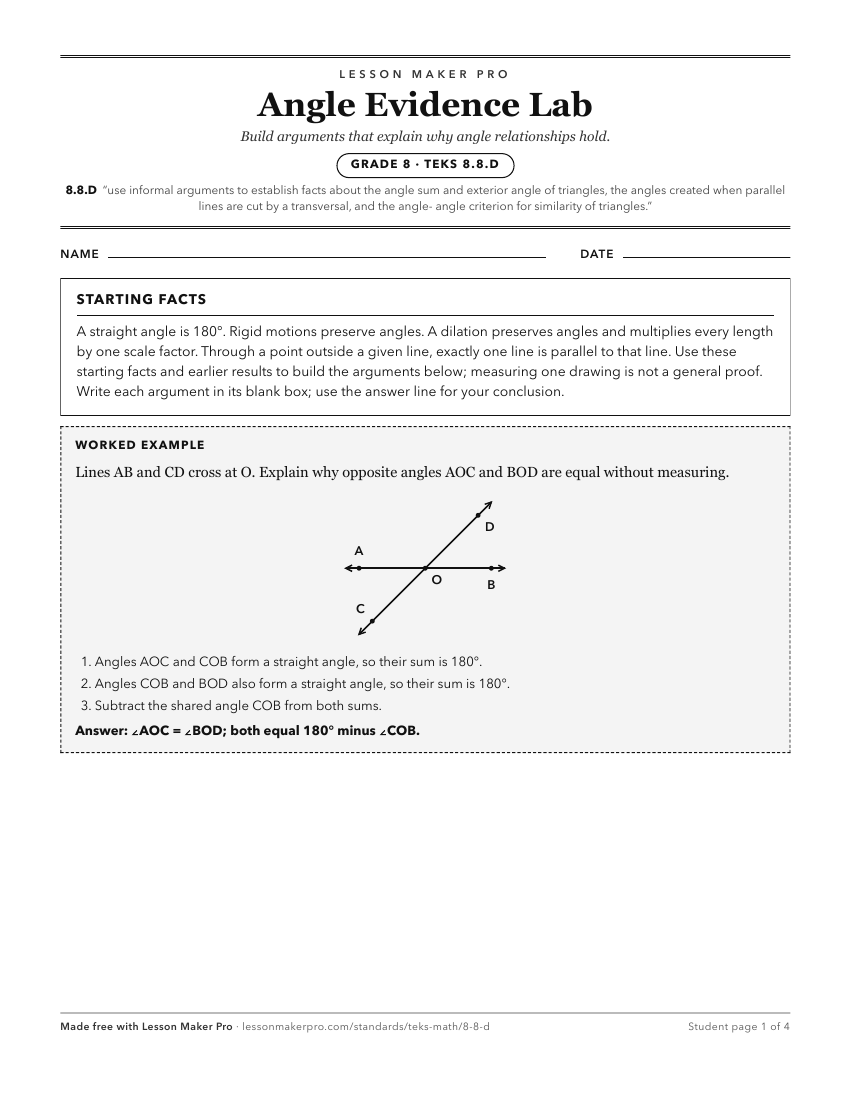
A ready-to-print activity worksheet aligned to 8.8.D, with an answer key for the teacher on its own page. No account needed.
PDF, US Letter, prints cleanly in black and white.
Download the worksheetKeep exploring
Related Standards
- 6.8.A
extend previous knowledge of triangles and their properties to include the sum of angles of a triangle, the relationship between the lengths of sides and measur...
- 4.6.A
identify points, lines, line segments, rays, angles, and perpendicular and parallel lines
- 7.11.C
write and solve equations using geometry concepts, including the sum of the angles in a triangle, and angle relationships
- 4.6.C
apply knowledge of right angles to identify acute, right, and obtuse triangles
Turn this exact standard into a lesson
Grade, subject, topic, and the complete standard are prefilled. Create one free, no account needed.
Also for this standard:Make a WorksheetMake a QuizMake a Sub Lesson