TEKS Math 6.8.A
The Standard
extend previous knowledge of triangles and their properties to include the sum of angles of a triangle, the relationship between the lengths of sides and measures of angles in a triangle, and determining when three lengths form a triangle
Texas Essential Knowledge and Skills for Mathematics
Teacher's field guide
What This Standard Means
What Students Need to Do
- Students use the 180° angle total to find an unknown interior angle. They connect longer sides with larger opposite angles and test whether three given lengths can make a triangle.
What Mastery Looks Like
- Given two angle measures, a student finds the third accurately. The student orders sides and opposite angles from least to greatest. The student tests three lengths by comparing the sum of the two shorter lengths with the longest.
Common Misconceptions
- Students often match the largest angle with an adjacent side instead of the opposite side. They may accept three lengths when the two shorter lengths equal the longest, or rely only on visual appearance.
How to Assess It
- Exit ticket: In triangle ABC, angle A is 48° and angle B is 67°; find angle C and order AB, BC, and AC from shortest to longest. Decide whether lengths 4, 7, and 11 form a triangle, and explain.
Lesson moves
Ways to Teach It
Cut the three corners from a paper triangle and place their vertices together on a straight line to show the 180° total.
Display a scalene triangle and ask students to write and defend a rule for identifying the longest side without measuring it.
Play a card sort where pairs classify length triples as possible or impossible triangles, earning a point only for a correct inequality.
Give students proposed sets of wooden roof-brace lengths and have them determine which sets can form a triangular support.
Free download
Printable 6.8.A Worksheet
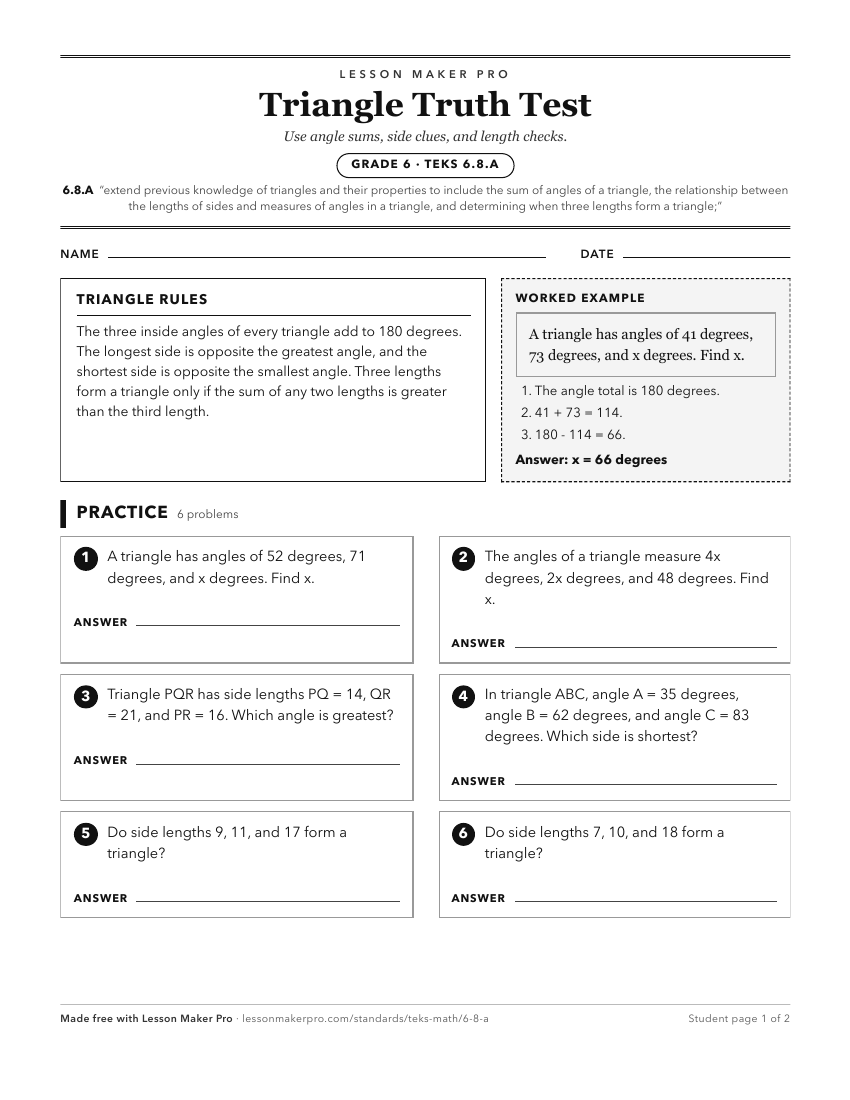
A ready-to-print activity worksheet aligned to 6.8.A, with an answer key for the teacher on its own page. No account needed.
PDF, US Letter, prints cleanly in black and white.
Download the worksheetKeep exploring
Related Standards
- 8.8.D
use informal arguments to establish facts about the angle sum and exterior angle of triangles, the angles created when parallel lines are cut by a transversal, ...
- 7.11.C
write and solve equations using geometry concepts, including the sum of the angles in a triangle, and angle relationships
- 4.6.C
apply knowledge of right angles to identify acute, right, and obtuse triangles
- 4.7.E
determine the measure of an unknown angle formed by two non-overlapping adjacent angles given one or both angle measures
Turn this exact standard into a lesson
Grade, subject, topic, and the complete standard are prefilled. Create one free, no account needed.
Also for this standard:Make a WorksheetMake a QuizMake a Sub Lesson