TEKS Math 4.7.E
The Standard
determine the measure of an unknown angle formed by two non-overlapping adjacent angles given one or both angle measures
Texas Essential Knowledge and Skills for Mathematics
Teacher's field guide
What This Standard Means
What Students Need to Do
- Students use the fact that two adjacent angle measures add to the measure of the whole angle. They add or subtract to find a missing part or the total.
What Mastery Looks Like
- Students identify the whole angle and its two adjacent parts. They add to find the whole or subtract a known part from the whole, then check that the parts combine correctly.
Common Misconceptions
- Students may add when they should subtract, especially when the whole angle is given. They may also subtract the smaller number from the larger without identifying the whole and the known part.
How to Assess It
- Give this exit ticket: “A 95° angle is split into angles measuring 38° and x°. Find x and write the equation you used.”
Lesson moves
Ways to Teach It
Give students paper angle wedges labeled with measures, then have them combine two wedges and calculate the total angle.
Ask students to explain why a 90° angle split into 35° and x° can be solved with subtraction.
Create matching cards with angle diagrams, equations, and missing measures for students to pair in small groups.
Use intersecting sidewalk or road diagrams to find an unknown turn angle from a total angle and one known part.
Free download
Printable 4.7.E Worksheet
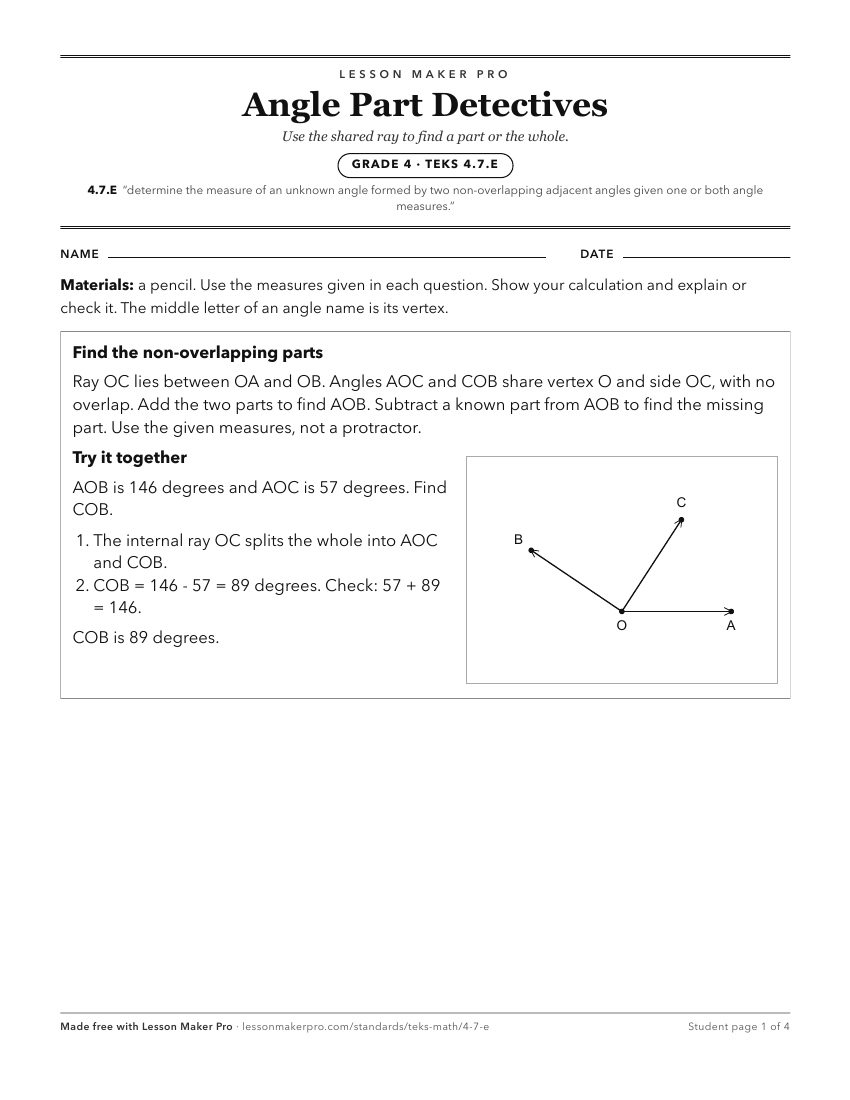
A ready-to-print activity worksheet aligned to 4.7.E, with an answer key for the teacher on its own page. No account needed.
PDF, US Letter, prints cleanly in black and white.
Download the worksheetKeep exploring
Related Standards
- 6.8.A
extend previous knowledge of triangles and their properties to include the sum of angles of a triangle, the relationship between the lengths of sides and measur...
- 4.7.C
determine the approximate measures of angles in degrees to the nearest whole number using a protractor
- 4.7.D
draw an angle with a given measure
- 4.7.A
illustrate the measure of an angle as the part of a circle whose center is at the vertex of the angle that is "cut out" by the rays of the angle. Angle measures...
Turn this exact standard into a lesson
Grade, subject, topic, and the complete standard are prefilled. Create one free, no account needed.
Also for this standard:Make a WorksheetMake a QuizMake a Sub Lesson