TEKS Math 4.7.A
The Standard
illustrate the measure of an angle as the part of a circle whose center is at the vertex of the angle that is "cut out" by the rays of the angle. Angle measures are limited to whole numbers
Texas Essential Knowledge and Skills for Mathematics
Teacher's field guide
What This Standard Means
What Students Need to Do
- Students connect an angle to a portion of a circle centered at the angle's vertex. They show the region swept between the two rays and relate it to a full 360-degree turn.
What Mastery Looks Like
- Students shade the correct part of a circle between two rays and identify the center as the vertex. They explain the angle measure as part of a 360-degree turn.
Common Misconceptions
- Students may think longer rays make a larger angle. They may measure the space between rays as a distance instead of viewing it as part of a full 360-degree turn.
How to Assess It
- Give students a circle with two rays drawn from its center. Ask them to shade the angle, estimate its whole-number measure, and explain how it compares with 360 degrees.
Lesson moves
Ways to Teach It
Give students paper circles, then have them cut from the center and rotate one edge to create and label different angles.
Show a shaded circle sector and ask, "What part of a full turn is shown, and about how many degrees is it?"
Play Angle Match with cards showing shaded sectors, whole-number degree measures, and descriptions such as one-fourth turn.
Use a clock face to connect movements of the minute hand with angles formed from the center.
Free download
Printable 4.7.A Worksheet
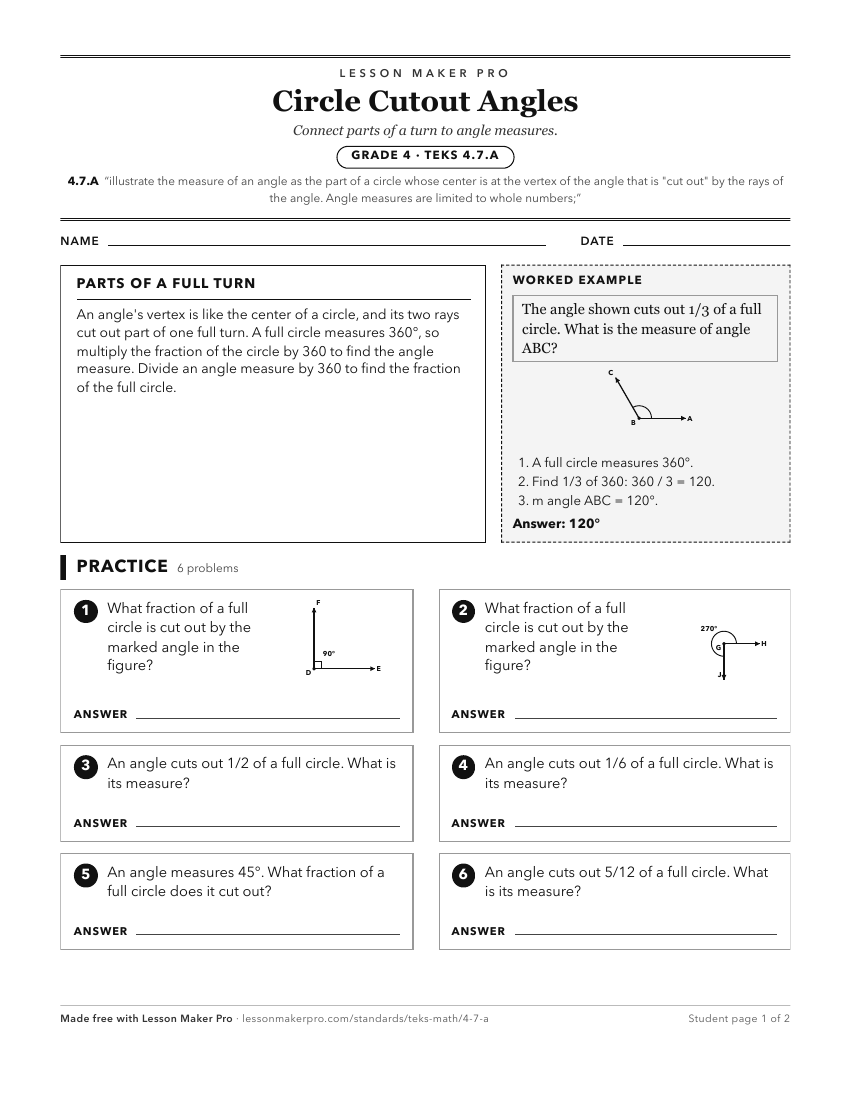
A ready-to-print activity worksheet aligned to 4.7.A, with an answer key for the teacher on its own page. No account needed.
PDF, US Letter, prints cleanly in black and white.
Download the worksheetKeep exploring
Related Standards
- 4.7.C
determine the approximate measures of angles in degrees to the nearest whole number using a protractor
- 4.7.D
draw an angle with a given measure
- 4.7.B
illustrate degrees as the units used to measure an angle, where 1/360 of any circle is one degree and an angle that "cuts" n/360 out of any circle whose center ...
- 4.7.E
determine the measure of an unknown angle formed by two non-overlapping adjacent angles given one or both angle measures
Turn this exact standard into a lesson
Grade, subject, topic, and the complete standard are prefilled. Create one free, no account needed.
Also for this standard:Make a WorksheetMake a QuizMake a Sub Lesson