TEKS Math 4.7.B
The Standard
illustrate degrees as the units used to measure an angle, where 1/360 of any circle is one degree and an angle that "cuts" n/360 out of any circle whose center is at the angle's vertex has a measure of n degrees. Angle measures are limited to whole numbers
Texas Essential Knowledge and Skills for Mathematics
Teacher's field guide
What This Standard Means
What Students Need to Do
- Students connect an angle’s opening to a turn around its vertex and measure that turn in whole-number degrees. They treat a full turn as 360 equal degree units and represent angles with circle diagrams.
What Mastery Looks Like
- A student can mark the part of a circle swept by an angle and state its measure. The student knows that circle size and ray length do not change the angle measure.
Common Misconceptions
- Students may judge an angle by ray length or arc length instead of the amount of turn. They may think a larger circle creates a larger angle, or confuse one-fourth of a turn with 45 degrees.
How to Assess It
- Exit ticket: Draw and label a 75-degree angle as part of a full circle. Explain why enlarging the circle would not change the angle measure.
Lesson moves
Ways to Teach It
Give students paper circles and split pins, then rotate two card strips to build and label 45°, 90°, 180°, and 270° angles.
Prompt: Why do two 90° angles stay equal when one is drawn inside a larger circle? Defend your answer with a sketch.
Play Angle Match with cards showing degree measures, circle fractions, and angle drawings; students collect sets of three equivalent cards.
Use clock hands to model turns from 12, then record each angle in degrees and as a fraction of a full turn.
Free download
Printable 4.7.B Worksheet
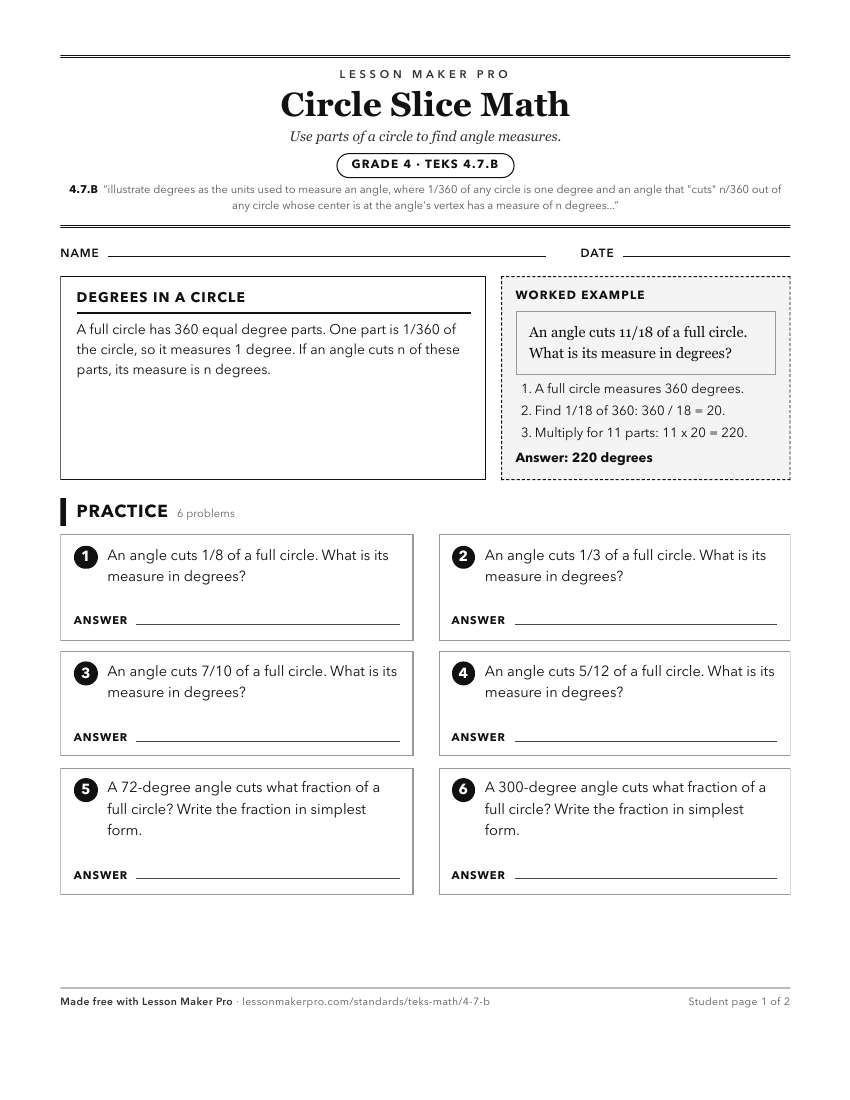
A ready-to-print activity worksheet aligned to 4.7.B, with an answer key for the teacher on its own page. No account needed.
PDF, US Letter, prints cleanly in black and white.
Download the worksheetKeep exploring
Related Standards
- 4.7.C
determine the approximate measures of angles in degrees to the nearest whole number using a protractor
- 4.7.D
draw an angle with a given measure
- 4.7.A
illustrate the measure of an angle as the part of a circle whose center is at the vertex of the angle that is "cut out" by the rays of the angle. Angle measures...
- 4.7.E
determine the measure of an unknown angle formed by two non-overlapping adjacent angles given one or both angle measures
Turn this exact standard into a lesson
Grade, subject, topic, and the complete standard are prefilled. Create one free, no account needed.
Also for this standard:Make a WorksheetMake a QuizMake a Sub Lesson