TEKS Math 4.7.C
The Standard
determine the approximate measures of angles in degrees to the nearest whole number using a protractor
Texas Essential Knowledge and Skills for Mathematics
Teacher's field guide
What This Standard Means
What Students Need to Do
- Students place a protractor so its center is on the angle’s vertex and one ray lines up with zero. They read the correct scale and report the measurement to the nearest degree.
What Mastery Looks Like
- Students align the center and baseline of a protractor correctly. They choose the correct scale, read the angle, and record a reasonable whole-degree measurement.
Common Misconceptions
- Students may place the protractor’s center away from the vertex or fail to line up one ray with zero. They may read the wrong scale or assume longer rays make larger angles.
How to Assess It
- Give students one acute and one obtuse angle. Ask them to measure each, record the nearest whole degree, and mark the scale they used.
Lesson moves
Ways to Teach It
Use two hinged craft sticks to make angles, trace them, then place a protractor and record each measurement to the nearest degree.
Show an angle with both scales visible, then ask, “Which reading is correct, and how do you know?”
Set up six angle cards around the room; pairs measure each, compare answers, and earn a point when readings differ by one degree or less.
Print photos of rooflines, ramps, and open doors; students trace one angle in each photo and measure it with a protractor.
Free download
Printable 4.7.C Worksheet
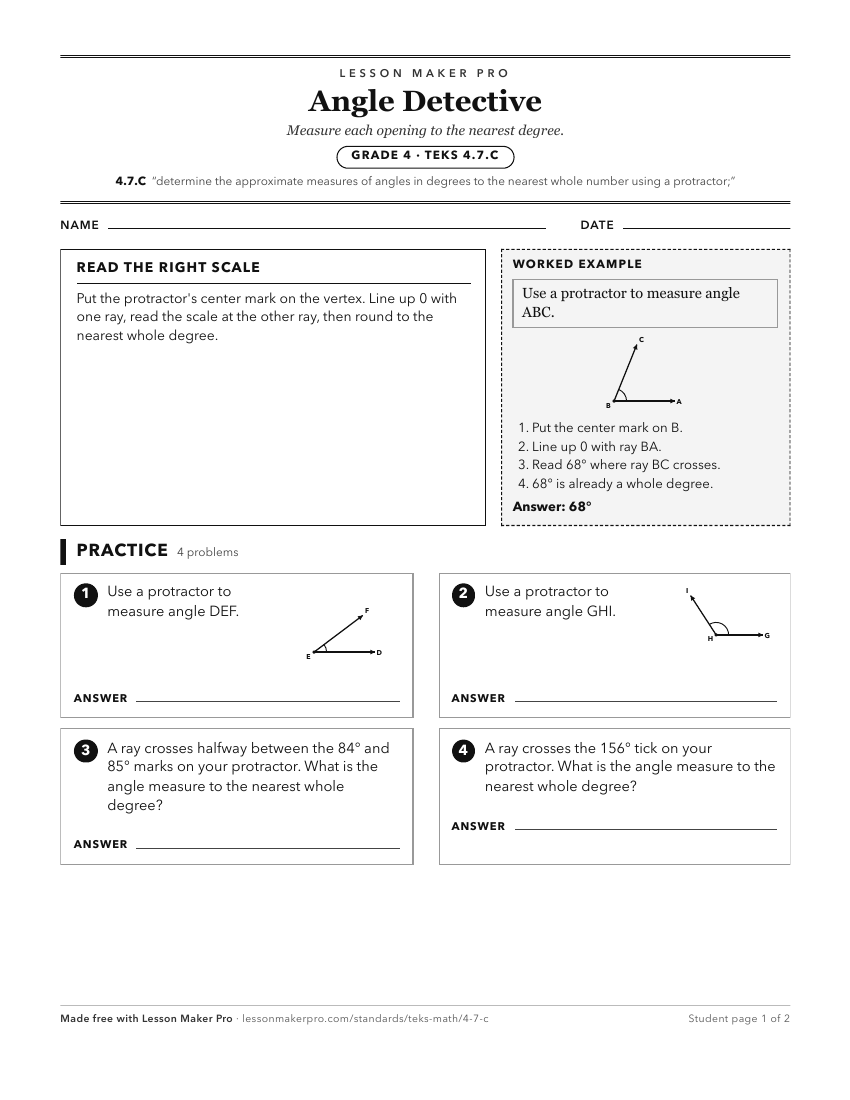
A ready-to-print activity worksheet aligned to 4.7.C, with an answer key for the teacher on its own page. No account needed.
PDF, US Letter, prints cleanly in black and white.
Download the worksheetKeep exploring
Related Standards
- 4.7.D
draw an angle with a given measure
- 4.7.A
illustrate the measure of an angle as the part of a circle whose center is at the vertex of the angle that is "cut out" by the rays of the angle. Angle measures...
- 4.7.B
illustrate degrees as the units used to measure an angle, where 1/360 of any circle is one degree and an angle that "cuts" n/360 out of any circle whose center ...
- 4.7.E
determine the measure of an unknown angle formed by two non-overlapping adjacent angles given one or both angle measures
Turn this exact standard into a lesson
Grade, subject, topic, and the complete standard are prefilled. Create one free, no account needed.
Also for this standard:Make a WorksheetMake a QuizMake a Sub Lesson