TEKS Math 3.6.B
The Standard
use attributes to recognize rhombuses, parallelograms, trapezoids, rectangles, and squares as examples of quadrilaterals and draw examples of quadrilaterals that do not belong to any of these subcategories
Texas Essential Knowledge and Skills for Mathematics
Teacher's field guide
What This Standard Means
What Students Need to Do
- Students examine side lengths, parallel sides, and right angles to classify four-sided figures. They also draw a four-sided figure that does not fit the named groups.
What Mastery Looks Like
- Students sort figures by number of equal sides, parallel sides, and right angles. They give a square several correct names and draw an irregular quadrilateral that lacks the listed subgroup attributes.
Common Misconceptions
- Students often classify shapes by appearance, position, or size instead of side and angle attributes. They may think a square is not a rectangle or that every four-sided figure fits a named subgroup.
How to Assess It
- Ask students to draw a square, rhombus, parallelogram, trapezoid, rectangle, and irregular quadrilateral. Have them label every name that fits each drawing and give one supporting attribute.
Lesson moves
Ways to Teach It
Give pairs geoboards and rubber bands; have them build each named shape, then an irregular quadrilateral, and record side and angle clues.
Ask, "Is every square a rectangle, and is every rectangle a square?" Students defend answers with side and angle attributes.
Play Attribute Sort with shape cards; students place each card under every matching label and earn a point for each correct reason.
Have students photograph or sketch tiles, windows, signs, and tabletops, then classify each outline and cite two visible attributes.
Free download
Printable 3.6.B Worksheet
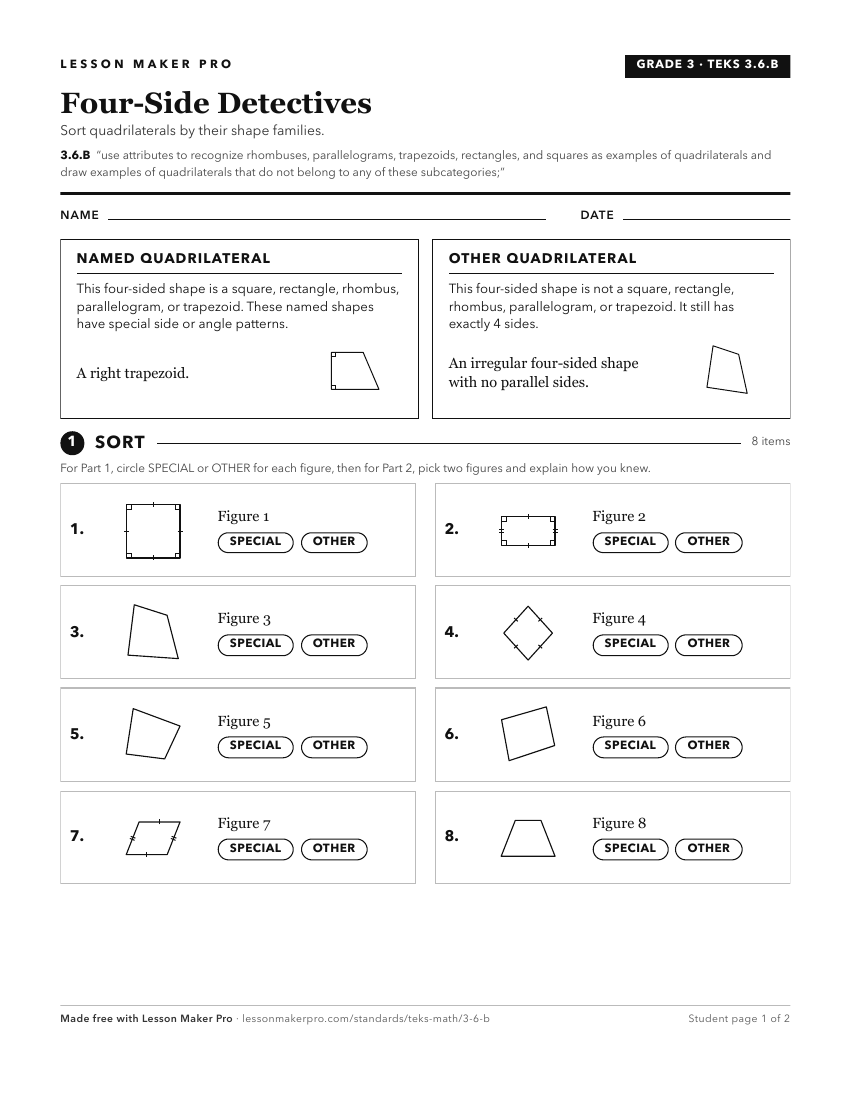
A ready-to-print activity worksheet aligned to 3.6.B, with an answer key for the teacher on its own page. No account needed.
PDF, US Letter, prints cleanly in black and white.
Download the worksheetKeep exploring
Related Standards
- K.6.A
identify two-dimensional shapes, including circles, triangles, rectangles, and squares as special rectangles
- 1.6.D
identify two-dimensional shapes, including circles, triangles, rectangles, and squares, as special rectangles, rhombuses, and hexagons and describe their attrib...
- 1.6.C
create two-dimensional figures, including circles, triangles, rectangles, and squares, as special rectangles, rhombuses, and hexagons
- 7.9.C
determine the area of composite figures containing combinations of rectangles, squares, parallelograms, trapezoids, triangles, semicircles, and quarter circles
Turn this exact standard into a lesson
Grade, subject, topic, and the complete standard are prefilled. Create one free, no account needed.
Also for this standard:Make a WorksheetMake a QuizMake a Sub Lesson