TEKS Math 7.9.C
The Standard
determine the area of composite figures containing combinations of rectangles, squares, parallelograms, trapezoids, triangles, semicircles, and quarter circles
Texas Essential Knowledge and Skills for Mathematics
Teacher's field guide
What This Standard Means
What Students Need to Do
- Students break an irregular figure into familiar shapes or enclose it in a larger shape and subtract missing parts. They calculate each area, then combine the results using square units.
What Mastery Looks Like
- A student can split a figure into familiar shapes without overlaps or gaps. The student selects the correct formulas, adds or subtracts areas as needed, and labels the answer in square units.
Common Misconceptions
- Students may add side lengths and find perimeter instead of area. They may use diameter as radius or forget to take half or one-fourth of a circle. They may also add a cutout that should be subtracted.
How to Assess It
- Give students a 10-by-6 rectangle with a semicircle of diameter 6 attached to one short side. Ask them to sketch the parts and find the total area using 3.14 for pi.
Lesson moves
Ways to Teach It
Give pairs paper composite figures to cut apart, label by shape, measure, and recombine before calculating the total area.
Ask students to explain which decomposition of the same composite figure is easiest and defend their choice with formulas.
Play a matching game where students pair composite figure cards with decomposition diagrams, area expressions, and numerical answers.
Have students calculate the material needed for a patio plan made from rectangles, trapezoids, and quarter-circle sections.
Free download
Printable 7.9.C Worksheet
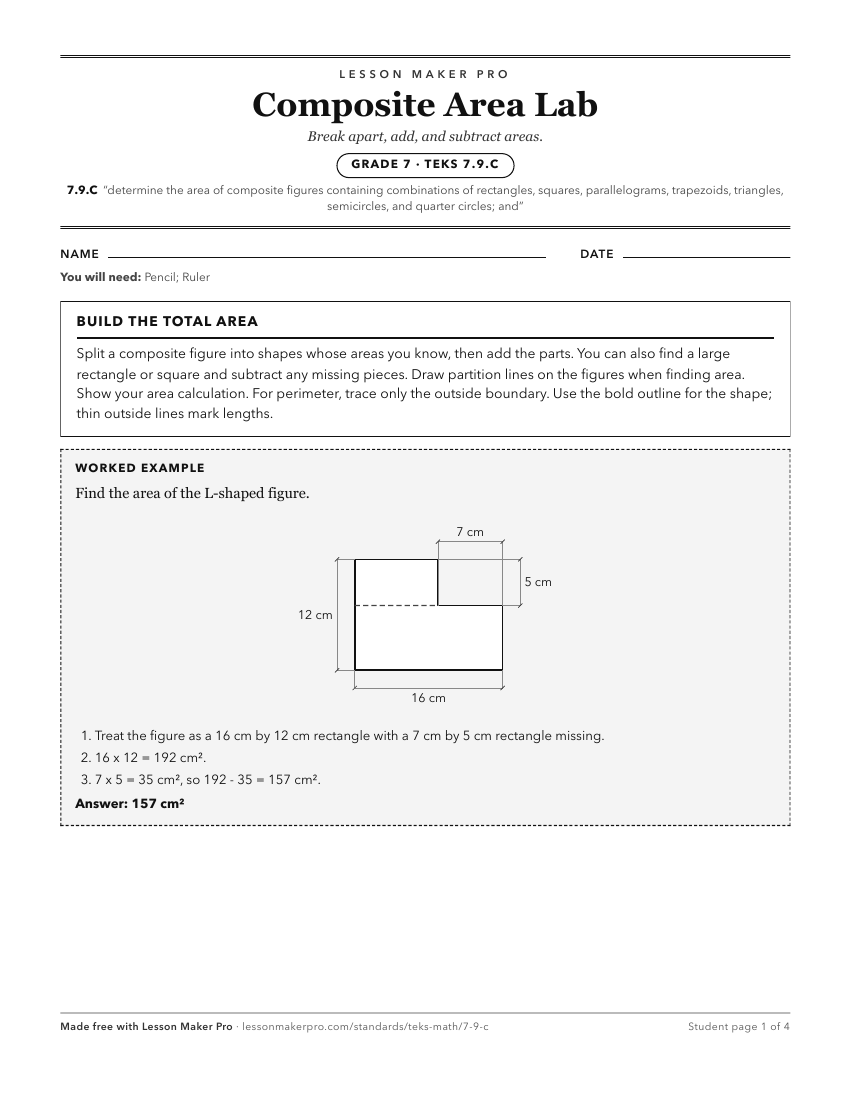
A ready-to-print activity worksheet aligned to 7.9.C, with an answer key for the teacher on its own page. No account needed.
PDF, US Letter, prints cleanly in black and white.
Download the worksheetKeep exploring
Related Standards
- 6.8.B
model area formulas for parallelograms, trapezoids, and triangles by decomposing and rearranging parts of these shapes
- 3.6.D
decompose composite figures formed by rectangles into non-overlapping rectangles to determine the area of the original figure using the additive property of are...
- 1.6.C
create two-dimensional figures, including circles, triangles, rectangles, and squares, as special rectangles, rhombuses, and hexagons
- 6.8.D
determine solutions for problems involving the area of rectangles, parallelograms, trapezoids, and triangles and volume of right rectangular prisms where dimens...
Turn this exact standard into a lesson
Grade, subject, topic, and the complete standard are prefilled. Create one free, no account needed.
Also for this standard:Make a WorksheetMake a QuizMake a Sub Lesson