TEKS Math 3.6.D
The Standard
decompose composite figures formed by rectangles into non-overlapping rectangles to determine the area of the original figure using the additive property of area
Texas Essential Knowledge and Skills for Mathematics
Teacher's field guide
What This Standard Means
What Students Need to Do
- Students split an irregular figure made from rectangles into smaller, non-overlapping rectangles. They find each rectangle’s area, then add the areas to find the total.
What Mastery Looks Like
- Students draw a valid partition with no gaps or overlaps. They find each rectangle’s area and add the areas correctly, even when another partition is possible.
Common Misconceptions
- Students may add side lengths instead of finding area. They may create overlapping rectangles, leave gaps, or use incorrect side lengths for hidden dimensions.
How to Assess It
- Give students an L-shaped figure with outer dimensions 8 by 6 units and a 5 by 3 corner missing. Ask them to partition it, label each rectangle, and write an area equation.
Lesson moves
Ways to Teach It
Build an L-shape with square tiles, outline two rectangles within it, and calculate each rectangle’s area.
Show two different partitions of one figure and ask, “Why do both area sums give the same total?”
Match cards showing composite figures, valid rectangle partitions, and area equations.
Use a labeled L-shaped patio plan and have students calculate how many square feet of paving material it needs.
Free download
Printable 3.6.D Worksheet
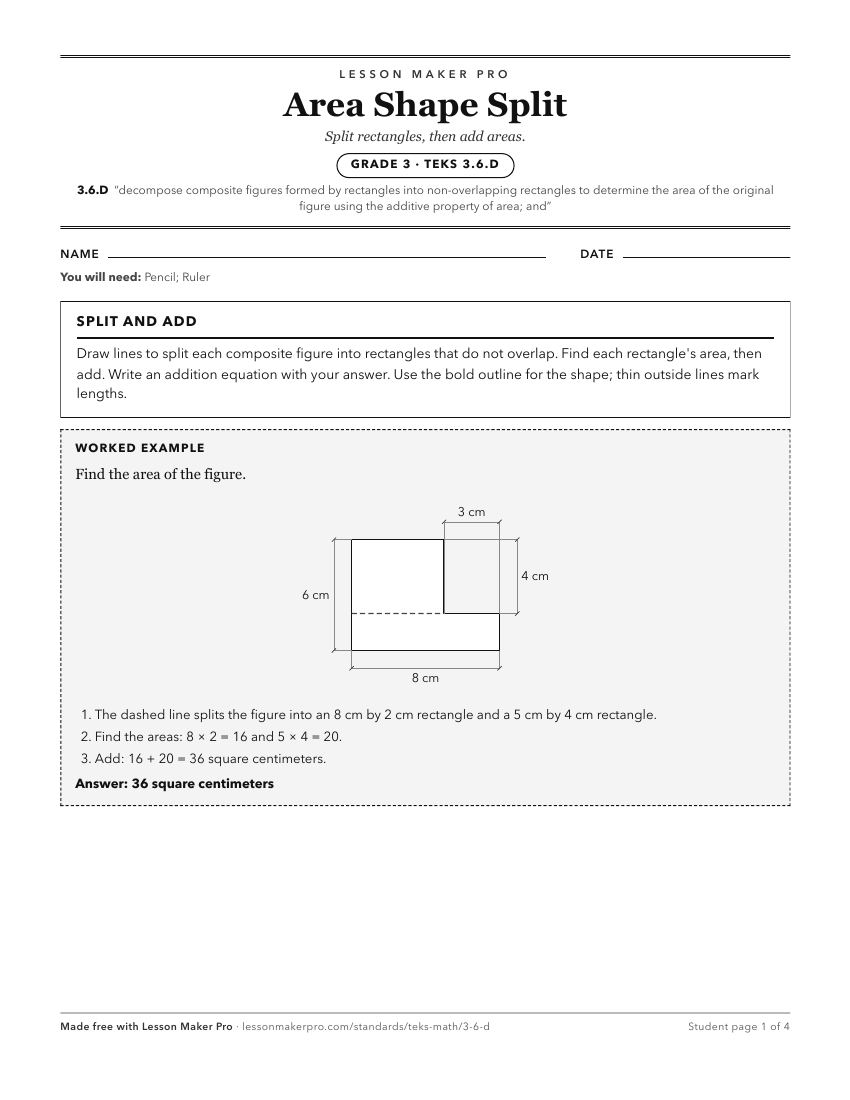
A ready-to-print activity worksheet aligned to 3.6.D, with an answer key for the teacher on its own page. No account needed.
PDF, US Letter, prints cleanly in black and white.
Download the worksheetKeep exploring
Related Standards
- 6.8.B
model area formulas for parallelograms, trapezoids, and triangles by decomposing and rearranging parts of these shapes
- 2.8.E
decompose two-dimensional shapes such as cutting out a square from a rectangle, dividing a shape in half, or partitioning a rectangle into identical triangles a...
- 3.6.E
decompose two congruent two-dimensional figures into parts with equal areas and express the area of each part as a unit fraction of the whole and recognize that...
- 7.9.C
determine the area of composite figures containing combinations of rectangles, squares, parallelograms, trapezoids, triangles, semicircles, and quarter circles
Turn this exact standard into a lesson
Grade, subject, topic, and the complete standard are prefilled. Create one free, no account needed.
Also for this standard:Make a WorksheetMake a QuizMake a Sub Lesson