TEKS Math 6.8.B
The Standard
model area formulas for parallelograms, trapezoids, and triangles by decomposing and rearranging parts of these shapes
Texas Essential Knowledge and Skills for Mathematics
Teacher's field guide
What This Standard Means
What Students Need to Do
- Students cut or split shapes and move the pieces to make rectangles or parallelograms. They use the new figure to explain each area formula and identify the correct base and perpendicular height.
What Mastery Looks Like
- Students can label the needed lengths, rearrange a shape, and connect the new figure to a familiar area formula. They can explain why the area stays the same when pieces move without overlapping or leaving gaps.
Common Misconceptions
- Students may use a slanted side as the height instead of the perpendicular distance. They may forget to halve a triangle or average a trapezoid’s two bases. Some think cutting and moving pieces changes the area.
How to Assess It
- Give students a trapezoid with bases 5 and 9 units and height 4 units. Ask them to sketch a rearrangement and write an equation proving its area is 28 square units.
Lesson moves
Ways to Teach It
Give pairs paper parallelograms, triangles, and trapezoids to cut, rearrange, tape, and label as rectangles or larger parallelograms.
Ask students to explain in writing why a triangle with base 8 and height 5 has half the area of its matching parallelogram.
Play a card match with shape diagrams, rearranged models, dimensions, and area equations, then have students defend each set.
Measure a triangular or trapezoidal garden plan, sketch a rearrangement, and calculate the soil coverage needed in square feet.
Free download
Printable 6.8.B Worksheet
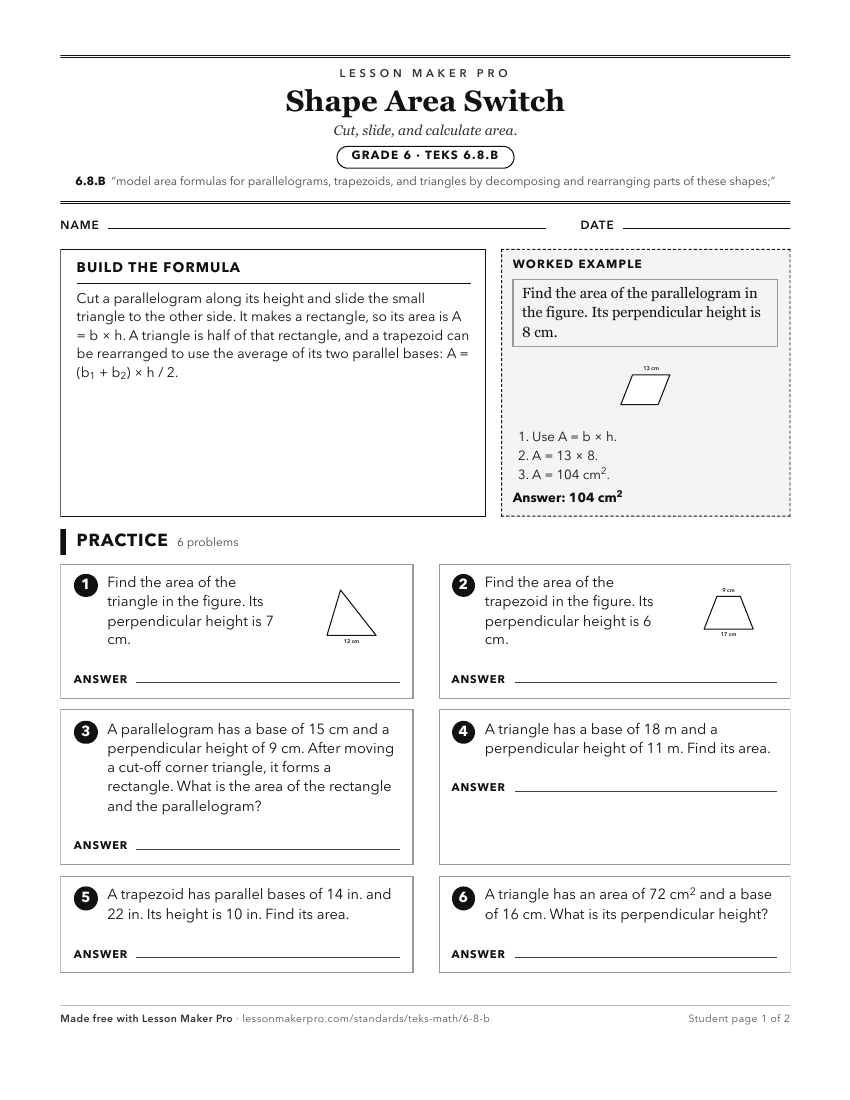
A ready-to-print activity worksheet aligned to 6.8.B, with an answer key for the teacher on its own page. No account needed.
PDF, US Letter, prints cleanly in black and white.
Download the worksheetKeep exploring
Related Standards
- 6.8.C
write equations that represent problems related to the area of rectangles, parallelograms, trapezoids, and triangles and volume of right rectangular prisms wher...
- 2.8.E
decompose two-dimensional shapes such as cutting out a square from a rectangle, dividing a shape in half, or partitioning a rectangle into identical triangles a...
- 7.9.C
determine the area of composite figures containing combinations of rectangles, squares, parallelograms, trapezoids, triangles, semicircles, and quarter circles
- 6.8.D
determine solutions for problems involving the area of rectangles, parallelograms, trapezoids, and triangles and volume of right rectangular prisms where dimens...
Turn this exact standard into a lesson
Grade, subject, topic, and the complete standard are prefilled. Create one free, no account needed.
Also for this standard:Make a WorksheetMake a QuizMake a Sub Lesson