TEKS Math 6.8.D
The Standard
determine solutions for problems involving the area of rectangles, parallelograms, trapezoids, and triangles and volume of right rectangular prisms where dimensions are positive rational numbers
Texas Essential Knowledge and Skills for Mathematics
Teacher's field guide
What This Standard Means
What Students Need to Do
- Students choose an area or volume formula that matches the figure. They identify perpendicular measurements, substitute fractions or decimals, calculate, and label answers with square or cubic units.
What Mastery Looks Like
- Students select the correct formula from a diagram or word problem and identify the needed measurements. They calculate accurately with fractions or decimals, show their work, and use square or cubic units.
Common Misconceptions
- Students may use a slanted side instead of the perpendicular height. They may forget the one-half factor for triangles or mishandle the two bases of a trapezoid. They also confuse square and cubic units or make errors with fractions and decimals.
How to Assess It
- Give this exit ticket: A trapezoid has bases 4.5 cm and 7.5 cm and height 3 cm. A box measures 2.5 cm by 4 cm by 1.2 cm. Find the trapezoid's area and the box's volume, with correct units.
Lesson moves
Ways to Teach It
Give students cardstock parallelograms and trapezoids, rulers marked in quarter inches, and scissors; have them rearrange pieces into rectangles and calculate area.
Ask, "Why must height be perpendicular to the base?" Students draw and label one example and one nonexample.
Run a formula match relay with shape cards, dimension cards using fractions and decimals, formula cards, and answer cards.
Have students use a floor plan to compare flooring for rectangular and trapezoidal rooms, then calculate a decimal-dimension shipping box's volume.
Free download
Printable 6.8.D Worksheet
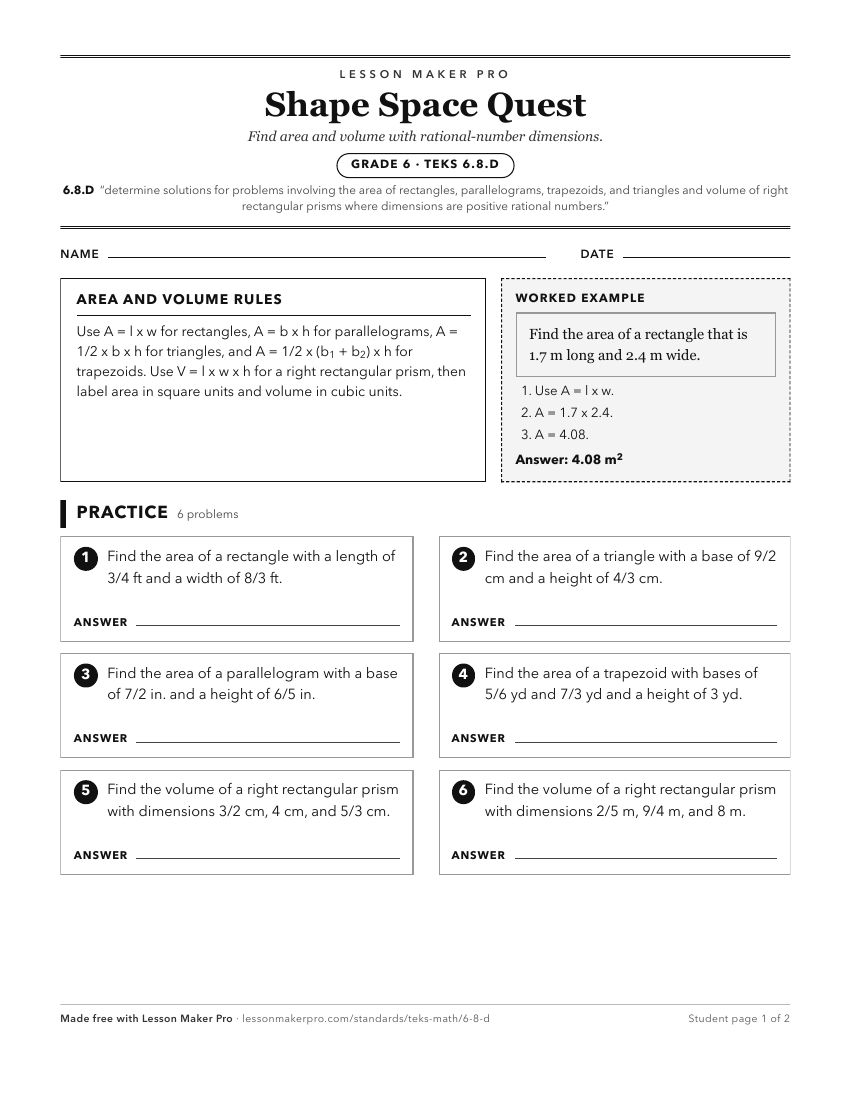
A ready-to-print activity worksheet aligned to 6.8.D, with an answer key for the teacher on its own page. No account needed.
PDF, US Letter, prints cleanly in black and white.
Download the worksheetKeep exploring
Related Standards
- 6.8.C
write equations that represent problems related to the area of rectangles, parallelograms, trapezoids, and triangles and volume of right rectangular prisms wher...
- 8.7.A
solve problems involving the volume of cylinders, cones, and spheres
- 7.9.A
solve problems involving the volume of rectangular prisms, triangular prisms, rectangular pyramids, and triangular pyramids
- 7.9.D
solve problems involving the lateral and total surface area of a rectangular prism, rectangular pyramid, triangular prism, and triangular pyramid by determining...
Turn this exact standard into a lesson
Grade, subject, topic, and the complete standard are prefilled. Create one free, no account needed.
Also for this standard:Make a WorksheetMake a QuizMake a Sub Lesson