TEKS Math 7.9.D
The Standard
solve problems involving the lateral and total surface area of a rectangular prism, rectangular pyramid, triangular prism, and triangular pyramid by determining the area of the shape's net
Texas Essential Knowledge and Skills for Mathematics
Teacher's field guide
What This Standard Means
What Students Need to Do
- Students break a prism or pyramid net into rectangles and triangles, then find each face's area. They add the correct faces to find lateral or total surface area and report square units.
What Mastery Looks Like
- Students label every face on a net and calculate each area with the correct dimensions. They add only lateral faces for lateral area and all faces for total surface area, with square units.
Common Misconceptions
- Students may include the bases when finding lateral area or leave them out when finding total area. They may use slant height as a base edge, overlook a face, or count a shared edge as a face.
How to Assess It
- Give a triangular prism net with triangles of base 6 cm and height 4 cm, plus rectangles measuring 5 by 8, 5 by 8, and 6 by 8. Ask students to label each face, then find the lateral area and total surface area.
Lesson moves
Ways to Teach It
Cut and fold cardstock nets, color the bases blue and lateral faces yellow, then calculate each colored region's area.
Show two different nets for the same solid and ask, "Why must their total surface areas be equal?"
Play a card match game pairing solid diagrams, labeled nets, face-area calculations, and correct lateral and total areas.
Give dimensions for a cereal box or tent and ask students to calculate the material needed with and without the base.
Free download
Printable 7.9.D Worksheet
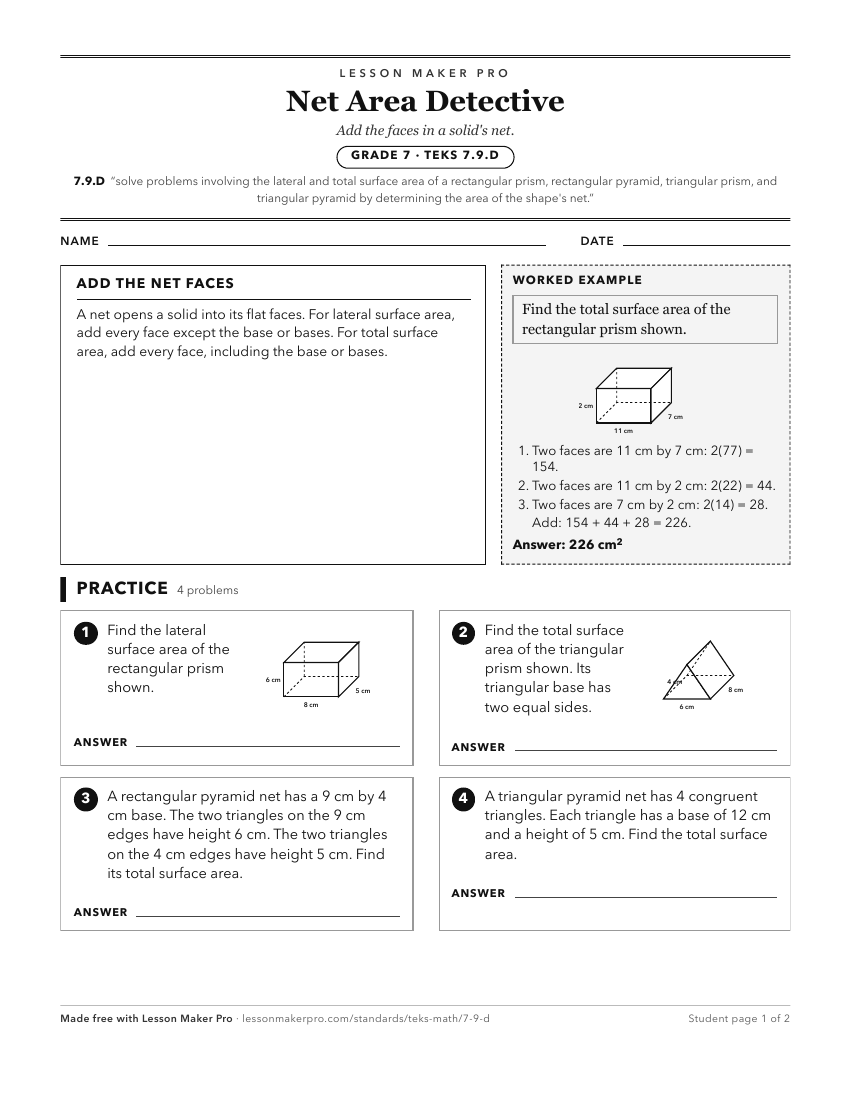
A ready-to-print activity worksheet aligned to 7.9.D, with an answer key for the teacher on its own page. No account needed.
PDF, US Letter, prints cleanly in black and white.
Download the worksheetKeep exploring
Related Standards
- 6.8.C
write equations that represent problems related to the area of rectangles, parallelograms, trapezoids, and triangles and volume of right rectangular prisms wher...
- 8.7.B
use previous knowledge of surface area to make connections to the formulas for lateral and total surface area and determine solutions for problems involving rec...
- 7.9.A
solve problems involving the volume of rectangular prisms, triangular prisms, rectangular pyramids, and triangular pyramids
- 6.8.D
determine solutions for problems involving the area of rectangles, parallelograms, trapezoids, and triangles and volume of right rectangular prisms where dimens...
Turn this exact standard into a lesson
Grade, subject, topic, and the complete standard are prefilled. Create one free, no account needed.
Also for this standard:Make a WorksheetMake a QuizMake a Sub Lesson