TEKS Math 7.9
Knowledge and Skills Statement (Standard Cluster)
The student applies mathematical process standards to solve geometric problems
Texas Essential Knowledge and Skills for Mathematics
Cluster contents
Student Expectations in This Statement
7.9 is a knowledge and skills statement. These are the student expectations under it.
- 7.9.A
solve problems involving the volume of rectangular prisms, triangular prisms, rectangular pyramids, and triangular pyramids
- 7.9.B
determine the circumference and area of circles
- 7.9.C
determine the area of composite figures containing combinations of rectangles, squares, parallelograms, trapezoids, triangles, semicircles, and quarter circles
- 7.9.D
solve problems involving the lateral and total surface area of a rectangular prism, rectangular pyramid, triangular prism, and triangular pyramid by determining...
Teacher's field guide
What This Cluster Means
What Students Need to Do
- Students calculate volume for prisms and pyramids, circle circumference and area, and area for figures built from several shapes. They use a solid's net to find lateral and total surface area. They select the right measurements, combine or subtract parts, and label units correctly.
What Mastery Looks Like
- Students identify needed measurements, choose the correct formula, and show substitutions clearly. They split composite figures into familiar parts and use nets to count each exposed face once. Their answers have reasonable values and correct linear, square, or cubic units.
Common Misconceptions
- Students often use diameter as radius, mix up circumference and area formulas, or report square units for circumference. They may forget the one-third factor for pyramid volume or use a slanted edge instead of perpendicular height. In composite figures and nets, they may double-count regions, omit bases from total surface area, or include bases in lateral area.
How to Assess It
- Give an exit ticket with four labeled diagrams: a triangular pyramid, a circle, a rectangle joined to a semicircle, and a rectangular prism net. Ask students to find the requested volume, circle measures, composite area, and total surface area, with units.
Lesson moves
Ways to Teach It
Cut and fold grid-paper nets for a prism and pyramid, then label faces and calculate lateral area, total area, and volume.
Ask students to explain which dimensions matter in each formula and why a pyramid has one-third the volume of a matching prism.
Run a card match with solid diagrams, nets, formulas, dimensions, and answers, requiring partners to justify every completed set.
Give a package design with a circular window, and ask students to calculate cardboard area, window area, and interior volume.
Free download
Printable 7.9 Worksheet
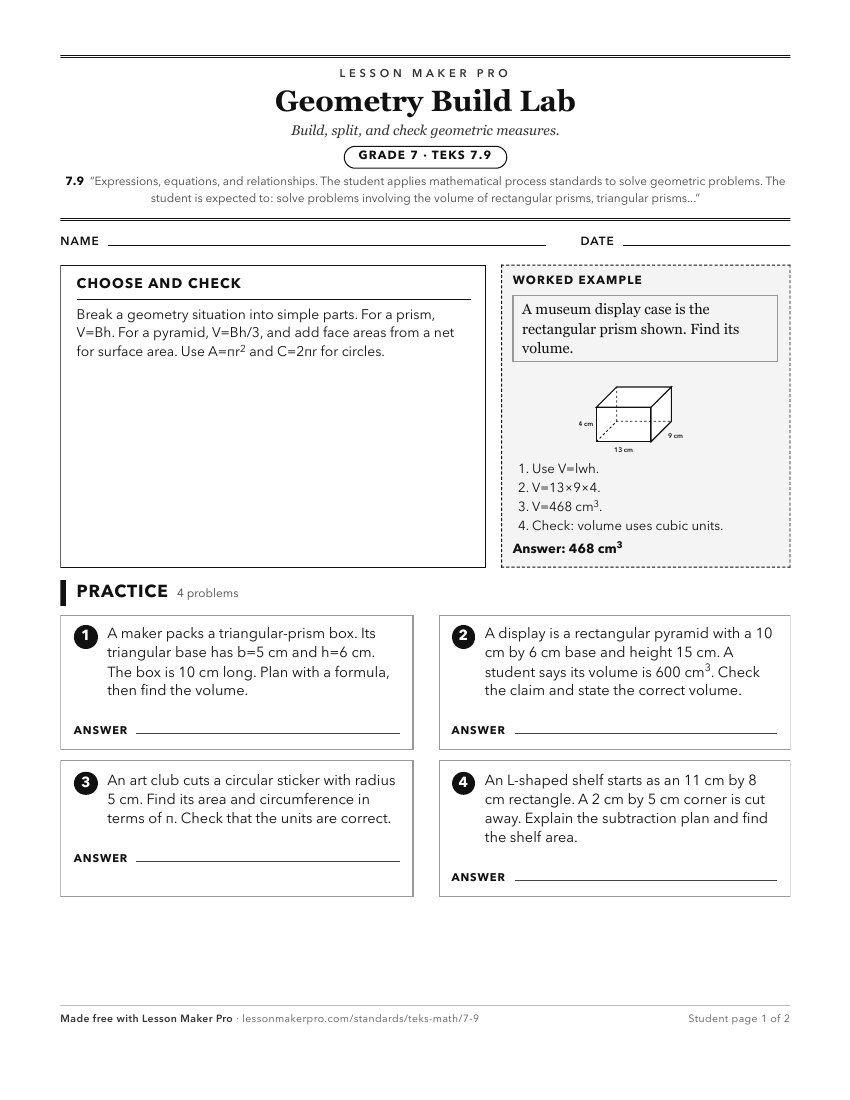
A ready-to-print activity worksheet aligned to 7.9, with an answer key for the teacher on its own page. No account needed.
PDF, US Letter, prints cleanly in black and white.
Download the worksheetKeep exploring
Related Standards
- 8.6
The student applies mathematical process standards to develop mathematical relationships and make connections to geometric formulas
- 8.7
The student applies mathematical process standards to use geometry to solve problems
- 8.10
The student applies mathematical process standards to develop transformational geometry concepts
- 6.8
The student applies mathematical process standards to use geometry to represent relationships and solve problems
Turn this cluster into a lesson
Grade, subject, topic, and the complete cluster are prefilled. Create one free, no account needed.
Also for this cluster:Make a WorksheetMake a QuizMake a Sub Lesson