TEKS Math 8.7
Knowledge and Skills Statement (Standard Cluster)
The student applies mathematical process standards to use geometry to solve problems
Texas Essential Knowledge and Skills for Mathematics
Cluster contents
Student Expectations in This Statement
8.7 is a knowledge and skills statement. These are the student expectations under it.
- 8.7.A
solve problems involving the volume of cylinders, cones, and spheres
- 8.7.B
use previous knowledge of surface area to make connections to the formulas for lateral and total surface area and determine solutions for problems involving rec...
- 8.7.C
use the Pythagorean Theorem and its converse to solve problems
- 8.7.D
determine the distance between two points on a coordinate plane using the Pythagorean Theorem
Teacher's field guide
What This Cluster Means
What Students Need to Do
- Students calculate capacity and covering material for common three-dimensional shapes. They connect surface area formulas to bases and side faces. They use right triangles to find missing lengths, test side lengths, and measure distance on a coordinate grid.
What Mastery Looks Like
- Students select the correct formula from a diagram or context, substitute accurately, and label square or cubic units. They explain how bases and lateral faces form surface area formulas. They test right triangles and find exact or approximate distances on coordinate grids.
Common Misconceptions
- Students often confuse radius with diameter, omit one base, or use square units for volume and cubic units for area. They may use the Pythagorean Theorem without identifying the hypotenuse or think its converse finds a missing side. On coordinate grids, they may add horizontal and vertical changes instead of treating them as perpendicular legs.
How to Assess It
- Use a four-item exit ticket: find a cone’s volume for r = 3 and h = 8, find a closed cylinder’s surface area for r = 2 and h = 5, test whether side lengths 6, 8, and 10 form a right triangle, and find the distance from (1, 2) to (7, 10).
Lesson moves
Ways to Teach It
Have pairs wrap and fill paper models of a cylinder, cone, and prism, then connect each measured part to its formula.
Ask students to explain why a cone with the same base and height as a cylinder has one-third the volume.
Run a card sort matching diagrams, dimensions, formulas, and units, including right-triangle tests and coordinate-plane distance problems.
Have students compare two food packages by capacity and material used, then defend which package is more efficient.
Free download
Printable 8.7 Worksheet
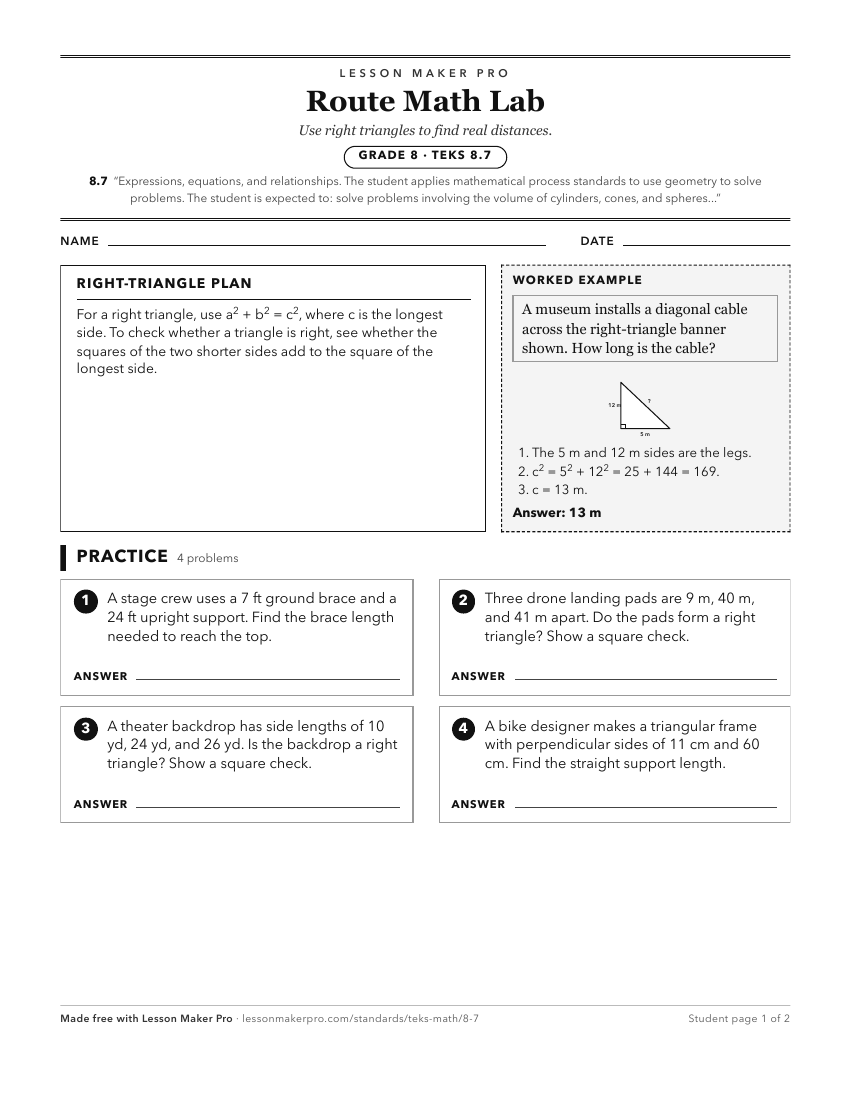
A ready-to-print activity worksheet aligned to 8.7, with an answer key for the teacher on its own page. No account needed.
PDF, US Letter, prints cleanly in black and white.
Download the worksheetKeep exploring
Related Standards
- 8.6
The student applies mathematical process standards to develop mathematical relationships and make connections to geometric formulas
- 7.5
The student applies mathematical process standards to use geometry to describe or solve problems involving proportional relationships
- 7.9
The student applies mathematical process standards to solve geometric problems
- 6.8
The student applies mathematical process standards to use geometry to represent relationships and solve problems
Turn this cluster into a lesson
Grade, subject, topic, and the complete cluster are prefilled. Create one free, no account needed.
Also for this cluster:Make a WorksheetMake a QuizMake a Sub Lesson