TEKS Math 7.5
Knowledge and Skills Statement (Standard Cluster)
The student applies mathematical process standards to use geometry to describe or solve problems involving proportional relationships
Texas Essential Knowledge and Skills for Mathematics
Cluster contents
Student Expectations in This Statement
7.5 is a knowledge and skills statement. These are the student expectations under it.
Teacher's field guide
What This Cluster Means
What Students Need to Do
- Students decide whether shapes are similar by matching equal angles and proportional corresponding sides. They use ratios and scale factors to find missing lengths and solve scale drawing problems. They explain π as the constant result of circumference divided by diameter.
What Mastery Looks Like
- Given two figures, students match corresponding parts, verify equal angles, and use a single scale factor to find missing lengths. They solve scale drawing problems with correct units. They also use circumference and diameter measurements to explain why their ratio is always close to π.
Common Misconceptions
- Students may compare unmatched sides or use additive differences instead of one scale factor. They may think similar figures must have the same size or orientation. They may treat π as a formula instead of the constant value of circumference divided by diameter.
How to Assess It
- Exit ticket: A floor plan uses 1 cm for 4 m and shows a 3 cm by 5 cm room; find the actual dimensions. Then find the circumference of a circular table with diameter 2 m and explain what π represents.
Lesson moves
Ways to Teach It
Students measure circular lids with string and rulers, then calculate circumference divided by diameter and compare class results.
Have pairs answer, “How can you prove two rotated figures are scaled copies using angles and matching side ratios?”
Play a card-matching game linking figure pairs, scale factors, missing side lengths, and completed calculations.
Give students a classroom floor plan scaled at 1 cm to 0.5 m and ask whether a chosen table fits.
Free download
Printable 7.5 Worksheet
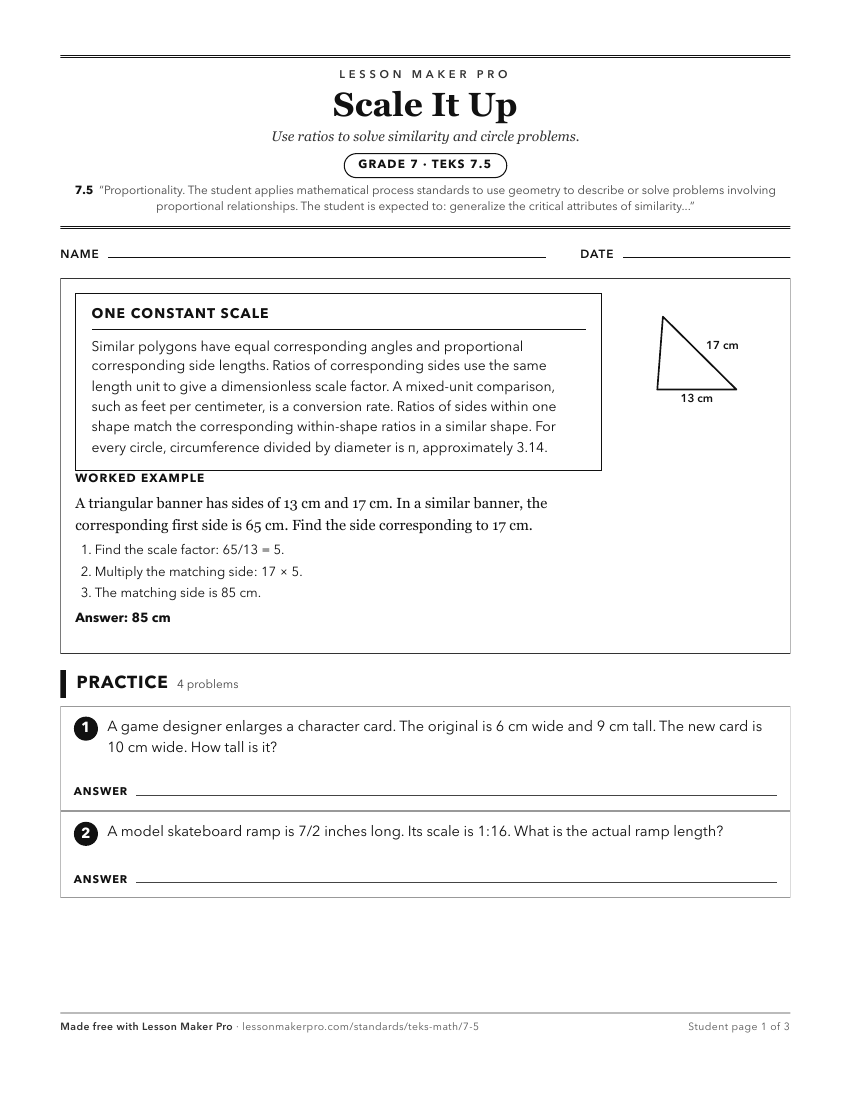
A ready-to-print activity worksheet aligned to 7.5, with an answer key for the teacher on its own page. No account needed.
PDF, US Letter, prints cleanly in black and white.
Download the worksheetKeep exploring
Related Standards
- 7.4
The student applies mathematical process standards to represent and solve problems involving proportional relationships
- 6.5
The student applies mathematical process standards to solve problems involving proportional relationships
- 6.4
The student applies mathematical process standards to develop an understanding of proportional relationships in problem situations
- 6.8
The student applies mathematical process standards to use geometry to represent relationships and solve problems
Turn this cluster into a lesson
Grade, subject, topic, and the complete cluster are prefilled. Create one free, no account needed.
Also for this cluster:Make a WorksheetMake a QuizMake a Sub Lesson