TEKS Math 7.5.C
The Standard
solve mathematical and real-world problems involving similar shape and scale drawings
Texas Essential Knowledge and Skills for Mathematics
Teacher's field guide
What This Standard Means
What Students Need to Do
- Students identify corresponding sides and determine the scale factor between two similar figures. They use a proportion or multiplicative equation to find missing lengths in diagrams, maps, blueprints, and models. They label answers with correct units and check that the result is reasonable.
What Mastery Looks Like
- A student can organize corresponding measurements, choose the correct scale ratio, and solve for an unknown length. The student can explain whether to enlarge or reduce and verify that all corresponding side ratios agree. Answers include correct units and fit the context.
Common Misconceptions
- Students may add the same amount to each side instead of multiplying by one scale factor. They may reverse the scale ratio, match noncorresponding sides, or mix units in a proportion. Some assume shapes are similar because they look alike, even when side lengths are not proportional.
How to Assess It
- Exit ticket: A blueprint uses 1 cm for 4 m. A wall measures 7.5 cm on the drawing. Find its actual length and show a proportion or scale factor equation.
Lesson moves
Ways to Teach It
Give pairs grid paper and a simple polygon, then have them create a 3:2 enlargement and verify each corresponding side.
Have students explain why every corresponding side must use the same scale factor, then show what fails when one side does not.
Run a matching game where students pair scale drawings, scale factors, proportions, and missing side lengths.
Use a classroom floor plan with a stated scale, then ask students to find actual wall lengths and decide where a 6-foot table fits.
Free download
Printable 7.5.C Worksheet
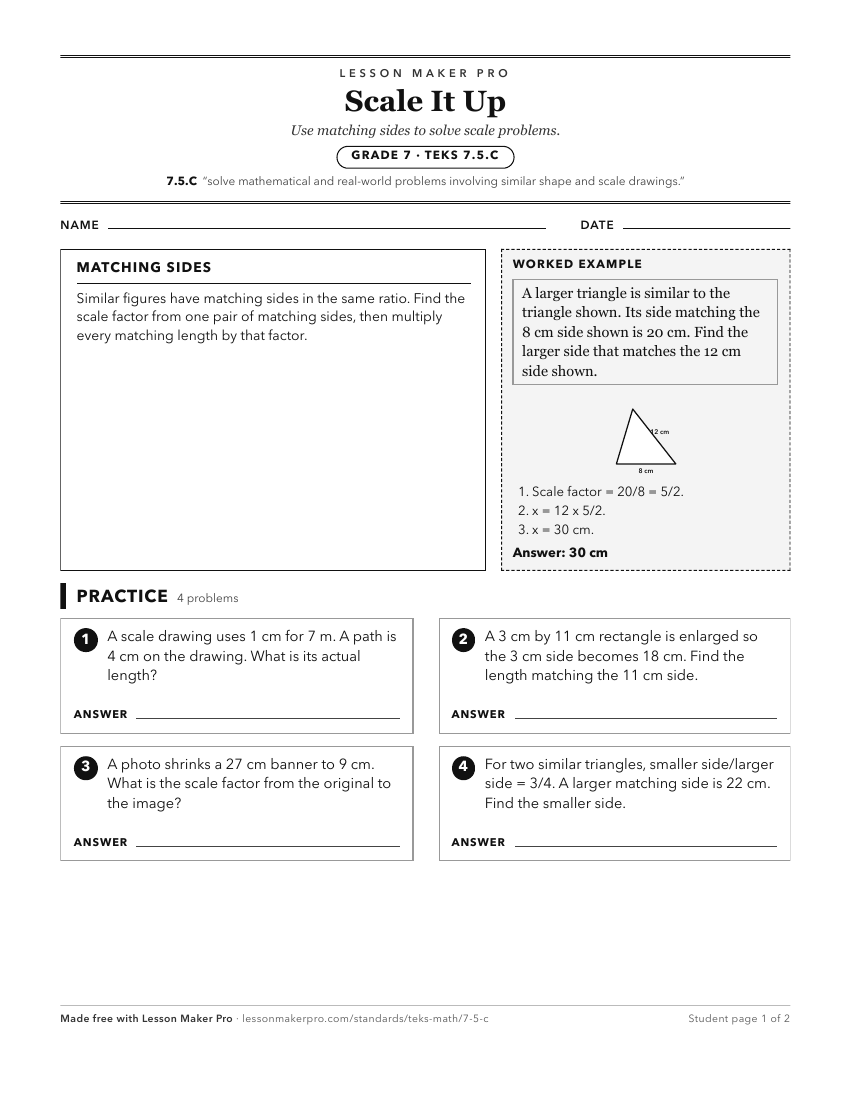
A ready-to-print activity worksheet aligned to 7.5.C, with an answer key for the teacher on its own page. No account needed.
PDF, US Letter, prints cleanly in black and white.
Download the worksheetKeep exploring
Related Standards
- K.6.F
create two-dimensional shapes using a variety of materials and drawings
- 7.5.A
generalize the critical attributes of similarity, including ratios within and between similar shapes
- 6.5.A
represent mathematical and real-world problems involving ratios and rates using scale factors, tables, graphs, and proportions
- 8.5.H
identify examples of proportional and non-proportional functions that arise from mathematical and real-world problems
Turn this exact standard into a lesson
Grade, subject, topic, and the complete standard are prefilled. Create one free, no account needed.
Also for this standard:Make a WorksheetMake a QuizMake a Sub Lesson