TEKS Math 6.5
Knowledge and Skills Statement (Standard Cluster)
The student applies mathematical process standards to solve problems involving proportional relationships
Texas Essential Knowledge and Skills for Mathematics
Cluster contents
Student Expectations in This Statement
6.5 is a knowledge and skills statement. These are the student expectations under it.
- 6.5.A
represent mathematical and real-world problems involving ratios and rates using scale factors, tables, graphs, and proportions
- 6.5.B
solve real-world problems to find the whole given a part and the percent, to find the part given the whole and the percent, and to find the percent given the pa...
- 6.5.C
use equivalent fractions, decimals, and percents to show equal parts of the same whole
Teacher's field guide
What This Cluster Means
What Students Need to Do
- Students represent ratio and rate situations with scale factors, tables, graphs, and proportions. They solve for a missing part, whole, or percent using numbers, drawings, or models. They show the same amount as a fraction, decimal, and percent.
What Mastery Looks Like
- Students choose a table, graph, scale factor, or proportion and use it correctly. They find a missing part, whole, or percent and label the answer. They move accurately among equivalent fractions, decimals, and percents.
Common Misconceptions
- Students may add the same amount in ratio tables instead of multiplying by a scale factor. They may divide the whole by the part or treat 25% as 25. They may not recognize that 1/4, 0.25, and 25% name the same amount.
How to Assess It
- Exit ticket: 18 is 30% of what number? Solve with a proportion, then write 30% as a decimal and a fraction.
Lesson moves
Ways to Teach It
Build a 40-tile model showing 30%, then record the amount as a fraction, decimal, and percent.
Ask students to explain whether finding 20% of 80 and finding the whole when 16 is 20% require the same operation.
Match cards showing equivalent ratio tables, graphs, proportions, fractions, decimals, and percents, then justify each match to a partner.
Compare two grocery prices by finding unit rates, then calculate a 15% discount on the better buy.
Free download
Printable 6.5 Worksheet
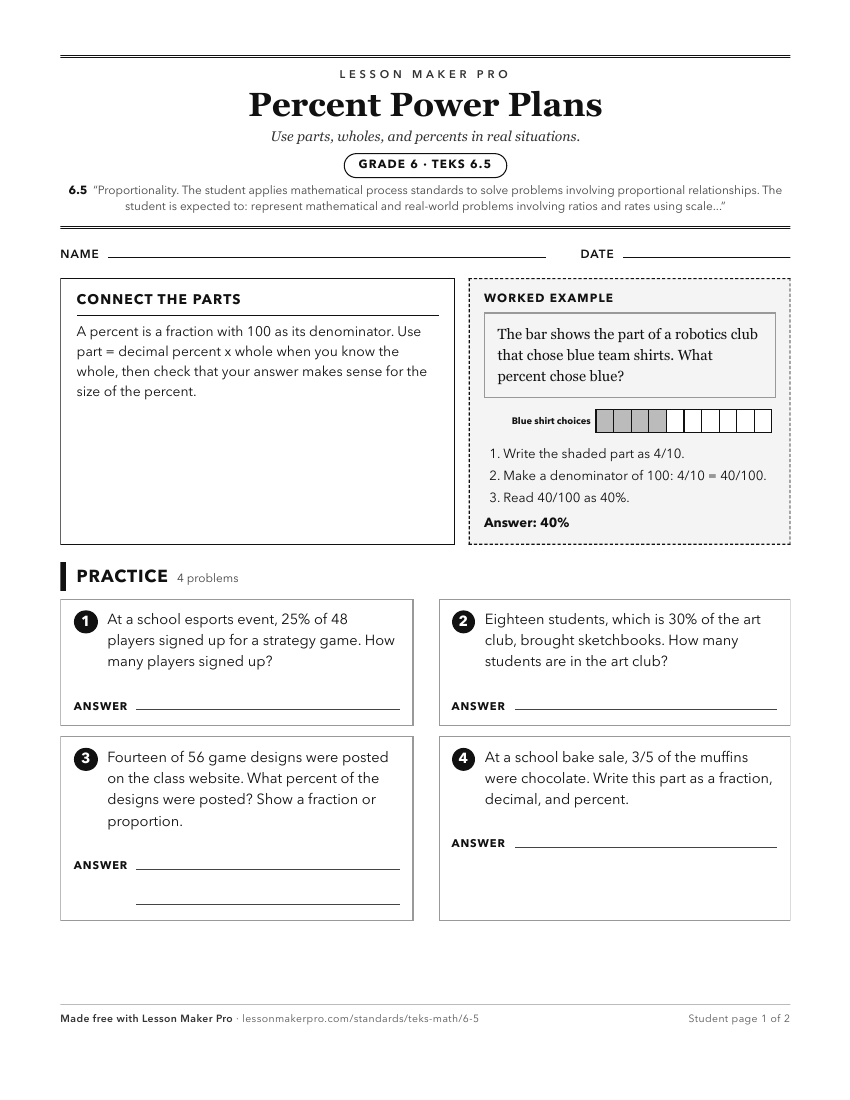
A ready-to-print activity worksheet aligned to 6.5, with an answer key for the teacher on its own page. No account needed.
PDF, US Letter, prints cleanly in black and white.
Download the worksheetKeep exploring
Related Standards
- 7.4
The student applies mathematical process standards to represent and solve problems involving proportional relationships
- 7.5
The student applies mathematical process standards to use geometry to describe or solve problems involving proportional relationships
- 6.4
The student applies mathematical process standards to develop an understanding of proportional relationships in problem situations
- 7.6
The student applies mathematical process standards to use probability and statistics to describe or solve problems involving proportional relationships
Turn this cluster into a lesson
Grade, subject, topic, and the complete cluster are prefilled. Create one free, no account needed.
Also for this cluster:Make a WorksheetMake a QuizMake a Sub Lesson