TEKS Math 6.5.B
The Standard
solve real-world problems to find the whole given a part and the percent, to find the part given the whole and the percent, and to find the percent given the part and the whole, including the use of concrete and pictorial models
Texas Essential Knowledge and Skills for Mathematics
Teacher's field guide
What This Standard Means
What Students Need to Do
- Students identify whether the missing quantity is the whole amount, the part, or the percent. They use counters, 100-grids, tape diagrams, or equations to calculate and label the unknown.
What Mastery Looks Like
- Students correctly identify the part, whole, and percent in a word problem. They choose a model or equation, solve accurately, label the answer, and check that it fits the context.
Common Misconceptions
- Students may multiply by the percent even when the whole or percent is unknown. They may use 30 instead of 0.30, reverse the part and whole, or choose the wrong quantity as the base.
How to Assess It
- Exit ticket: Find 35% of 80, find the whole when 18 is 30%, and find the percent when 24 out of 60 are selected. Require one tape diagram and one equation.
Lesson moves
Ways to Teach It
Use counters and percent mats to model 30% of 80, then rearrange the models to find missing wholes and percents.
Ask, "Which number is the whole, part, and percent in each problem, and what clue tells you?" Students justify in writing.
Play Percent Match with cards showing a situation, tape diagram, equation, and answer, then have teams build correct sets.
Give sale signs and original prices; students calculate discounts, sale prices, or discount rates, then check whether each sign is accurate.
Free download
Printable 6.5.B Worksheet
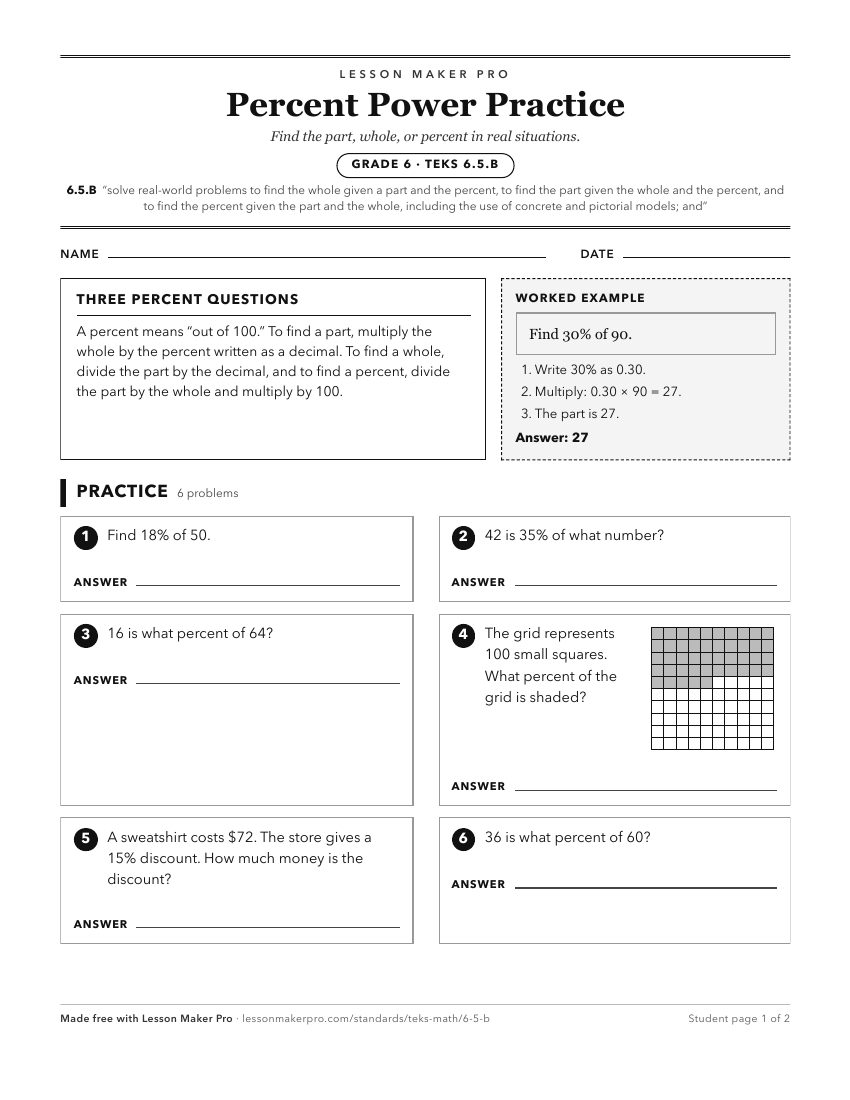
A ready-to-print activity worksheet aligned to 6.5.B, with an answer key for the teacher on its own page. No account needed.
PDF, US Letter, prints cleanly in black and white.
Download the worksheetKeep exploring
Related Standards
- 2.3.C
use concrete models to count fractional parts beyond one whole using words and recognize how many parts it takes to equal one whole
- 6.4.E
represent ratios and percents with concrete models, fractions, and decimals
- 7.4.D
solve problems involving ratios, rates, and percents, including multi-step problems involving percent increase and percent decrease, and financial literacy prob...
- 5.3.I
represent and solve multiplication of a whole number and a fraction that refers to the same whole using objects and pictorial models, including area models
Turn this exact standard into a lesson
Grade, subject, topic, and the complete standard are prefilled. Create one free, no account needed.
Also for this standard:Make a WorksheetMake a QuizMake a Sub Lesson