TEKS Math 7.4.D
The Standard
solve problems involving ratios, rates, and percents, including multi-step problems involving percent increase and percent decrease, and financial literacy problems
Texas Essential Knowledge and Skills for Mathematics
Teacher's field guide
What This Standard Means
What Students Need to Do
- Students use ratios, unit rates, and percent calculations to solve one-step and multistep situations. They find discounts, markups, tax, tips, percent change, and final costs in money problems.
What Mastery Looks Like
- Students choose a proportion, unit rate, or percent equation that fits the situation. They track the base amount through several steps, label units, and check whether the result is reasonable.
Common Misconceptions
- Students may add or subtract the percent as a whole number instead of converting it to a decimal. They may use the original amount as the base for every step, reverse a ratio, or confuse the discount amount with the final price.
How to Assess It
- Exit ticket: A jacket costs $80, is discounted 25%, then has 8.25% sales tax added. Find the final price and show each step.
Lesson moves
Ways to Teach It
Set up a classroom store with price tags, discount cards, and tax cards; pairs calculate final prices and check with calculators.
Write whether 20% off followed by 10% off equals 30% off, then defend your answer with a $100 example.
Play a four-corner game using ratio, unit-rate, percent-increase, and percent-decrease cards, with students moving to the matching answer.
Compare two phone plans using monthly fees, data rates, and a stated price increase; choose the lower six-month cost.
Free download
Printable 7.4.D Worksheet
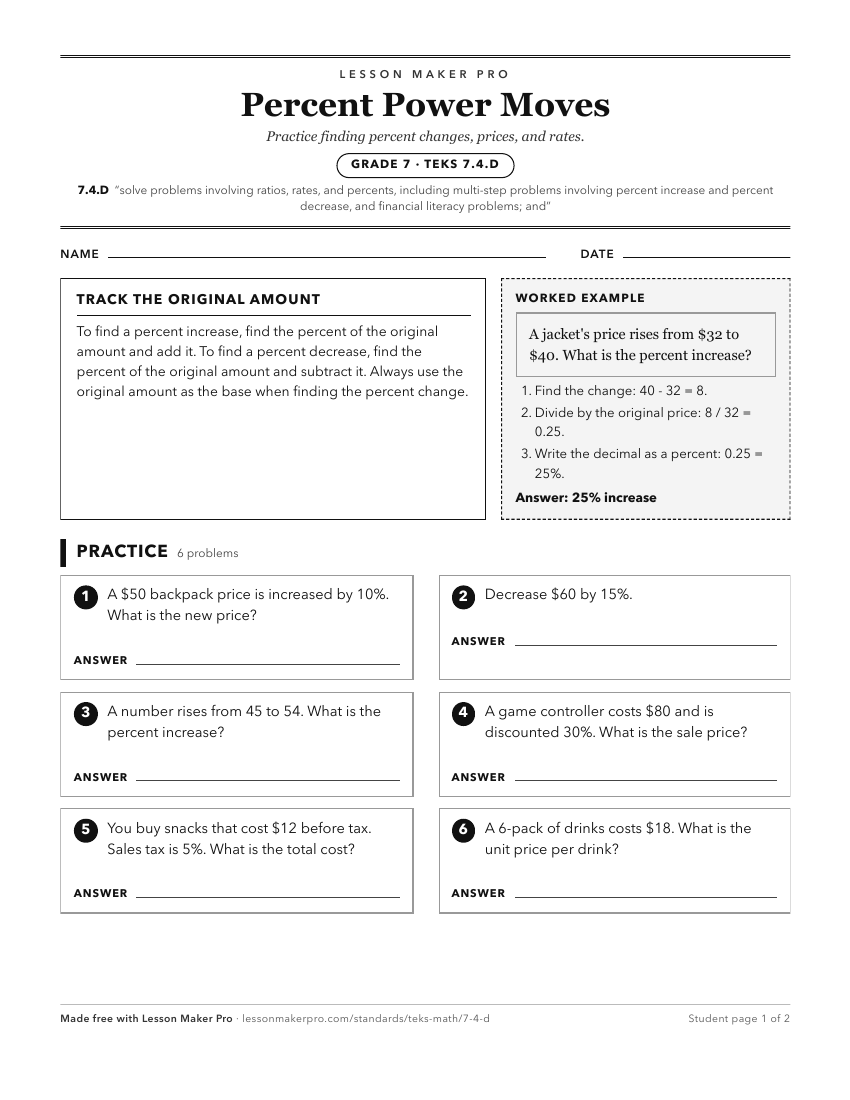
A ready-to-print activity worksheet aligned to 7.4.D, with an answer key for the teacher on its own page. No account needed.
PDF, US Letter, prints cleanly in black and white.
Download the worksheetKeep exploring
Related Standards
- 6.5.A
represent mathematical and real-world problems involving ratios and rates using scale factors, tables, graphs, and proportions
- 6.5.B
solve real-world problems to find the whole given a part and the percent, to find the part given the whole and the percent, and to find the percent given the pa...
- 6.4.G
generate equivalent forms of fractions, decimals, and percents using real-world problems, including problems that involve money
- 4.8.C
solve problems that deal with measurements of length, intervals of time, liquid volumes, mass, and money using addition, subtraction, multiplication, or divisio...
Turn this exact standard into a lesson
Grade, subject, topic, and the complete standard are prefilled. Create one free, no account needed.
Also for this standard:Make a WorksheetMake a QuizMake a Sub Lesson