TEKS Math 6.4
Knowledge and Skills Statement (Standard Cluster)
The student applies mathematical process standards to develop an understanding of proportional relationships in problem situations
Texas Essential Knowledge and Skills for Mathematics
Cluster contents
Student Expectations in This Statement
6.4 is a knowledge and skills statement. These are the student expectations under it.
- 6.4.A
compare two rules verbally, numerically, graphically, and symbolically in the form of y = ax or y = x + a in order to differentiate between additive and multipl...
- 6.4.B
apply qualitative and quantitative reasoning to solve prediction and comparison of real-world problems involving ratios and rates
- 6.4.C
give examples of ratios as multiplicative comparisons of two quantities describing the same attribute
- 6.4.D
give examples of rates as the comparison by division of two quantities having different attributes, including rates as quotients
- 6.4.E
represent ratios and percents with concrete models, fractions, and decimals
- 6.4.F
represent benchmark fractions and percents such as 1%, 10%, 25%, 33 1/3%, and multiples of these values using 10 by 10 grids, strip diagrams, number lines, and ...
- 6.4.G
generate equivalent forms of fractions, decimals, and percents using real-world problems, including problems that involve money
- 6.4.H
convert units within a measurement system, including the use of proportions and unit rates
Teacher's field guide
What This Cluster Means
What Students Need to Do
- Students decide whether a situation follows an additive rule or a multiplicative rule. They use ratios and rates to compare quantities, make predictions, and solve problems. They also move among fractions, decimals, percents, models, and measurement units.
What Mastery Looks Like
- Students can identify additive and multiplicative rules from words, tables, equations, and graphs. They can find equivalent ratios, unit rates, fractions, decimals, and percents, then use them to compare options or predict values. Their unit conversions are reasonable and include correct labels.
Common Misconceptions
- Students often treat every relationship as additive, especially when values increase by a steady amount. They may reverse a ratio, confuse a rate with a ratio, or move the decimal incorrectly when converting percents. They may also multiply when converting to a smaller unit instead of checking whether the answer should increase or decrease.
How to Assess It
- Exit ticket: A drink mix uses 3 cups of water for 2 packets, and shipping adds $3 to an order. Write each rule, label it additive or multiplicative, find the water needed for 5 packets, express 3/4 as a decimal and percent, and convert 2 cups to fluid ounces using 1 cup = 8 fluid ounces.
Lesson moves
Ways to Teach It
Shade 10%, 25%, 50%, and 75% on laminated 10 by 10 grids, then match each model to fraction and decimal cards.
Ask students to explain why y = 4x is multiplicative while y = x + 4 is additive, using tables and graphs.
Run a card sort matching ratio statements, unit rates, fractions, decimals, percents, equations, tables, and graphs.
Use grocery ads to compare unit prices, calculate a percent discount, and decide which package is the better buy.
Free download
Printable 6.4 Worksheet
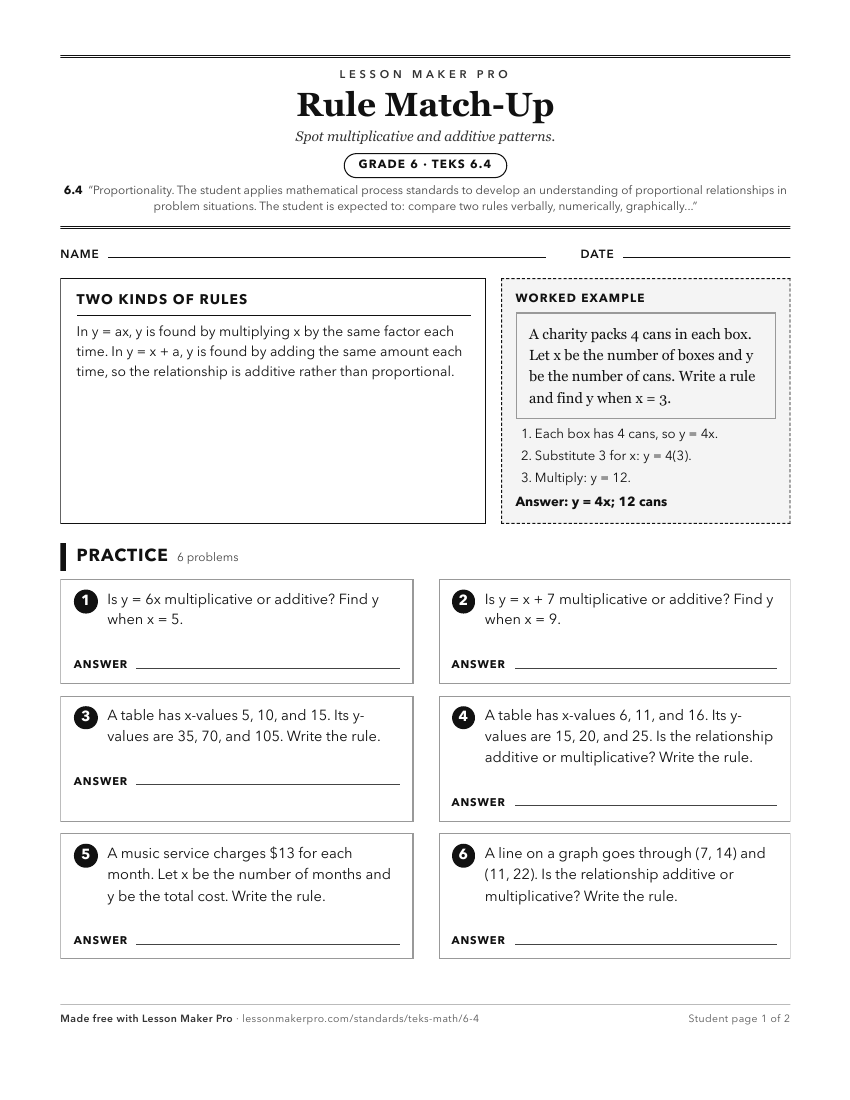
A ready-to-print activity worksheet aligned to 6.4, with an answer key for the teacher on its own page. No account needed.
PDF, US Letter, prints cleanly in black and white.
Download the worksheetKeep exploring
Related Standards
- 7.4
The student applies mathematical process standards to represent and solve problems involving proportional relationships
- 7.5
The student applies mathematical process standards to use geometry to describe or solve problems involving proportional relationships
- 6.5
The student applies mathematical process standards to solve problems involving proportional relationships
- 7.6
The student applies mathematical process standards to use probability and statistics to describe or solve problems involving proportional relationships
Turn this cluster into a lesson
Grade, subject, topic, and the complete cluster are prefilled. Create one free, no account needed.
Also for this cluster:Make a WorksheetMake a QuizMake a Sub Lesson