TEKS Math 6.4.B
The Standard
apply qualitative and quantitative reasoning to solve prediction and comparison of real-world problems involving ratios and rates
Texas Essential Knowledge and Skills for Mathematics
Teacher's field guide
What This Standard Means
What Students Need to Do
- Students use ratio tables, equivalent ratios, or unit rates to predict unknown amounts and compare real choices. They use numbers and context clues to decide whether an answer makes sense.
What Mastery Looks Like
- Students can use a ratio table, equation, or unit rate to find missing amounts and compare choices. They label units and explain why their prediction is reasonable in the situation.
Common Misconceptions
- Students may add the same amount instead of scaling both quantities by the same factor. They may reverse a rate, mix different units, or assume the smaller number always represents the better choice.
How to Assess It
- Exit ticket: A van travels 180 miles on 6 gallons. Predict the gallons needed for 300 miles, then compare its fuel use with a van that gets 32 miles per gallon.
Lesson moves
Ways to Teach It
Mix colored water in a 1-to-3 concentrate-to-water ratio, then scale the recipe for three pitcher sizes and compare color strength.
Discuss: Store A sells 8 notebooks for $12, while Store B sells 5 for $8. Which is the better buy, and why?
Play a card match using situation cards, ratio tables, unit rates, and predictions that represent the same relationship.
Use grocery ads to compare unit prices for two package sizes, then predict the cost of buying enough for 30 students.
Free download
Printable 6.4.B Worksheet
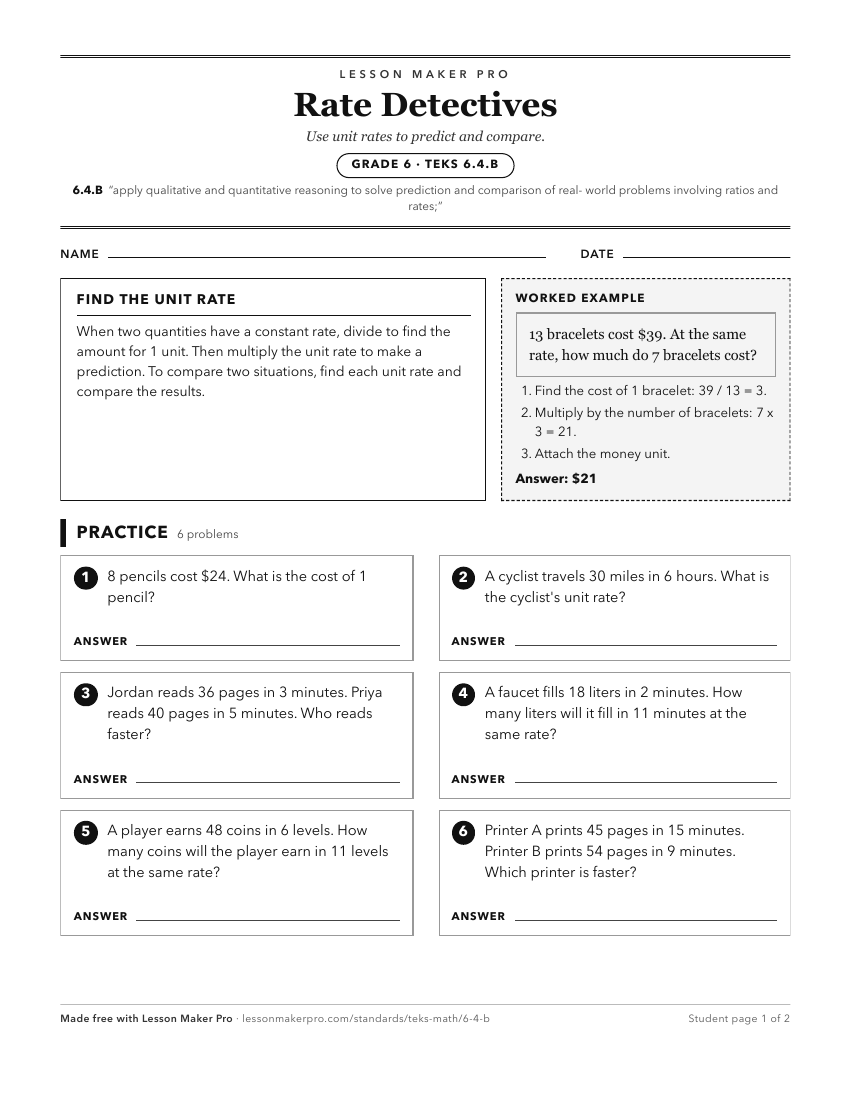
A ready-to-print activity worksheet aligned to 6.4.B, with an answer key for the teacher on its own page. No account needed.
PDF, US Letter, prints cleanly in black and white.
Download the worksheetKeep exploring
Related Standards
- 7.4.B
calculate unit rates from rates in mathematical and real-world problems
- 6.5.A
represent mathematical and real-world problems involving ratios and rates using scale factors, tables, graphs, and proportions
- 7.4.D
solve problems involving ratios, rates, and percents, including multi-step problems involving percent increase and percent decrease, and financial literacy prob...
- 7.6.H
solve problems using qualitative and quantitative predictions and comparisons from simple experiments; and
Turn this exact standard into a lesson
Grade, subject, topic, and the complete standard are prefilled. Create one free, no account needed.
Also for this standard:Make a WorksheetMake a QuizMake a Sub Lesson