TEKS Math 7.5.B
The Standard
describe π as the ratio of the circumference of a circle to its diameter
Texas Essential Knowledge and Skills for Mathematics
Teacher's field guide
What This Standard Means
What Students Need to Do
- Students measure or use given values for a circle’s circumference and diameter. They divide the circumference by the diameter and recognize that the result is always close to π, or 3.14.
What Mastery Looks Like
- Students correctly identify a circle’s circumference and diameter, then calculate a ratio close to 3.14. They explain that the ratio stays the same for circles of different sizes.
Common Misconceptions
- Students may divide diameter by circumference instead of circumference by diameter. They may use the radius in place of the diameter or think π equals exactly 3.14.
How to Assess It
- Give students a circle with a circumference of 31.4 cm and a diameter of 10 cm. Ask them to calculate the ratio, name it, and explain what it represents.
Lesson moves
Ways to Teach It
Wrap string around three circular lids, measure each diameter with a ruler, then calculate circumference divided by diameter and compare the results.
Write two sentences explaining why a small coin and a large plate produce nearly the same circumference-to-diameter ratio.
Play a matching game that pairs circle measurements with calculated ratios, rejecting cards whose ratios are not close to 3.14.
Measure a bicycle wheel, use its diameter to predict one full rotation's travel, then check the prediction by rolling it.
Free download
Printable 7.5.B Worksheet
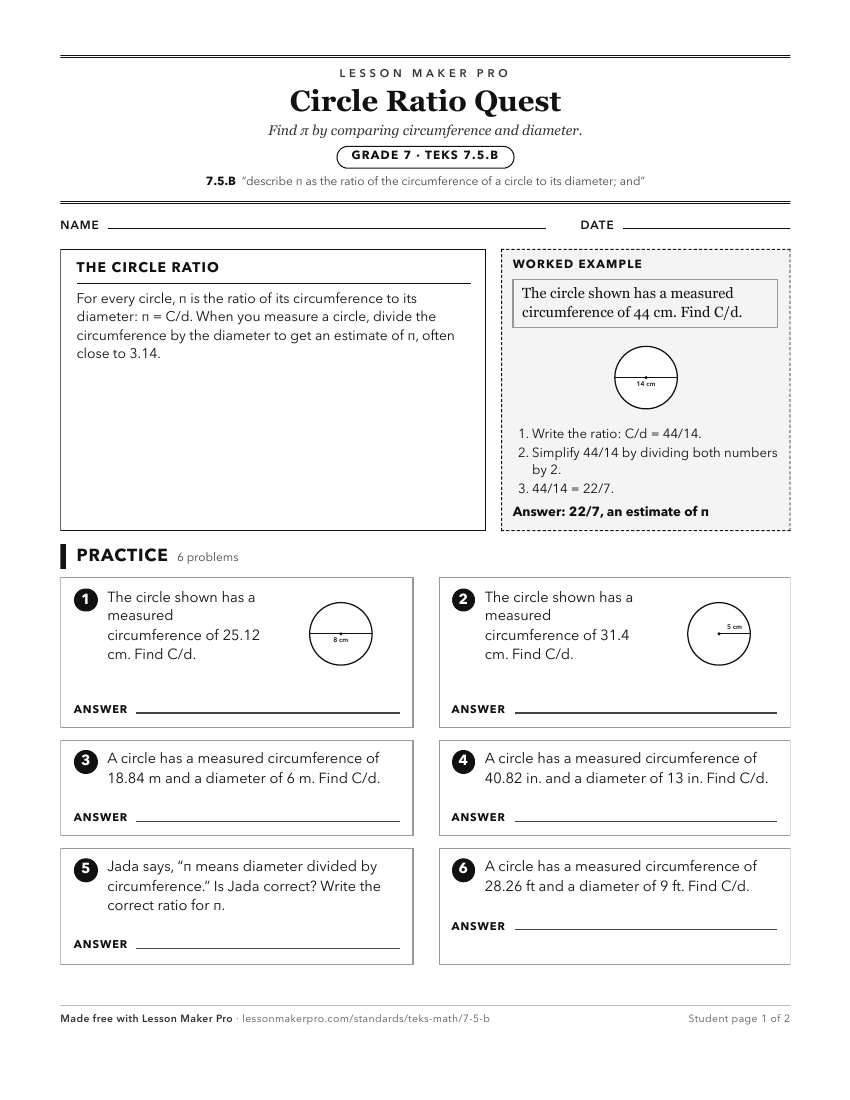
A ready-to-print activity worksheet aligned to 7.5.B, with an answer key for the teacher on its own page. No account needed.
PDF, US Letter, prints cleanly in black and white.
Download the worksheetKeep exploring
Related Standards
- 8.6.A
describe the volume formula V = Bh of a cylinder in terms of its base area and its height
- 7.9.B
determine the circumference and area of circles
- 7.8.C
use models to determine the approximate formulas for the circumference and area of a circle and connect the models to the actual formulas
- 8.3.A
generalize that the ratio of corresponding sides of similar shapes are proportional, including a shape and its dilation
Turn this exact standard into a lesson
Grade, subject, topic, and the complete standard are prefilled. Create one free, no account needed.
Also for this standard:Make a WorksheetMake a QuizMake a Sub Lesson