TEKS Math 8.3.A
The Standard
generalize that the ratio of corresponding sides of similar shapes are proportional, including a shape and its dilation
Texas Essential Knowledge and Skills for Mathematics
Teacher's field guide
What This Standard Means
What Students Need to Do
- Students identify which sides match in similar figures. They use one scale factor to write proportions and find missing lengths, including lengths created by a dilation.
What Mastery Looks Like
- A student can pair corresponding sides even when figures are turned or reflected. They can find the scale factor, calculate missing lengths, and show that all matching side ratios are equal.
Common Misconceptions
- Students may match sides by page position instead of matching corresponding vertices. They may use additive differences, reverse only one ratio, or apply different scale factors to different sides.
How to Assess It
- Exit ticket: A triangle with side lengths 6, 9, and 12 is dilated so the 6-unit side becomes 10 units. Find the other two side lengths and show one proportion.
Lesson moves
Ways to Teach It
Give students grid paper to draw a polygon, dilate it by a factor of 1.5, measure both figures, and compare matching sides.
Ask students to explain why adding three units to every side does not usually create a similar figure.
Run a card sort matching diagrams, scale factors, proportions, and missing side lengths, with students checking each match.
Use a floor plan enlargement to calculate new wall lengths from one known original and enlarged measurement.
Free download
Printable 8.3.A Worksheet
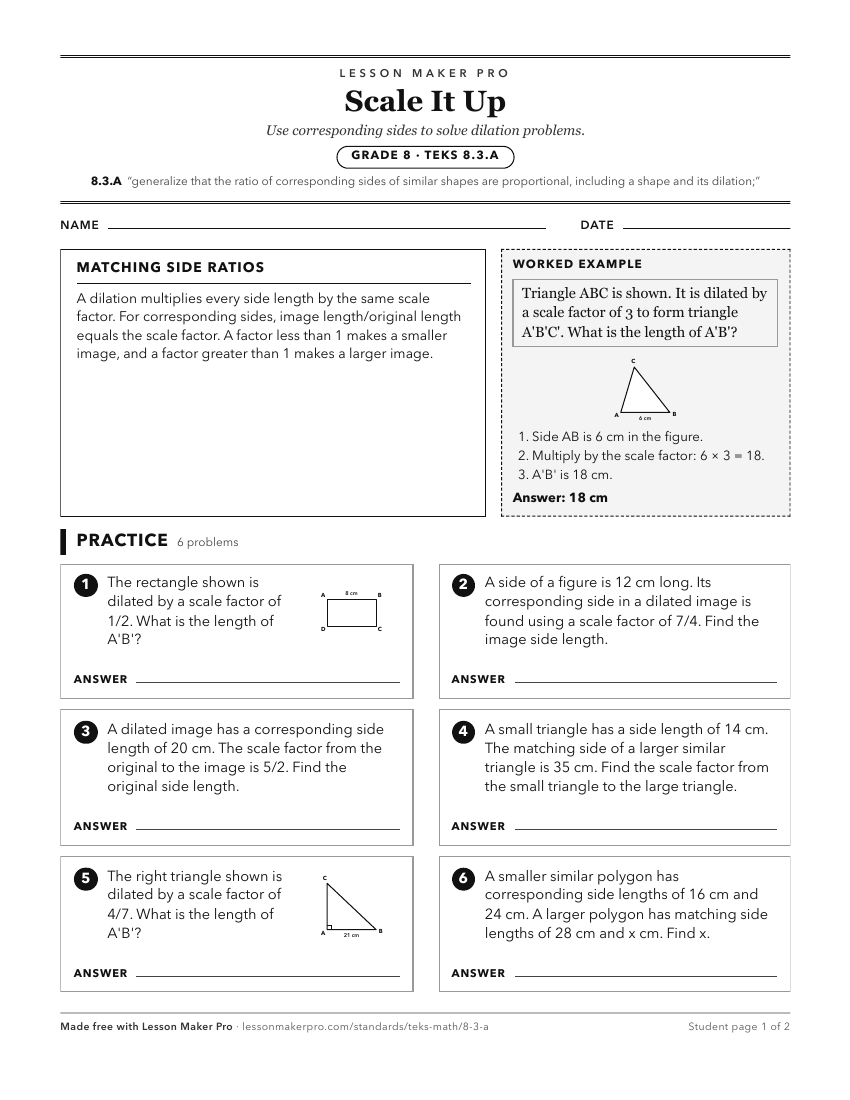
A ready-to-print activity worksheet aligned to 8.3.A, with an answer key for the teacher on its own page. No account needed.
PDF, US Letter, prints cleanly in black and white.
Download the worksheetKeep exploring
Related Standards
- 8.3.B
compare and contrast the attributes of a shape and its dilation(s) on a coordinate plane
- 8.3
The student applies mathematical process standards to use proportional relationships to describe dilations
- 7.5.A
generalize the critical attributes of similarity, including ratios within and between similar shapes
- 8.3.C
use an algebraic representation to explain the effect of a given positive rational scale factor applied to two-dimensional figures on a coordinate plane with th...
Turn this exact standard into a lesson
Grade, subject, topic, and the complete standard are prefilled. Create one free, no account needed.
Also for this standard:Make a WorksheetMake a QuizMake a Sub Lesson